Showing posts with label stopimperialism. Show all posts

Saturday, February 21, 2015

Guardian's Lies Spread Noxious Cloud of Disinformation over Ukraine

February 21, 2015 (Eric Draitser - Counterpunch) - The western media is busily trying to prop up their failed narrative of “Russian aggression” in Ukraine in a desperate attempt to legitimize their consciously deceitful reporting. To do so, they are now relying not on experts or western intelligence reports, but a discredited blogger and his corporate media chums.


On February 17, 2015, The Guardian ran a story with the headline “Russia shelled Ukrainians from within its own territory, says study.” The title alone is enough to convince many casual observers that yes, the mainstream media reporting on the civil war in Ukraine has been correct all along. You see, it’s all because of Russian aggression, or so the meme would go. But closer analysis of this story, and the key players involved, should cause any reasonably intelligent and logical person to seriously doubt the veracity of nearly every aspect of the story.

Let’s begin first with the headline and subhead which, as anyone in media knows, is often all that will be read by many readers. The headline leads with a conclusion: Russia shelled Ukraine from within Russian territory. Simple. Clear. Why bother reading further? Well, in reality, the article both overtly and tacitly admits that the so called “study” (more on that later) has not reached that clear conclusion, not even close. Here are some key phrases sprinkled throughout the piece that should give pause to any serious-minded political observer or analyst.

Despite the declaration in the headline, a close reader encounters phrases such as “near conclusive proof,” “estimated trajectories,” “likely firing positions,” and other ambiguous phrases that are more suggestive than they are declarative. In other words, these are mere rhetorical flourishes designed to lead casual, uninformed readers to make conclusions that are simply not backed up by the evidence.

The so called study relied heavily on “crater patterns from satellite photos of three battlefields,” and it is from these crater patterns, and the equally dubious “tyre tracks” that the authors of the study drew their conclusions. However, even the independent military forensics expert contacted by The Guardian “warned that the accuracy of crater analysis in determining direction of fire on the basis of satellite photography was scientifically unproven.”

Indeed, conveniently buried at the end of the long article is the key quote from Stephen Johnson, a weapons expert at the Cranfield Forensic Institute, part of the Defence Academy of the United Kingdom who said quite clearly that crater analysis is “highly experimental and prone to inaccuracy.” Mr. Johnson added that “This does not mean there is no value to the method, but that any results must be considered with caution and require corroboration.”


Wait a second. I thought that our dear expert authors of the study had “near conclusive proof” according to the lead paragraphs of the story. When you actually read what the real expert, as opposed to the non-experts who conducted the “study,” has to say, it immediately casts a long shadow of doubt on the entire narrative being propagated by the article. Is The Guardian here guilty of clear manipulation of the story for political purposes? It would seem at best unprofessional and dishonest reporting, at worst it’s outright lying in the service of the agenda of those at the top of the western political establishment.

Now of course we know that The Guardian has repeatedly been taken to task by highly respected journalists and analysts for its biased and one-sided reporting of issues ranging from its coverage of Russian President Putin and Russia’s actions in Crimea, to its shamefully biased (here, here and here for three of the many examples) coverage of Israel-Palestine conflict, and a number of other important issues.

Perhaps most germane to this discussion is The Guardian’s own reporting last summer, which it references in this article, of Russian military vehicles crossing the border into Ukraine – a significant charge that would be taken seriously if there were one shred of tangible proof. But alas there isn’t. There is only the word of The Guardian’s reporter Shaun Walker, who conveniently could not get a photograph or video of the alleged military vehicles crossing into Ukraine. One would think with mobile phones all equipped with cameras and the vast resources of a major western media outlet, not to mention the seemingly all-encompassing global surveillance architecture at the disposal of western governments, at least some credible, verifiable evidence would have emerged. But no, we just have to take the Guardian’s word for it.

Image: Professional coach potato, Eliot Higgins ... on his couch.
There’s a lot of that going around when it comes to Ukraine. We just have to “take their word for it,” as we were supposed to with regard to the charges of Russian military shooting down MH17, a baseless charge that has since disappeared from the headlines, with the actual results of the investigation being buried or suppressed entirely.

Not only should The Guardian’s reporting be scrutinized, but so too should their darling “expert” blogger Eliot Higgins, aka Brown Moses, the author of this inconclusive “conclusive report.”

Fifty Shades of Brown

Aside from the deceptive language and misleading statements, there is a broader issue that must be addressed, namely the reliability of the source of this so called study. Perhaps first we should dispense with the use of the term “study” as that would imply experts using objective facts, data, etc. Rather, what we are dealing with is a politically motivated report by a source that has already been discredited numerous times.

The report comes from an organization called Bellingcat, purportedly an independent citizen journalism platform that uses social media and other open source information to draw conclusions about everything from military hardware movements to the firing of missiles and artillery. Of course it should immediately raise questions that The Guardian’s article is co-authored by one Eliot Higgins, a self-proclaimed “military expert” who founded the “Brown Moses” blog. Why is this important? Because Bellingcat is a creation of the same Eliot Higgins. Indeed, Bellingcat’s Kickstarter page made no secret of the fact that “Bellingcat is a website founded by Brown Moses…the pseudonym for Eliot Higgins, a laid-off government worker turned blogger turned weapons analysis expert and leading source of information on the conflict in Syria.”

A close look at some of the blurbs noted on the Kickstarter page reveals that this “independent blogger” has been touted by The Guardian, Deutsche Welle, UK’s Channel 4, The Daily Beast, and many other corporate media outlets. Anyone with an understanding of how hard it is to actually be an independent analyst knows that such establishment outlets do not simply promote independent media that provides thoughtful analysis. Rather, Brown Moses and Bellingcat have been seized upon as a convenient foil to true alternative media, spinning the establishment narrative under the guise of “independent reporting.” However, let us not simply deride this obvious sham. Let us evaluate Brown Moses’ own record, which for an “expert” is dismal.

Higgins aka Brown Moses aka BM claimed to have proven that the chemical weapons attack on Ghouta, Syria on August 21, 2013 could only have been carried out by the Syrian military and government. His claims are based on his own “expert” analysis of missile trajectories and other “evidence” he claims to have obtained through videos and other open source information. Of course, in making this claim, Higgins places himself in direct opposition to former UN weapons inspector Richard Lloyd and Prof. Theodore Postel of MIT, the authors of an actual report from the MIT Science, Technology, and Global Security Working Group entitled “Possible Implications of Faulty US Technical Intelligence in the Damascus Nerve Agent Attack of August 21, 2013.” The report, conducted by real experts, not armchair bloggers, concluded that the Syrian government could not have carried out the attack, and that such intelligence was nearly used as justification for yet another aggressive war.

Image: Award-winning veteran journalist, Seymour Hersh.
Also debunking BM’s spurious charges is the report from Pulitzer Prize winning investigative journalist Seymour Hersh which revealed the existence of a classified US Defense Intelligence Agency briefing which noted unequivocally that the Al Nusra Front had its own chemical weapons, not to mention deep ties to Saudi and Turkish intelligence and chemical arms suppliers. Hersh’s reporting finally firmly established the fact that the rebels were indeed capable of carrying out the attack on East Ghouta, and that they had help from Turkey, Saudi Arabia, and possibly other regional actors. And so, not only did they have the motive (to blame Assad for using chemical weapons while international investigators were in Syria, thereby justifying a military intervention and regime change), but also the means and opportunity. This is an essential point because the entire ‘case’ against Assad relied on the fact that only Damascus was technologically and logistically capable of carrying out such an attack.

But BM contended that he was right, Hersh, Lloyd, and Postel were wrong, and that the narrative should reflect that. So, on the one hand we have a blogger with no formal training in ballistics, physics, or any relevant scientific or military field, and on the other we have a Pulitzer Prize winner with decades of experience and high-level contacts and sources all over the world. We have the word of some guy in an apartment in the UK, or the scientifically arrived at findings of a former chemical weapons inspector (read actual expert) and an internationally respected Professor of Science, Technology, and National Security Policy at MIT, a world renowned academic and research institution. And which do you think The Guardian chose to promote?

But BM’s noxious odor also pervades the reporting on the downing of MH 17, yet another story that The Guardian utterly distorted, before mostly dropping it from the headlines when the western narrative was discredited. In an August 2, 2014 article written by Higgins entitled “MH17 Missiles Can’t Hide From These Internet Sleuths,” Higgins claims to have concluded that Russia or the anti-Kiev rebels must have shot down the plane with a Buk missile launcher – a weapons system also in the possession of Kiev’s military. What is his evidence? It’s a series of photographs published in various media outlets that he cannot corroborate in any way. Instead, this “sleuth” is making his case based on faith – faith that the photographs were taken where and when they claim to have been, and show what they claim to show.

Of course, it has since been publicly acknowledged on more than one occasion that photographs purporting to show Russian military incursions into Ukraine have been fabricated and/or misrepresented causing tremendous embarrassment for US and European governments that have repeatedly claimed to have such evidence. But our dear BM is unfazed by such revelations. Instead, he seems to simply shriek louder. Rather than leaving analysis of MH 17 to aviation and military experts, he peddles his “opinion.” Rather than acknowledging the bias in his own reporting, to say nothing of the limitations of armchair technical analysis, he continues to grow his image, and with it, the lies, omissions, and distortions he propagates.

And so we return to the new “study” by Higgins and his Bellingcat group of “digital detectives.” They are obviously front-and-center in the western media because their conclusions are aligned with the US-NATO political agenda. They are a de facto arm of the western corporate media and military-industrial complex, providing the veneer of “independent analysis” in order to penetrate the blogosphere and social media platforms where the mainstream narrative is being questioned, scrutinized, and discredited. Bellingcat and Higgins’ names should be known to everyone, but not because their analysis is worthwhile. Rather, they need to become household names so that those who understand how western propaganda and soft power actually works, will be on the lookout for more of their disinformation.

Perhaps The Guardian should also be more careful in how it presents its information. By promoting Higgins and his discredited outfit, they are once again promoting disinformation for the purposes of selling war. The US almost went to war with Syria (which it is doing now anyway) based on the flawed intelligence and “analysis” of people like Higgins. Naturally, everyone remembers how The Guardian, like all of its corporate media brethren, helped to sell the Iraq War based on complete lies. Have they learned nothing? It would seem so.

But those interested in peace and truth, we have learned something about propaganda and lies used to sell war. We who have called out these lies repeatedly – from Iraq in 2003, to Syria and Ukraine today – we once again repudiate the false narrative and the drumbeat for war. We reject the corporate media propagandists and their “alternative media” appendages. We stand for peace. And unlike The Guardian and Higgins, we stand on firm ground.

Eric Draitser is the founder of StopImperialism.org. He is an independent geopolitical analyst based in New York City. You can reach him at ericdraitser@gmail.com.

Tuesday, January 27, 2015

Nigeria: Unraveling the Mystery of Boko Haram

January 28, 2015 (Eric Draitser - Counterpunch) The most entertaining mysteries are the ones with compelling protagonists, enigmatic and often surreptitious antagonists, and surprising or shocking conclusions. Indeed, without these essential elements, one is unlikely to read the story at all. However, when it comes to politics and geopolitics, somehow our mass media storytellers – the scores of journalists, military and counter-terrorism ‘experts,’ and establishment mouthpieces – fail to even point us in the right direction. Not only do they not follow the threads of the story, they prefer to pretend they simply aren’t there.


And so it is with the great ‘mystery’ of Boko Haram, a group that in just a few years has become one of the most recognizable terrorist entities in the world. Having carried out heinous massacres of men, women, and children, abducted thousands of innocents, and destroyed whole towns, Boko Haram now symbolizes just that perfect blend of barbarism, religious and ideological fundamentalism, and non-white skin, which come together to cast them, in the eyes of westerners especially, as the manifestation of evil – the devil incarnate that can only be destroyed by the forces of righteousness. You know, the ‘good guys.’

But what happens when there are no ‘good guys’ to be found? What happens when you follow the story only to find the most cynical of intentions from every player involved? Such is the case with this Boko Haram story, and indeed the regional politics and geopolitics of West Africa as a whole.

In trying to unravel the labyrinthine web of political, economic, and strategic threads connecting a number of significant actors, it becomes clear that no analysis of Boko Haram is worth reading unless it approaches the issue from three distinctly different, yet intimately connected, angles.


First, there is Nigeria’s domestic politics, and the issue of Boko Haram and the perception of the government and opposition’s responsibility for the chaos it has wreaked. With elections scheduled to take place in February, Boko Haram and national security have, quite understandably, become dominant issues in the public mind. The mutual finger-pointing and accusations provide an important backdrop for understanding how Boko Haram fits both into the public discourse, and into the strategies of political networks behind the scenes in Nigeria, and the region more broadly.


Second is the all-important regional political and economic chessboard. In West Africa – an area rich in strategic resources – there are a few interested parties who stand to gain from Boko Haram’s ongoing attacks which amount to a destabilization of the entire Nigerian state. Nigeria’s neighbor Chad has recently come under heavy scrutiny from Nigeria’s military apparatus for its purported role in financing and facilitating Boko Haram’s expansion. Chad sees in Nigeria potential oil profits as it expands its own oil extraction capabilities throughout the Chad Basin – a geographical region that includes significant territory in Chad, Nigeria, Cameroon, and Niger. Of course, major oil companies, not to mention powerful western nations such as France, have a vested interest in maintaining their profits from West African oil.

Finally and, perhaps most importantly, is the continental and global perspective. Nigeria, as Africa’s most dynamic economy, presents major opportunities and challenges for key global powers. For China, Nigeria represents one of its principal investment footholds in Africa. A key trading partner for Beijing, Nigeria has increasingly been moving out of the direct orbit of the West, transforming it from a reliable, if subservient, Western ally, into an obstacle to be overcome. Coinciding with these developments has been the continually expanding US military presence throughout Africa, one that is increasingly concentrated in West Africa, though without much media fanfare aside from the Ebola story.

The international media has seized on the heart-rending story of thegirls of Chibok – the ubiquitous #BringBackOurGirls meme – and for most people that is all they know about Boko Haram. However, such a superficial understanding of one of the most complex international stories in recent years does little to further the discourse, or bring about a resolution. Rather, a more nuanced understanding puts Boko Haram into a larger international context, one which can go a long way to dismantling the organization, and the air of mystery that surrounds it. While many of the details remain murky at best, with powerful players operating behind the scenes, the contours of a regional destabilization and a proxy war become discernible.

The Politics of Boko Haram

With national elections less than a month away, the competing factions of Nigeria’s political establishment are busily trying to scapegoat their opponents, with each side implying that the other is either in league with Boko Haram, or is deliberately trying to capitalize on the situation. The two major parties – the ruling People’s Democratic Party (PDP) led by President Goodluck Jonathan, and the All Progressives Congress (APC) – have made Boko Haram into a political hot potato, passing it back and forth in hopes that voters will associate it with their opponent.

Last September, before Boko Haram once again made international headlines with their most recent offensives, the political mudslinging was already fierce. The Chairman of the People’s Democratic Party Councillors Forum, Collins Onogu stated that:
Most of those who have been rendered homeless in the North Eastern part of the country by Boko Haram are PDP members. What is their offence? The spokesperson of APC…has neglected his duty and he is now making statements on behalf of Boko Haram….APC has been using the media to blackmail President Goodluck Jonathan, their plan is to make the country ungovernable for him, they have plans of diverting the attention of Nigerians but it will not work out.
While Onogu’s characterization of the issue is certainly debatable, it is quite clear the PDP sees the issue of Boko Haram as a major political liability for their party, and for President Jonathan. It is for this reason that Collins and other PDP leaders have repeatedly threatened to “reveal the names of APC members sponsoring Boko Haram.” It’s entirely possible that the PDP might do this purely to sabotage their opponents in the campaign. However, it is equally true that the PDP is desperately trying to deflect the blame for a crisis that has developed while the Government has been under their control. Either way, the PDP is smearing the APC in order to guilt them by association.

Conversely, the APC has not only denied all the charges, they have made their own counter-claims, alleging that former high-ranking PDP officials are intimately involved in financing Boko Haram. John Oyegun, national chairman of the APC said in September 2014:
Dr. Stephen Davis, a man hired by the President Jonathan-led Federal Government to negotiate with Boko Haram for the release of the Chibok girls decided to speak out, believing the best way to tackle the insurgency is to expose the sponsors. And who are they?…he named former Borno Governor Ali Modu Sheriff and a former Army Chief, Gen. Azubuike Ihejirika, as the sponsors of Boko Haram… The sponsors of Boko Haram are within the PDP and the Presidency. They are known friends of President Jonathan. He knows them and they know him.
These revelations, vehemently denied by the PDP and Nigerian President Jonathan’s administration, certainly raise important questions as to the networks supporting and financing Boko Haram, and when, where, and why they were originally organized. According to leaked intelligence information obtained by the Nigerian news outletPremium Times, the former governor of Borno State, and Goodluck Jonathan ally, Ali Modu Sheriff has been one of the principal financiers and organizers of Boko Haram, basing his operations out of Chad (more on Chad later). The dated communications obtained by Premium Times “painted a picture of what appears to be a powerful regional support structure involving the Chadian president, Nigerian officials and Niger Republic, and spearheaded by Mr. Sheriff whom the intelligence presents as a powerful figure within this circle.”

Add to this information the findings of a presidential panel commissioned by President Jonathan:

The Report traced the origin of private militias in Borno State in particular, of which Boko Haram is an offshoot, to politicians who set them up in the run-up to the 2003 general elections. The militias were allegedly armed and used extensively as political thugs. After the elections and having achieved their primary purpose, the politicians left the militias to their fate since they could not continue funding and keeping them employed. With no visible means of sustenance, some of the militias gravitated towards religious extremism, the type offered by Mohammed Yusuf.

Certainly there are a lot of questions to answer here. Is Sheriff simply a former ally who has since “gone rogue” and decided to establish his own private army to enrich himself and his foreign patron? Conversely, could it be that Sheriff continues to be connected, if perhaps only indirectly, with the government in Abuja? The communications between Sheriff’s network and Nigerian military officials as far back as 2011 does seem to suggest at least an indirect connection between them. As such, there is obviously a complex web of relations connecting various parties in Nigeria, as well as its neighbors, with Boko Haram.

According to a 2011 intelligence memo from field officers in Chad, “members of Boko Haram sect are sometimes kept in Abeche region in Chad and trained before being dispersed. This happens usually when Mr. Sheriff visits Abeche.” So, even the most conservative analysis would have to admit there is undeniably a connection between the domestic politics of Nigeria, especially within the ruling party, and international actors who have their own agenda. And it is those actors, and their motivations, that deserve careful analysis.

Regional Conflict, Resource War

West Africa’s vast riches have long since been a prize for colonial powers and post-colonial states alike. Nigeria alone has become a global player in terms of oil production – supplying at least 8 percent of US oil imports – though it is debatable whether that has been much of a blessing for the Nigerian people. Throughout the region, economic interests have been central to the policies and agendas of a number of states whose leaders have both dollar signs in their eyes, and hegemony on their minds. This has only accelerated in recent years, especially since the imperialist war that toppled former Libyan leader Muammar Gaddafi, perhaps the single force in Africa providing stability, and keeping peripheral actors such as Chad, Niger, and others more or less in line. Naturally, Gaddafi’s impact was seen a bit differently by those rulers whose ambitions suffered because of it.

Perhaps no leader has been more ambitious in recent years than Chadian President Idriss Déby who has played a central role in the entire Boko Haram story, from accusations that his government has provided them safe haven, to his possibly genuine, possibly disingenuous attempts to broker a ceasefire between the terror group and the Nigerian government. He has been linked with the aforementioned Ali Modu Sheriff, the alleged mastermind of the Boko Haram network. Intelligence information from a number of sources does seem to point to a direct connection. In addition, a 2009 US diplomatic cable published by Wikileaks revealed that:
A well-trained veteran Chadian extremist, Abu-Mahjin, who has limited ties to al-Qa’ida associates, recently traveled to Nigeria. He may be planning to conduct or facilitate a terrorist operation…recent tearline stated, ‘Nigerian-based probable Chadian extremist is keen to obtain more funds…it is not clear when he will receive this additional finance.’
Could it be that Abu-Mahjin acted as a de facto intermediary between certain elements in Nigeria and Chad? It is certainly plausible that, at the very least, the connection between Chad and Boko Haram goes back to the very transformation of that organization into a terrorist entity.

But what can Chad offer? And why would they?

To answer the former question, one must dive into recent history to see how Déby came to power. Curiously enough, his rise to the presidency was directly thanks to Gaddafi who, after years of war with Chad – war in which Déby himself led troops against Libyan forces – backed Déby against the former government of Hissène Habré who had been hosting a number of anti-Gaddafi Libyans with close ties to US intelligence, such as the once again relevant General Hifter. As Time magazine noted in 2001, “While the full scope of Déby’s relationship with Gaddafi remains hazy, it is known that Libya equipped Déby’s army with as many as 200 Toyota land cruisers fitted with 23-mm Soviet-made cannons.” It is quite likely that the military backing for Déby went far deeper than what is being acknowledged here.

In any event, the NATO-led war that toppled Gaddafi in 2011 radically changed the political character of the region. Suddenly, someone like Déby could pursue his own regional ambitions without the ever-watchful eye of Gaddafi who stood against any forces that sought to destabilize West Africa in the service of western corporations. With a long-established network of weapons and fighter smuggling, Chad became a major transit point for many of the weapons (and fighters) streaming out of Libya by the end of 2011. While much of the military hardware went through the Sahel region, likely into the arms of the equally shadowy Al Qaeda in the Islamic Maghreb (AQIM), it is probable that a significant amount of it went to Chad. The long-standing ties with elements of the Libyan military only increase the likelihood that Chad became a refuge and/or conduit for countless weapons and fighters.

So, as Libya collapsed, and weapons and fighters came streaming out, Chad all of a sudden found itself in a position of strength, able to finally pursue an agenda to enrich itself, or at least enrich Déby and the clique around him. But what is it that he wants?

In recent years, oil discoveries throughout the Chad Basin have transformed how the states of West Africa view their economic future. At the heart of the basin is Lake Chad, surrounded by the nations of Chad, Cameroon, and Niger. According to a 2010 assessment from the US Geological Survey (USGS), the Chad Basin has “estimated mean volumes of 2.32 billion barrels of oil, 14.65 trillion cubic feet of natural gas, 391 million barrels of natural gas liquids.” The potential size of these resources certainly has whet a few palettes, both in the region and internationally.

All the countries of the basin have expressed strong desire in recent years to begin exploiting the energy reserves there. However, thus far, Nigeria has been unable to do so due to the Boko Haram insurgency.E&P (Exploration & Production), the publication of Hart Energy, noted in March 2014:
Hopes of stepping up oil exploration in Nigeria’s Lake Chad Basin have been dashed by the brutal attacks of Islamic Boko Haram and the Ansaru sect terrorists in the country’s northeastern region…Between 2011 and 2013 the Nigerian government provided $240 million to facilitate oil and gas exploration activities in the Lake Chad Basin…Oil prospecting in the Lake Chad Basin was “yielding promising results and may lead to commercial exploration of oil and gas this year,” Nigeria’s Vice President Namadi Sambo said in 2013…But the deadly activities of the Boko Haram insurgents halted plans.
So, while Nigeria is forced to put the brakes on its oil exploration and development in the Chad Basin, its neighbors, most notably Chad, continue theirs. As Dr. Peregrino Brimah explained, “The Boko Haram insurgency has conveniently provided Chad, under the government of Idriss Déby, unfettered access to oil under Nigeria’s soils through 3D oil drilling from within its territorial borders, which the country exports.” So, in true Daniel Plainview “I drink your milkshake” style, Déby has engaged in siphoning off Nigeria’s oil wealth, and exporting it for massive profits for himself and his cronies. But of course, Chad is not alone in this endeavor, as it has company from Cameroon and Niger, both of whom are doing precisely the same thing.

Standing above and behind this practice is the former colonial power France – the one-time colonial master of Chad, Cameroon, and Niger. Today, France’s dominant role continues as its port of Le Havre is the final destination for the unrefined oil extracted from under the feet of West Africans. Needless to say, there are very powerful interests both in Africa and Europe who want to ensure that the flow of their precious oil continues unabated. Moreover, they will do anything to prevent the major oil exporting power of the region, namely Nigeria, from being able to cut in on their action.

And this regional rivalry is, at least in part, the reason why Boko Haram really has the potential to spark international conflict. Last October, after Nigerian military forces launched an offensive against Boko Haram, the ensuing battle spilled across the Nigeria-Cameroon border where, depending on who you believe, either Nigerian forces retreated, or they pursued Boko Haram suspects. In total, 107 Boko Haram militants were killed, along with 8 Cameroonian military officers and dozens of civilians. In this way, the resource war is transmogrified into a shooting war. The destabilization of the entire region is not far off from that.

It is precisely this danger of a regional destabilization that has so many observers around the world biting their nails. The obvious danger is that West Africa could become, like the Sahel and most of North Africa, a locus of extremism and terror. However, the most pressing question of all is why. In whose interest is it to see the whole region destabilized? What is the global and geopolitical context for understanding these decidedly complex and interconnected issues?

Part 2 of this article will examine the geopolitical and strategic context within which these events should be understood. It will detail how the US and certain European powers are exploiting the situation for their own gain.

Eric Draitser is the founder of StopImperialism.com. He is an independent geopolitical analyst based in New York City. You can reach him at ericdraitser@gmail.com.

Sunday, January 18, 2015

Did a Russian Parliamentarian Just Commit Treason?

PowerPoint given by Russian opposition leader blueprints US-backed violent overthrow of Russian government.

January 19, 2015 (Eric Draitser - LD) - An interesting thing happened in Washington recently, and it had nothing to do with Beltway politics, Democrats vs. Republicans, or any of the other standard fare for the middle of the week in mid-January. Rather, a relatively small, little publicized event took place at the Center for Strategic and International Studies (CSIS), a prominent liberal-leaning think tank in Washington.


Image: Ilya Ponomarev prepared an entire PowerPoint detailing his contempt for Russia and his best advice for its ruination. The entire presentation can be viewed here


The event, “Russia’s Opposition in a Time of War and Crisis,” featured prominent Russian liberal opposition parliamentarian (member of the Russian Duma) Ilya Ponomarev, a noted critic of Russian President Putin, providing a detailed presentation regarding the current political climate in Russia, and the potential for the ousting or overthrow of the Russian government. Yes, you heard that right. A Russian elected official came to the United States to give a talk about how best to effect regime change in his own country.

At this point, the question is not so much whether what Ponomarev did was improper. The much more pressing issue is whether or not, by making this presentation in Washington precisely at the moment of heightened tensions between the US and Russia, Ponomarev has committed treason. While this may seem a rather extreme characterization, it is in fact quite appropriate.

What Is Treason and Does It Apply?

If we define treason as “the offense of acting to overthrow one’s government or to kill or harm its sovereign,” then Ponomarev’s actions seem to tread very close to the threshold for treason. Moreover, the fact that such a presentation was delivered at CSIS – a think tank rife with “strategic planners” and proponents of the use of “soft power” to expand US hegemony – is instructive as it provides a window into both Ponomarev’s thinking and, perhaps more importantly, that of the political establishment in the US.

During his presentation, Ponomarev touched on a number of critical issues related to Russia’s domestic political situation, trying to illustrate for the attendees that the political reality in Russia, despite the simplicity of the western corporate media narrative, is rather complex. Though he described the Putin-led government as “Bonapartist,” he noted that “Putin is Russia’s only reliably working institution.” While the veracity of that statement is debatable, it does seem interesting that an elected Russian lawmaker would go to a foreign country under the auspices of wanting to help his country move forward, and then proceed to advocate the overthrow of the “only reliable institution.” Would this not be a thinly veiled attempt to advocate for destabilization, putsch, or something similar? 
 
The most significant portion of Ponomarev’s presentation centered on a slide titled “Conditions for the Change of Power in Russia,” which laid out essentially a roadmap or blueprint for regime change in Russia. Ponomarev’s slide outlined what he believes to be the essential elements for successful overthrow of the democratically elected government. These include: 


  1. Organized street protest (versus spontaneous one)
  2. Appealing vision of the future presented to the majority of Russians
  3. Leader, acceptable for all protesters and the elites
  4. Access to some financial resources
  5. Part of the elites should support the revolution
  6. Trigger event


Examining these points, it is clear that Ponomarev is not merely “informing” the assembled policymakers, journalists, and guests about what should happen, but rather is making a case for what must be made to happen. This is no educational exercise, but a thoughtfully crafted appeal to the political establishment of the US to support Ponomarev and his faction both financially and politically.
Of course the prescription above is nothing new to keen political observers who have followed the development of the crisis in Ukraine, and who have knowledge of how “soft power” works, and the concept of the “color revolution.” What Ponomarev is describing has happened more than a few times before. What is particularly troubling this time is that a sitting parliamentarian, himself a beneficiary of the democratic electoral process, is openly advocating an anti-democratic, unconstitutional overthrow of his own government. 

And Ponomarev is perfectly aware of this fact. Indeed, he included in the slide entitled “Conditions for the change of power in Russia” the following points: 


  • Unlikely – elections
  • Likely – revolution (non-violent or violent)
  • Compromise with the current elites increases probability of non-violent changes, but decreases the probability of successful reforms in the future

Here, Ponomarev is openly acknowledging a number of critical points. First, that regime change is unlikely to come through elections. This is a blatant admission that not only is Putin democratically elected and wildly popular, but that the opposition will never have anything close to enough popular support to defeat him. In other words, Ponomarev is tacitly saying that Putin must be overthrown precisely because the Russian people support him, and will likely continue to do so. Imagine: a democratically elected politician from a country supposedly run by an “authoritarian dictator” comes to the US – allegedly the world’s great champion of democracy – to advocate an anti-democratic regime change scenario. The hypocrisy is beyond words.
Imagine: a democratically elected politician from a country supposedly run by an “authoritarian dictator” comes to the US – allegedly the world’s great champion of democracy – to advocate an anti-democratic regime change scenario. The hypocrisy is beyond words. 
Second, and this is crucial to the question of treason, is the fact that Ponomarev is advocating “non-violent or violent revolution” in collaboration with a foreign power. Here the propagandists and assorted mouthpieces for the Empire might argue that CSIS is a private institution that is not affiliated with the US Government. One would have to painfully naïve about the nature of power in the US and how it functions to believe such a line of argument.

CSIS, with its long association with individuals such as Zbigniew Brzezinski who come from the uppermost echelons of power, is one of a small number of hugely influential think tanks that directly impact US foreign policy. CSIS, along with the Rand Corporation, Council on Foreign Relations, and a handful of other groups, are a useful barometer for measuring the pulse of the US establishment, and for individuals such as Ponomarev to get close to the levers of US power.

Therefore, it could be argued that Ponomarev is openly collaborating with a foreign government – in this case through the nominal intermediary of CSIS – to bring about the overthrow of his own government. I would refer readers back to the above-referenced definition of treason.

Third, and perhaps most telling about Ponomarev, is the fact that he openly warns against any form of compromise with the government, or the elites with influence in the government. Such a preemptively hostile, and inherently adversarial, relationship with the government precludes any possibility for dialogue or even negotiation. Considering the fact that, at best, Ponomarev and the liberal opposition represent a relatively small proportion of the Russian people (primarily the western-oriented business, finance, and media community, and the young liberals they can mobilize on the streets), the net effect of what he is advocating is that a small, foreign-backed minority with deep pockets seize control of the government in a quite possibly violent putsch. Ukraine anyone? Treason anyone?

While such open treason might come as a shock to many outside Russia, those who follow the country closely are all too aware of the insidious role of the United States in fomenting unrest and bankrolling the liberal opposition. It is an open secret in Russia that many, if not most, of the opposition liberals are either directly or indirectly collaborating with the US against their own country.

Liberal Opposition or Agents of a Foreign Power?

It would be an extreme oversimplification, and not entirely honest, to characterize all Russian liberals as foreign agents. Some are simply socially liberal people who see in the West a political, economic, social and cultural template for their own society. Needless to say, such a view is a small minority in Russia where traditional values and social/cultural conservatism have been on the rise since the end of the Soviet Union, and especially since Putin came to power.

However, when one examines key figures and institutions of the liberal establishment in Russia – both in politics and civil society – it becomes clear that some of the most influential are in fact collaborating with foreign powers (especially the US) to undermine the Russian government.


Boris Nemtsov is not only one of the leading liberal opposition figures in Russia, he is also a notoriously corrupt and oligarch-friendly politician who, in recent years, has fashioned for himself the public persona of an anti-corruption, anti-oligarch crusader. Of course, he doesn’t care to mention his notorious, and politically and financially lucrative, relationship with disgraced Russian oligarch Khodorkovsky. Nor does he advertise his deep commitment to aiding the US further its own agenda, as evidenced by his appearance at the now infamous 2012 gathering at the US Embassy of liberal leaders with then newly appointed Ambassador, and self-described “expert” in regime change, Michael McFaul.

Similarly, Nemtsov’s ally Vladimir Ryzhkov, according to various accounts, “formed a Committee…in 2003 to ‘draw’ funds of the imprisoned Khodorkovsky along with soliciting funds from fugitive oligarchs such as Boris Berezovsky and western foundations such as the Soros Foundation. The stated aim of the effort was to rally ‘democratic’ forces against Putin.” The anti-corruption campaigner seemed to have little qualms with being financed by the most corrupt forces in the country.

Gary Kasparov, the outspoken opposition figure, former chess champion and darling of the US neocon establishment, has his own questions to answer. As F. William Engdahl has written: 


In April 2007, Kasparov admitted he was a board member of the National Security Advisory Council of [the] Center for Security Policy, a “non-profit, non-partisan national security organization that specializes in identifying policies, actions, and resource needs that are vital to American security.” Inside Russia Kasparov is more infamous for his earlier financial ties to Leonid Nevzlin, former Yukos vice-president and partner of Michael Khodorokvsky. Nevzlin fled to Israel on being charged in Russia on charges of murder and hiring contract killers to eliminate “objectionable people” while Yukos vice-president.

Can one really doubt the true intentions of a Russian “activist” and “leader” who happily sits on the board of a US think tank that focuses on “American security” (coded language for US foreign policy objectives)? Rather than being interested in progress in Russia, Kasparov is motivated only by his desire to gain power and prestige.

Beyond just the individuals, a number of influential “civil society” organizations deeply tied to the US establishment figure prominently in the liberal opposition. These organizations (Strategy 31, the Moscow-Helsinki Group, Levada Center, GOLOS, and many others) are either directly or indirectly funded by the United States through its myriad soft power organs, the most infamous among them being the National Endowment for Democracy. That these organizations knowingly take money from the US Government, and then present themselves as objective, disinterested civil society organizations is the height of cynicism and hypocrisy. What does one call such an organization if not an “agent of a foreign power”? I would again refer readers to the above-cited definition of “treason.”

Whether or not Ponomarev’s presentation fits the legal definition of treason would be for lawyers and legal scholars to decide. What is clear however is that Ponomarev, and indeed the vast bulk of the Russian liberal establishment, is a de facto appendage of US soft power in Russia. They act not in the interests of the Russian people, but of themselves and their patrons in the West. As such, it is up to the people of Russia to address this sort of treacherous behavior in their elected (and unelected) officials. And it is up to those of us around the world – those who refuse to go along with western imperialism in its many forms – to expose these individuals and organizations wherever they rear their ugly heads.


Eric Draitser is an independent geopolitical analyst based in New York City, he is the founder of StopImperialism.org and OP-ed columnist for RT and frequent contributor to “New Eastern Outlook.” 

Monday, August 18, 2014

'ISIS a pretext for US-sponsored regime change in Iraq'

August 18, 2014 (Eric Draitser - RT) - The ousting of Iraqi Prime Minister Nouri al-Maliki is part of a broader US plan for Iraq and the Middle East as a whole.


Against the backdrop of the war against the Islamic State (IS, formerly ISIS/ISIL), Washington has managed to kill two birds with one stone, as the saying goes. Not only has the US removed a political leader who had proven to be problematic due to his opposition to US military presence in Iraq, as well as his staunch support for Syria and President Assad, they have also created the conditions for the dismemberment of the Iraqi state. The US and its allies are supporting de facto ‘independence’ for the Kurdish region in the north of the country, using the IS as a convenient pretext for openly arming and supporting Kurdish forces. Naturally, one should not look for altruism in Washington’s motives. Rather, this strategy is to benefit western oil companies with dollar signs in their eyes, licking their lips in anticipation of being able to deal directly with Kurdish President Barzani.

Additionally, Maliki’s ouster deprives Syrian President Assad of a key ally, thereby emboldening the IS and the other militants waging war against Syria. It provides further evidence, as if more were needed, that the political future is bleak for any Iraqi leader who dares to break from the script written for him by Washington. Perhaps most importantly, it allows the US and its allies to be the leading force politically in the war against the IS, an organization created by US policy and covert operations in the region.

In the sales and marketing industry, there is a term known as ‘solution selling’ whereby the salesperson either creates or exaggerates a problem, then presents his or her product as the invaluable solution. Indeed, this sort of sales strategy is precisely the approach Washington has taken in the region, and specifically in Iraq.

The IS Disease 

The IS has only very recently become an internationally recognized epidemic of militant Islamist extremism that must be eradicated at all costs. That international recognition came only when the organization began taking control of territory in Iraq, threatening Western oil and gas interests. While the IS was waging its brutal and vicious war against the Syrian people and government however, the IS was merely an afterthought, simply a group of extremists fighting the ‘brutal dictator’ Assad.

It seems then that the danger of ISIS and the necessity to eradicate it is directly correlative to US interests. Put another way, the IS is a useful tool in Syria and southern Lebanon where it creates chaos to the detriment of Assad and Hezbollah respectively, while in Iraq, the IS is dangerous where it threatens the US client regime in Kurdistan and Western oil interests. But of course, the detail consistently left out of most analysis of the IS problem is the simple fact that it is a creation of US intelligence and its covert war on Syria.

Continue reading at RT.com... 

Sunday, July 27, 2014

The Propaganda and Politics of MH17

July 27, 2014 (Eric Draitser - NEO) - The downing of Malaysian Airlines flight 17 (MH17) is a tragedy that will be remembered for years to come. However, the way in which the West has distorted the facts about what happened is no mere accident. Rather, it is a clear attempt by Washington and its allies and proxies to capitalize on the incident, using it as a weapon in their continued belligerent and aggressive policies toward Russia.

Recent days have seen a deluge of propaganda from both the US Government and the western media (especially US media) which, despite being short on facts, has attempted to place the blame for MH17 squarely on Russia and Russian President Vladimir Putin. While this certainly is no surprise given the public demonization campaign of Russia throughout the conflict in Ukraine, it undoubtedly crosses the line from laughable to utterly irresponsible and dangerous. Given the already icy relations between the two countries, it seems that Washington has as part of its strategy the inflammation of tensions.

But why? What does the US political establishment, which includes both major parties, hope to gain from this tragedy? Or, perhaps more specifically, how does the United States plan to capitalize on the incident? The propaganda, spin, and outright lies from Western media cannot be understood in a vacuum. Rather, they must be recognized as part and parcel of the larger political agenda of the West both in Ukraine, and Eastern Europe as a whole.

Lies, Damned Lies, and Western Media

Although the investigation into the crash has only just begun, that has not stopped Washington from attempting to shape the narrative into an indictment of Russia, accusing Moscow of being behind the attacks. Headlines such as White House Blames Russia For MH17 Crash, Saying There’s No Believable Alternative (Huffington Post) and Congress: MH17 Crash Is ‘Ac of Terror,’ and Putin May Be To Blame (The Daily Beast), both of which interestingly come from “liberal” media outlets, have become routine in recent days. The not so subtle, indeed overt, implication of such headlines is that Russia is responsible for the downing of MH17, despite there being no evidence to that effect.

Essentially, the US political establishment, and its corporate media appendage, attempted to make a flimsy case into a politically expedient narrative that would bolster the US-NATO agenda in Ukraine, while simultaneously legitimizing the belligerent, anti-Russian rhetoric and policies that the White House and Congress have been pursuing. Moreover, Washington has attempted to use the incident to deflect attention from the brutal war crimes and other embarrassing aspects of the US-backed Kiev regime’s horrific war against the people of eastern Ukraine.

The specific lies, omissions, and distortions propagated by Washington and its dutiful media servants must be recalled in order to debunk them, but perhaps more importantly, to demonstrate the clear and unmistakable way in which they have been used to cobble together a false narrative that, despite being an admitted fabrication, will be made permanent in the minds of many Americans.

Monday, March 31, 2014

Cold War 2.0

April 1, 2014 (Eric Draitser - StopImperialism.org) - Eric Draitser of StopImperialism.org appears on RT’s CrossTalk to discuss the rekindling of the Cold War. Draitser examines the geopolitical context within which the conflict between US-EU-NATO and Russia should be understood, noting that NATO’s expansion since the end of the Soviet Union has been a critical destabilizing force. He also explains some of the motivations behind the demonization of Russia in Western media and the political agenda behind this. Draitser presents his analysis of US-NATO foreign policy, international law, and much much more.

Wednesday, March 12, 2014

Crimea: Democracy Is Not Democracy…Unless Obama Says It Is…

6654
Source: Flickr
March 12, 2014 (Eric Draitser - New Eastern Outlook) - As Crimea prepares to vote on Saturday March 16th in a crucial referendum on its future, the rhetoric coming from the West and its propaganda machine has hit a new and ridiculous low. Not only has US President Barack Obama and his administration done everything to undermine democracy in Ukraine, they have now resorted to the most naked forms of hypocrisy in an attempt to delegitimize the democratic process.

On Thursday March 6th President Obama spoke at the White House on the referendum and the issue of Crimea. In his prepared remarks, Obama stated categorically that the United States would not recognize the results of the Crimean referendum. He argued that the it would violate both the “Ukrainian Constitution and international law.” Obama kept the comedy coming when he noted that, “In 2014 we are well beyond the days when borders can be redrawn over the heads of democratic leaders.” As with all statements made by the US government, and the President specifically, this must be contextualized and deconstructed in order to be effectively critiqued.

First and foremost is the question of democracy and, more specifically, how exactly Washington is choosing to define this gravely abused word. In referring to the so-called “interim government” in Kiev, headed by Yatsenyuk and his associates, as “democratic leaders”, Obama demonstrates either a complete lack of understanding of the word democracy, or as I think is more likely, an utter contempt for democratic principles. By referring to an unelected entity that has seized political power in Kiev by force, and through collaboration with Nazi elements, as “democratic leaders,” Obama exposes himself and his administration to be cynical opportunists whose interests rest not in democracy but in a geopolitical agenda guided solely by strategic interests.

Naturally, the references to the Ukrainian Constitution and international law are also deeply disingenuous. Obama, and the US imperial system more generally, speak of international law purely when it suits their interests, eschewing it completely when it does not. This fact has been illustrated quite clearly with Washington’s wars of aggression throughout that last two decades, including the illegal wars in Afghanistan, Iraq, and Libya, not to mention the habitual violations of international law in Somalia, Yemen, Pakistan and around the world.

The most significant point here is that the US recognizes democracy and international law only when it suits their interests. Moreover, US hypocrisy regarding democracy becomes self evident if one examines the recent historical precedents of Kosovo and South Sudan. In both these cases, precisely the same individuals who today cry about international law and argue against the democratic right of Crimea to determine its own future, were then eloquently and unabashedly in favor of precisely the same sort “democratic aspirations.”

 Kosovo, South Sudan, and Washington’s Amnesia

Friday, February 14, 2014

Iran: A Diplomatic Threat?


Eric Draitser of StopImperialism.com appears on Press TV to discuss the absurd accusation of Iran being in league with Al Qaeda.  Draitser explains that such a narrative is rooted in a deeply held fear that Iran’s foreign policy presents an obstacle to US hegemony in the region.  He draws the connection between US policy in Syria, and the similarity of these most recent accusations with similar lies spouted by the Bush Administration.

Thursday, January 23, 2014

The Secret War in Libya

January 23, 2014 (Eric Draitser - Stop Imperialism) - The battles currently raging in the South of Libya are no mere tribal clashes.  Instead, they represent a possible burgeoning alliance between black Libyan ethnic groups and pro-Gaddafi forces intent upon liberating their country of a neocolonial NATO-installed government.
On Saturday January 18th, a group of heavily armed fighters stormed an air force base outside the city of Sabha in southern Libya, expelling forces loyal to the “government” of Prime Minister Ali Zeidan, and occupying the base.  At the same time, reports from inside the country began to trickle in that the green flag of the Great Socialist People’s Libyan Arab Jamahiriya was flying over a number of cities throughout the country.  Despite the dearth of verifiable information – the government in Tripoli has provided only vague details and corroboration – one thing is certain: the war for Libya continues.

On the Ground
Libya’s Prime Minister Ali Zeidan called an emergency session of the General National Congress to declare a state of alert for the country after news of the storming of the air base broke.  The Prime Minister announced that he had ordered troops south to quell the rebellion, telling reporters that, “This confrontation is continuing but in a few hours it will be solved.”  A spokesman for the Defense Ministry later claimed that the central government had reclaimed control of the air base, stating that “A force was readied, then aircraft moved and took off and dealt with the targets…The situation in the south opened a chance for some criminals…loyal to the Gaddafi regime to exploit this and to attack the Tamahind air force base…We will protect the revolution and the Libyan people.”
In addition to the assault on the airbase, there have been other attacks on individual members of the government in Tripoli.  The highest profile incident was the recent assassination of the Deputy Industry Minister Hassan al-Droui in the city of Sirte.  Although it is still unclear whether he was killed by Islamist forces or Green resistance fighters, the unmistakable fact is that the central government is under assault and is unable to exercise true authority or provide security in the country.  Many have begun speculating that his killing, rather than being an isolated, targeted assassination, is part of a growing trend of resistance in which pro-Gaddafi Green fighters figure prominently.
The rise of the Green resistance forces in Sabha and elsewhere is merely one part of larger and more complex political and military calculus in the South where a number of tribes and various ethnic groups have risen against what they correctly perceive to be their political, economic, and social marginalization.  Groups such as the Tawergha and Tobou ethnic minorities, both of which are black African groups, have endured vicious attacks at the hands of Arab militias with no support from the central government.  Not only have these and other groups been the victims of ethnic cleansing, but they have been systematically shut out of participation in Libyan political and economic life.
The tensions came to a head earlier this month when a rebel chief from the Arab Awled Sleiman tribe was killed.  Rather than an official investigation or legal process, the Awled tribesmen attacked their black Toubou neighbors, accusing them of involvement in the murder.  The resulting clashes have since killed dozens, once again demonstrating that the dominant Arab groups still view their dark skinned neighbors as something other than countrymen.  Undoubtedly, this has led to a reorganization of the alliances in the region, with the Toubou, Tuareg and other black minority groups that inhabit southern Libya, northern Chad and Niger moving closer to the pro-Gaddafi forces.  Whether or not these alliances are formal or not still remains unclear, however it is apparent that many groups in Libya have come to the realization that the government installed by NATO has not lived up to its promises, and that something must be done.
The Politics of Race in Libya

Despite the high-minded rhetoric from Western interventionists regarding “democracy” and “freedom” in Libya, the reality is far from it, especially for dark skinned Libyans who have seen their socioeconomic and political status diminished with the end of the Jamahiriya government of Muammar Gaddafi.  While these peoples enjoyed a large measure of political equality and protection under the law in Gaddafi’s Libya, the post-Gaddafi era has seen their rights all but stripped from them.  Rather than being integrated into a new democratic state, the black Libyan groups have been systematically excluded.
In fact, even Human Rights Watch – an organization which in no small measure helped to justify the NATO war by falsely claiming that Gaddafi forces used rape as a weapon and were preparing “imminent genocide” – has reported that, “A crime against humanity of mass forced displacement continues unabated, as militias mainly from Misrata prevented 40,000 people from the town of Tawergha from returning to their homes from where they had been expelled in 2011.”  This fact, coupled with the horrific stories and images of lynchings, rapes, and other crimes against humanity, paints a very bleak picture of life in Libya for these groups.
In its 2011 report, Amnesty International documented a number of flagrant war crimes carried out by the so called “freedom fighters” of Libya who, despite being hailed in the Western media as “liberators”, used the opportunity of the war to carry out mass executions of black Libyans as well as rival clans and ethnic groups.  This is of course in stark contrast to the treatment of black Libyans under the Jamahiriya government of Gaddafi which was praised up and down by the Human Rights Council of the United Nations in their 2011 report which noted that Gaddafi had gone to great lengths to ensure economic and social development, as well as specifically providing economic opportunities and political protections to black Libyans and migrant workers from neighboring African countries.  With this in mind, is it any wonder that Al Jazeera quoted a pro-Gaddafi Tuareg fighter in September 2011 as saying, “fighting for Gaddafi is like a son fighting for his father…[We will be] ready to fight for him until the last drop of blood.”
As the Toubou and other black ethnic groups clash with Arab militias, their struggle should be understood in the context of a continued struggle for peace and equality.  Moreover, the fact that they must engage in this form of armed struggle again illustrates the point that many international observers made from the very beginning of the war: NATO’s aggression was never about protecting civilians or human rights, but rather regime change for economic and geopolitical interests.  That the majority of the population, including black ethnic minorities, is worse off today than they ever were under Gaddafi is a fact that is actively suppressed.

Black, Green, and the Struggle for Libya
It would be presumptuous to assume that the military victories made by the pro-Gaddafi Green resistance in recent days will be long-lasting, or that they represent an irreversible shift in the political and military landscape of the country.  Though decidedly unstable, the neocolonial puppet government in Tripoli is supported economically and militarily by some of the most powerful interests in the world, making it difficult to simply overthrow it with minor victories.  However, these developments do signal an interesting shift in the calculus on the ground.  Undoubtedly there is a confluence between the black ethnic minorities and the Green fighters as both recognize their enemy as being the tribal militias who participated in the overthrow of Gaddafi as well as the central government in Tripoli.  Whether a formal alliance emerges from this remains to be seen.
Were such an alliance to develop however, it would be a watershed moment in the continued war for Libya.  As Green resistance fighters have shown in Sabha, they are able to organize themselves in the south of the country where they enjoy a large degree of popular support.  One could imagine an alliance in the south that would be able to hold territory and possibly consolidate power throughout the southern part of Libya, creating a de facto independent state.  Naturally, the cry from NATO and its apologists would be that this is anti-democratic and counter-revolution.   This would be understandable as their goal of a unified Libya subservient to international finance capital and oil interests would become unattainable.
One should be careful not to make too many assumptions about the situation in Libya today, as reliable details are hard to come by.  More to the point, Western media has attempted to completely suppress the fact that the Green resistance even exists, let alone is active and winning victories.  All this simply further illustrates that the war for Libya rages on, whether the world wants to admit it or not.
Eric Draitser is the founder of StopImperialism.com.  He is an independent geopolitical analyst based in New York City.  You can reach him at ericdraitser@gmail.com.

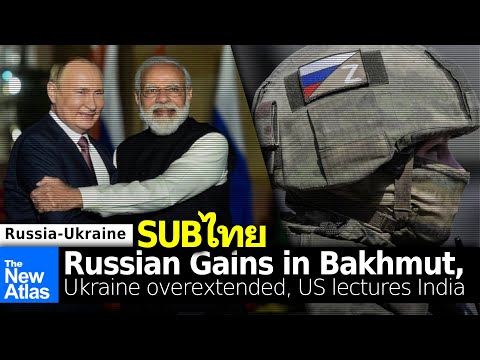
Russian Gains in Bakhmut, Ukraine Overextended, & US Lectures India

 October 17, 2022 (The New Atlas) - Update for Russian military operations against Ukraine for October 17, 2022.  Russian forces are closing...