Showing posts with label Libya. Show all posts

Friday, October 23, 2020

Europe Helps US Destroy Libya, Now Blames/Sanctions Russia

October 24, 2020 (Tony Cartalucci - NEO) - The EU has leveled sanctions against Russia for - among other things - "meddling" in Libya's ongoing civil war.

AFP in its article, "EU sanctions senior Putin aides over Navalny, Libya," would claim: 

The EU said Wagner had committed "multiple and repeated breaches" of a UN arms embargo on Libya, where Russia has backed warlord Khalifa Haftar in his uprising against the internationally-recognised government.

The UK - despite leaving the EU - has also said it would uphold the sanctions. 

The EU's attempt to high-road Russia, however, raises an important point - that it was the EU alongside the US who destroyed Libya's government in 2011 in the first place. 

The 2011 Western military intervention led to the civil war now currently consuming the nation and its people. And if Russia really is supplying weapons to Libyan groups in Libya - they are fighting groups who are being supplied arms in violation of the same UN arms embargo by other nations - namely the EU and the US.  

The US and Europe Destroyed Libya in the First Place 

Libya's ongoing chaos is a direct result of a 2011 US-led military intervention which included forces from several European nations including the UK. After destroying much of the nation's infrastructure and ousting the Libyan government led by Muammar Qaddafi - Libya was plunged into perpetual infighting as the country was divided by competing warlords and terrorist organizations flush with weapons the US and Europe provided them. 

The US-led military intervention eventually impacted Washington's European allies directly when a tidal wave of refugees flooded Europe from Africa to not only flee the war in Libya itself but also because Libya - once a safe haven for Africans from across the continent - was no longer hospitable. Arms the US and Europe provided militants and terrorists in Libya were also proliferated across the entirety of North Africa fuelling conflicts across the region. 

The US and Europe have since cynically used the consequences of their own military intervention as a pretext to remain perpetually involved in Libya's ongoing conflict - transparently exposing the self-serving politically-motivated nature of attempts to accuse Russia of "meddling."  

Despite Europe's direct and continued role in Libya's destruction - it has followed Washington's lead in blaming Russia - but obviously for no real concern over Libya's future which Europe itself helped destroy - and instead rather to aid Washington in its increasingly confrontational propaganda, economic, and hybrid war with Russia.

Europe One Step Forward, Two Steps Back in Breaking With Washington 

Europe has recently found itself locked in a foreign policy cycle " taking one step forward, and two steps back." Attempts to ignore US demands to shun both Russia and China have been received positively internationally providing hope that at least some in the West may desire a more constructive role upon the global stage. 

However sanctions aimed at Russia regarding Libya coupled with Europe's unrepentant role in the US-led war which destroyed Libya in the first place is a stark reminder of just how far the West still must go to reach even the most basic standards of maintaining equitable relations with the rest of the world. 

It remains to be seen whether these sanctions are followed up by a growing dedication to Washington's expanding and increasingly dangerous anti-Russian as well as anti-Chinese campaign - or is a means of relieving pressure the US is placing on its own European allies for their increased, apparent desire to do business with both Russia and China. 

Regardless of what current circles of power in Europe intend on doing - supporting the US further or eventually pivoting East - the shifting balance of power hinged on the rise of Eurasia is and will continue rolling back the West's style of exploitation and coercion and ensure that either current circles of Western power learn to work with rather than above the rest of the world - or new circles willing to do so will rise among Western political and economic circles to replace them.

Tony Cartalucci, Bangkok-based geopolitical researcher and writer, especially for the online magazine “New Eastern Outlook”. 

Saturday, July 11, 2020

Reading Stabbings: Deliberate Product of UK Foreign Policy

July 12, 2020 (Tony Cartalucci - NEO) - It should surprise no one paying attention that the suspect in the recent stabbing spree in Reading, UK was not only known to British security agencies as an extremist and security threat, but that he comes from the pool of extremists the British aided Washington in funding, arming, training, and providing air support for during the 2011 overthrow of the Libyan government and have harbored before and ever since.


The London Guardian in its article, "Libyan held over Reading multiple stabbing 'known to security services'," would admit:
The suspect in an alleged terror attack that left a teacher and two others dead was known to security services and other authorities, it emerged on Sunday.

Khairi Saadallah, the 25-year-old Libyan refugee held over the stabbings in a Reading park, was on the radar of MI5 in the middle of last year, sources told the Guardian.
Saadallah joins a long and growing list of extremists - and in the UK's case, Libyans specifically - who have carried out attacks in the UK after receiving political and material support from Western governments in proxy wars waged across the globe.

The 2017 Manchester Arena bombing killing 23 and injuring over 800 was also carried out by Libyans Salman and Hashem Abedi, also extremists long known to British security agencies.

The London Guardian in its article on the Manchester bombing titled, "Salman Abedi: from hot-headed party lover to suicide bomber," would report:
Quite when Abedi’s aggressive tendencies acquired an ideological bent is difficult to establish, but it has emerged that he travelled to Libya as a 16-year-old in 2011 to join the Libyan Islamic Fighting Group (LIFG) and fight alongside his father in the battle to oust Gaddafi.
His father was a prominent member of the militia, which was banned in the UK because of its jihadi links.
Despite terrorists from LIFG still carrying out terrorism to this day the US and UK have both removed the group from their lists of terrorist organizations.

The Western media admits that LIFG was involved in fighting and toppling the Libyan government in 2011 and admits they provided weapons to fighters in Libya as well as granted them asylum after Libya collapsed into disarray in the wake of US-led regime change.

US Senators would even shower awards and support on senior LIFG leaders after the fall of the Libyan government - including Abdelhakim Belhaj who served as "emir" of LIFG and who would at one point lead what was left of Libya after 2011.


Western newspapers regularly admit that Western security services are fully aware of LIFG members living within the borders of their respective nations - having deliberately provided them asylum there.

It takes little imagination to predict tragedies resulting from the West's policy of creating extremists, deploying them in proxy wars abroad, and then placing them amongst their own populations at home.


It was predicted long before the first US and British bombs dropped on Libya that their war of aggression against the North African nation would spread terrorism across the Middle East and North African region (MENA) as well as flood Europe with both refugees fleeing the catastrophe and extremists deliberately created by Western interventionism.

It is so predictable - in fact - that incidents like the Manchester Arena bombing or the Reading stabbings in Reading should be interpreted as deliberate by the British government - who like its American counterparts - readily uses extremists as armed proxies abroad and as an omnipresent threat at home justifying a growing police state while dividing and distracting the public.

Narrative management in the UK seeks to turn the stabbings into an issue surrounding race, religion, and social conditions when in reality the murders are a direct and deliberate product of the UK's foreign policy and those responsible reside in London, Washington, and Brussels, not in mosques or in the pages of the Qu'ran.

To call it "blowback" is not accurate since blowback implies the consequences were somehow unpredictable or undesirable. It is inconceivable that the British government believes harboring thousands of terrorists within its borders will not result in terrorism.

It harbors these terrorists in order to cultivate and deploy them in future proxy wars and in the meantime prevents them from being liquidated abroad when targets of Western aggression get the upperhand.

To solve the problem of extremism the Western public must focus on the deliberate foreign policy creating it - not on the social, religious, and racial excuses used to cover it up and to distract away from it.

Tony Cartalucci, Bangkok-based geopolitical researcher and writer, especially for the online magazine “New Eastern Outlook”. 

Wednesday, April 10, 2019

Battlefield Libya: Fruits of US-NATO Regime Change

April 10, 2019 (Tony Cartalucci - NEO) - Libya is back in the news, as fighting escalates around the capital, Tripoli.


Forces under the control of Khalifa Haftar - a former Libyan general under the government of Muammar Qaddafi - turned opposition during the 2011 US-led NATO intervention - turned "opposition" again against the UN-backed "Government of National Accord" (GNA) seated in Tripoli - have most recently reached Tripoli's airport.

The confusing chaos that has continually engulfed Libya since 2011 should come as no surprise. It is the predictable outcome that follows any US-led political or military intervention. Other examples showcasing US-led regime change "success" include Afghanistan, Iraq, and Ukraine.

And just like in Afghanistan, Iraq, and Ukraine - the Western corporate media has regularly omitted mention of Libya from headlines specifically to mask the very predictable consequences of US-led regime change as additional interventions against nations like Venezuela, Syria, and Iran are engineered and pursued.

Battlefield Libya 

In 2011, the North African nation of Libya was transformed from a prosperous, developing nation, into a divided, perpetual battlefield where local warlords backed by a milieu of opposing foreign sponsors and interests have vied for power since.

Libya's current status as a failed, warring state is owed entirely to the US-led NATO intervention in 2011.

Predicated on lies promoted by Western-funded "human rights" organizations and fought under the pretext of R2P (responsibility to protect) - the US and its NATO allies dismembered Libya leading to predictable and perpetual chaos that has affected not only Libya itself, but North Africa, Southern Europe, and even the Middle East.

The war immediately triggered not only a wave of refugees fleeing the war itself, but the redirection of refugees from across Africa seeking shelter and work in Libya, across the Mediterranean and into Europe instead.

Militants fighting as proxies for the US-led war in 2011 would be armed and redeployed to Turkey where they entered Syria and played a key role in taking the cities of Idlib and Aleppo during the early stages of that US-led proxy war.

Currently, Libya is divided between the UN-backed government based in Tripoli, eastern-based forces loyal to Haftar, and a mix of other forces operating across the country, holding various degrees of control over Libya's other major cities, and equally varying degrees of loyalty to the UN-backed government, Haftar's forces, or other factions.

Fighting around Tripoli has even allegedly prompted US military forces stationed in Libya to temporarily evacuate. CNBC in its article, "US pulls forces from Libya as fighting approaches capital," would report:
The United States has temporarily withdrawn some of its forces from Libya due to “security conditions on the ground,” a top military official said Sunday as a Libyan commander’s forces advanced toward the capital of Tripoli and clashed with rival militias. 

A small contingent of American troops has been in Libya in recent years, helping local forces combat Islamic State and al-Qaida militants, as well as protecting diplomatic facilities.
The presence of US forces in Libya might be news to some - and was certainly only a dream within the Pentagon until after the 2011 US-led NATO intervention finally toppled the Libyan government.

America's foreign policy of arsonist-fireman has endowed it with a large and still growing military footprint in Africa - one it uses to project power and affect geopolitics well beyond the continent.

America's Growing Footprint in Africa 

The ongoing Libyan conflict - flush with weapons pouring in from foreign sponsors - has also fuelled regional terrorism impacting neighboring Egypt, Tunisia, Algeria, Niger, and Chad, as far west as Mali and Nigeria, and southeast as far as Kenya. The war has been a boon for US Africa Command (AFRICOM) which has used the resulting chaos as a pretext to expand Washington's military footprint on the continent.


In a 2018 Intercept article titled, "U.S. Military Says it has a "Light Footprint" in Africa. These Documents Show a Vast Network of Bases," it was reported that:
According to a 2018 briefing by AFRICOM science adviser Peter E. Teil, the military’s constellation of bases includes 34 sites scattered across the continent, with high concentrations in the north and west as well as the Horn of Africa. These regions, not surprisingly, have also seen numerous U.S. drone attacks and low-profile commando raids in recent years.
The article notes that much of AFRICOM's expansion in Africa has occurred over the past decade.

While the pretext for US military expansion in Africa has been "counter-terrorism," it is clear US military forces are there to protect US interests and project US power with "terrorism" a manufactured pretext to justify Washington's militarization of the continent.


Much of the terrorism the US claims it is fighting was only possible in the first place through the flood of weapons, equipment, and support provided to militants by the US and its partners amid regime change operations targeting nations like Libya.

The US-led NATO war in Libya is a perfect example of the US deliberately arming terrorist organizations - including those listed as foreign terrorist organizations by the US State Department itself - overthrowing a nation, predictably destabilizing the entire region, and using the resulting instability as a pretext to massively expand America's military footprint there.

The wider agenda at play is Washington's desire to displace current Russian and Chinese interests on the continent, granting the US free reign.

Fruits of US-NATO Regime Change 

As NATO celebrates its 70th anniversary, NATO Secretary General Jens Stoltenberg would claim:
Over seven decades, NATO has stepped up time and again to keep our people safe, and we will continue to stand together to prevent conflict and preserve peace.
This "peace" includes 8 years of heavy fighting in Libya following NATO's intervention there.

NATO's Secretary General proclaims NATO's mission as one to "prevent conflict and preserve peace," yet it paradoxically and very intentionally engineered the war in Libya, overthrew the government in Tripoli, and triggered regional chaos that not only plagues North Africa to this day - but also inundated Europe with refugees fleeing the conflict.

Europe is one of the few places NATO could conceivably claim any mandate to protect or operate in - yet its own wars of aggression abroad directly compromised European safety and security. 

The media blackout that has shrouded the true impact of NATO's intervention in Libya for the past 8 years helps enable the US and its NATO partners to perpetrate additional proxy wars and political interventions elsewhere.

As the US openly pursues aggressive regime change in Venezuela and meddles in the internal politics of nations across Southeast Asia, the "fruits" of US intervention in places like Libya should always be kept in mind.

What is most alarming of all is considering that the US-led intervention in Libya may not necessarily be a failure. It is only a failure if one believed the US truly sought a better future for the nation. However, if the fruits of perpetual chaos and an equally perpetual pretext for the US militarization of Africa were intentionally set out for from the beginning - then in many ways - Libya was a resounding success.

Depending on how the current fighting around Tripoli unfolds, whether or not a unified Libya emerges, and whose foreign military presence and economic interests are allowed to persist on Libyan soil thereafter - will help determine just how successful Washington's true agenda in Libya - and in Africa - has been.

 Tony Cartalucci, Bangkok-based geopolitical researcher and writer, especially for the online magazine “New Eastern Outlook”. 

Wednesday, July 26, 2017

NATO's New Libya Still Burning

July 27, 2017 (Ulson Gunnar - NEO) - In 2011, US and European policy think tanks, which both create and promote policy serving the collective interests of the corporations that sponsor them, promoted NATO military intervention in Libya. Under the guise of a humanitarian intervention, what unfolded was the long-planned overthrow of the Libyan government, then headed by Muammar Ghaddafi.


Unable or unwilling to commit significant ground troops, the majority of the fighting was carried out by militant groups with NATO air and covert ground support. Many of these militant groups would be later revealed as comprised of extremists, including Al Qaeda and its affiliates.

In essence, NATO overthrew a unifying government in Libya, placed entire regions of the fractured nation under the control of terrorist organizations and opposing militant groups, and allowed the nation to slid into chaos ever since.

The consequences of overthrowing the Libyan government in 2011 were well known long before the intervention even took place. Libya's role as a destination for refugees and migrants fleeing socioeconomic turmoil across Africa was long-established. After NATO's intervention, Libya has now become a springboard for those fleeing from across Africa, across the Mediterranean Sea, and into Europe.


The issue of pirates, smuggling, organized crime and many other ills the Libyan government had kept under control, have also predictably spiraled out of control.

Now, those same policy think tanks that promoted the Libyan intervention, lament over the catastrophe that has continued to unfold ever since.

Foreign Affairs, published by one of the most prominent of these policy think tanks, the Council on Foreign Affairs (CFR), has published a series of articles by various authors, illustrating a sort of "buyers remorse" regarding the now devastated North African state. Part historical revision, part spin and part shifting of blame, articles like, "Europe's Libya Problem: How to Stem the Flow of Migrants," go into great detail about the problems now facing Libya and its neighbors.

The article laments:
Nearly 11,000 migrants arrived on Italian shores in just the last five days of June, following nearly 80,000 in the first half of 2017. Over 2,000 have perished at sea since the start of this year. The vast majority came from sub-Saharan Africa and embarked from the Libyan coast.
It then notes how Europe has been attempting to deal with the ongoing migrant crisis, claiming:
The European Union (EU) has been searching for a way to stem the flow of migrants and handle the tens of thousands who arrive in Italy on a daily basis. The EU’s current policy approach aims to shut off the route through the central Mediterranean and strengthen Libyan coastal patrol and enforcement capacities at sea. But it is unlikely to be effective or humane, given the sheer volume of migrants and the number of groups that profit from trafficking them, not to mention the weakness of the Libyan navy and other official security structures. 
The final sentence, noting the "weakness of the Libyan navy," is particularly ironic, since it was NATO that attacked and sent many of the Libyan navy's vessels to the bottom of Libya's harbors.

The article concludes, offering no practical means of stemming the crisis besides waiting for the next Ghaddafi to unite Libya's currently warring factions, eliminate or confine Western-sponsored terrorist organizations mainly based in the east, particularly in Benghazi, and rebuilding the nation's economy to once again offer incentives for refugees and migrants to live and work in Libya rather than travelling onward toward Europe.

Nowhere in Foreign Affairs' article is it mentions that the only reason Libya is now in chaos is not despite NATO military intervention, but because of it.

Unifying Libya will be difficult. Another Foreign Affairs article, titled, "Filling the Vacuum in Libya: The Need for a Political, Not Military Solution," admits just how fractured the nation is:
The GNA [Government of National Accord] barely controls the capital, Tripoli, through militias that are only nominally under its authority. Although the GNA recently succeeded in pushing a rump government—containing remnants of the Islamist-dominated parliament that was elected in 2012—out of the capital, it was long in coming, and these rival factions continue to prove a threat to Tripoli. 
Meanwhile, in the eastern part of the country, Field Marshal Khalifa Haftar, a former military officer under Qaddafi, and his Libyan National Army (LNA)—a coalition largely made up of eastern, anti-Islamist militias—are aligned with the House of Representatives, which refuses to recognize the GNA.
Foreign Affairs notes the rising political as well as military prominence of Field Marshal Khalifa Haftar, a "strongman" who appears to have the most potential of creating anything resembling a unified Libya. However, that will leave Libya once again in the same position it found itself before the 2011 intervention, with a strongman running the nation, and likely to drift further and further away from US and European interests until yet another proxy war is engineered, promoted by think tanks like the CFR and fought.

Again, despite Foreign Affairs' apparently in-depth analysis, it failed to isolate the true source of Libya's upheaval and instability, NATO. It was the 2011 intervention that upended stability not only in Libya, but created a chain reaction of violence and chaos that was felt as far west as Nigeria, Mali and Niger. This violence prompted, or more accurately, served as a pretext for the reintroduction of French troops in several of its "former" colonies. It has also served as a pretext for US Africa Command's (AFRICOM) continued expansion.

Ultimately, Libya is a showcase of the chaos and regression that NATO intervention brings, and serves as the greatest case for isolating, containing and by all means, opposing and obstructing further use of NATO military forces anywhere beyond NATO's own borders. The enduring chaos that is currently consuming nations like Libya also serve as a warning of what awaits nations like Syria and beyond should they fail in dissuading the West from further intervention within their borders.

It has been 6 years since NATO divided and destroyed Libya and the nation still remains fractured and fighting. The notion that NATO and its Western membership hold the solution to problems the West itself intentionally created should not be entertained, and, if international organizations, courts and laws had any meaning, NATO would be barred from any further role regarding Libya, beyond paying reparations for what it has done.

Ulson Gunnar, a New York-based geopolitical analyst and writer especially for the online magazine “New Eastern Outlook”.  

Wednesday, May 24, 2017

UK Government Harbored Terrorists Linked to Manchester Blast for Decades

UK Proscribed terrorist organization, Libyan Islamic Fighting Group (LIFG), maintains large presence in Manchester area and is now being linked to recent blast. 

May 24, 2017 (Tony Cartalucci - LD) - As suspected and as was the case in virtually all recent terror attacks carried out in Europe - including both in France and Belgium - the suspect involved in the recent Manchester blast which killed 22 and injured scores more was previously known to British security and intelligence agencies.


The Telegraph in its article, "Salman Abedi named as the Manchester suicide bomber - what we know about him," would report:
Salman Abedi, 22, who was reportedly known to the security services, is thought to have returned from Libya as recently as this week.
While initial reports attempted to craft a narrative focused on a a "lone wolf" attacker who organized and executed the blast himself, the nature of the improvised explosive device used and the details of the attack revealed what was certainly an operation carried out by someone who either acquired militant experience through direct contact with a terrorist organization, or was directed by a terrorist organization with extensive experience.

A Thriving Terrorist Community in the Midst of Manchester 

The same Telegraph article would also admit (emphasis added):
A group of Gaddafi dissidents, who were members of the outlawed Libyan Islamic Fighting Group (LIFG), lived within close proximity to Abedi in Whalley Range.

Among them was Abd al-Baset Azzouz, a father-of-four from Manchester, who left Britain to run a terrorist network in Libya overseen by Ayman al-Zawahiri, Osama bin Laden’s successor as leader of al-Qaeda. 

Azzouz, 48, an expert bomb-maker, was accused of running an al-Qaeda network in eastern Libya. The Telegraph reported in 2014 that Azzouz had 200 to 300 militants under his control and was an expert in bomb-making. 

Another member of the Libyan community in Manchester, Salah Aboaoba told Channel 4 news in 2011 that he had been fund raising for LIFG while in the city. Aboaoba had claimed he had raised funds at Didsbury mosque, the same mosque attended by Abedi.
Thus, the required experience for the recent Manchester attack exists in abundance within the community's Libyan Islamic Fighting Group (LIFG) members.

LIFG is in fact a proscribed terrorist group listed as such by the United Kingdom's government in 2005, and still appears upon its list of "Proscribed terrorist groups or organisations," found on the government's own website.

The accompanying government list (PDF) states explicitly regarding LIFG that:
The LIFG seeks to replace the current Libyan regime with a hard-line Islamic state. The group is also part of the wider global Islamist extremist movement, as inspired by Al Qa’ida. The group has mounted several operations inside Libya, including a 1996 attempt to assassinate Mu’ammar Qadhafi.
Thus, astoundingly, according to the Telegraph, a thriving community of listed terrorists exists knowingly in the midst of the British public, without any intervention by the UK government, security, or intelligence agencies - with members regularly travelling abroad and participating in armed conflict and terrorist activities before apparently returning home - not only without being incarcerated, but apparently also without even being closely monitored.

LIFG also appears on the US State Department's list of Foreign Terrorist Organizations. Astoundingly, it appears under a section titled, "Delisted Foreign Terrorist Organizations," and indicates that it was removed as recently as 2015.

Elsewhere on the US State Department's website, is a 2012 report where LIFG is described:
On November 3, 2007, [Al Qaeda (AQ)] leader Ayman al-Zawahiri announced a formal merger between AQ and LIFG. However, on July 3, 2009, LIFG members in the United Kingdom released a statement formally disavowing any association with AQ.
The report also makes mention of LIFG's role in US-led NATO regime change operations in Libya in 2011 (emphasis added):
In early 2011, in the wake of the Libyan revolution and the fall of Qadhafi, LIFG members created the LIFG successor group, the Libyan Islamic Movement for Change (LIMC), and became one of many rebel groups united under the umbrella of the opposition leadership known as the Transitional National Council. Former LIFG emir and LIMC leader Abdel Hakim Bil-Hajj was appointed the Libyan Transitional Council's Tripoli military commander during the Libyan uprisings and has denied any link between his group and AQ.
Indeed, a literal senior Al Qaeda-affiliate leader would head the regime put into power by US-led military operations - which included British forces.


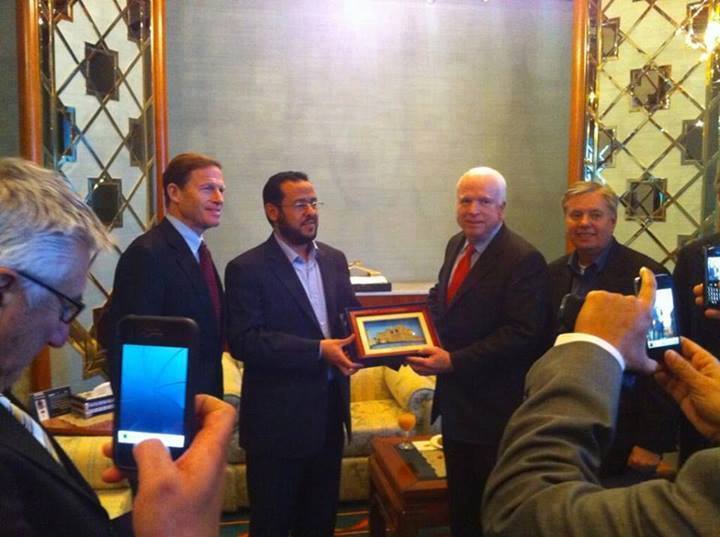
Not only this, but prominent US politicians would even travel to Libya to personally offer support to Bil-Hajj (also spelled Belhaj). In one notorious image, US Senator John McCain is seen shaking hands with and offering a gift to the terrorist leader in the wake of the Libyan government's collapse.

The US State Department's report regarding LIFG ends with information about its "area of operation," claiming (emphasis added):
Since the late 1990s, many members have fled to southwest Asia, and European countries, particularly the UK.
For the residents of Manchester, the British government appears to have categorically failed to inform them of the threat living openly in their midst. While the British population is divided and distracted with a more general strategy of tension focused on Islam, Muslims, and Islamophobia, the very specific threat of US-UK sanctioned terrorists living and operating within British communities is overlooked by the public.

However - for British security and intelligence agencies - it is unlikely that such an obvious security threat was merely "overlooked." That extremists thrive within British communities without government intervention indicates complicity, not incompetence.

LIFG Terrorists Are Anglo-America's Helping Hands

The Guardian in a 2011 article titled, "The Libyan Islamic Fighting Group – from al-Qaida to the Arab spring," would claim:
British intelligence and security service interest in Libya has focused for 20 years on the Libyan Islamic Fighting Group (LIFG), whether it was opposing Muammar Gaddafi and working with al-Qaida, later renouncing its old jihadi worldview – or taking part in the armed uprising that has now overthrown the regime.
The article in reality is nothing more than an attempt to portray a listed terrorist organization as "reformed" ahead of increased public awareness regarding the true nature of Libya's US and British-backed "rebels."

LIFG members would not only assist the US and British governments in the 2011 overthrow of the Libyan government, they would also move on - with Western arms and cash - to NATO-member Turkey where they staged an invasion of northern Syria.

The Telegraph in a November 2011 article titled, "Leading Libyan Islamist met Free Syrian Army opposition group," would report:
Abdulhakim Belhadj, head of the Tripoli Military Council and the former leader of the Libyan Islamic Fighting Group, "met with Free Syrian Army leaders in Istanbul and on the border with Turkey," said a military official working with Mr Belhadj. "Mustafa Abdul Jalil (the interim Libyan president) sent him there."
The article would continue by reporting:
The meetings came as a sign of a growing ties between Libya's fledgling government and the Syrian opposition. The Daily Telegraph on Saturday revealed that the new Libyan authorities had offered money and weapons to the growing insurgency against Bashar al-Assad. 

Mr Belhaj also discussed sending Libyan fighters to train troops, the source said. Having ousted one dictator, triumphant young men, still filled with revolutionary fervour, are keen to topple the next. The commanders of armed gangs still roaming Tripoli's streets said yesterday that "hundreds" of fighters wanted to wage war against the Assad regime.  

Revealed once again is a convenient intersection of terrorist and US-British interests - this time in pursuit of regime change in Syria in the wake of successful US-UK backed regime change in Libya.

Confirming that these plans to send Libyan extremists to fight in Syria were eventually executed is CNN's 2012 article, "Libya rebels move onto Syrian battlefield," which reported:
Under the command of one of Libya's most well known rebel commanders, Al-Mahdi al-Harati, more than 30 Libyan fighters have made their way into Syria to support the Free Syrian Army rebels in their war against President Bashar al-Assad's regime.
Al Harati's army of Libyan terrorists would expand to hundreds, possibly thousands of fighters and later merge with other Syrian militant groups including Al Qaeda's Syrian franchise - Jabhat Al Nusra. In Libya, LIFG fighters have divided themselves among various warring factions, including Al Qaeda and Islamic State affiliates.


As these terrorists filter out of Syria and back home, those hailing from LIFG are mainly returning to the UK where they have been known by US and British security and intelligence agencies for years to exist. With them they will be bringing back the technical knowledge and experience needed to carry out devastating attacks like the recent blast that targeted Manchester.

It is terrorism that follows as a direct result of British foreign and domestic policy - supporting terrorists abroad and deliberately refusing to dismantle their networks at home - all as they feed fighters and resources into the US-UK proxy war still raging in Syria.

The British government is directly responsible for the recent Manchester blast. It had foreknowledge of LIFG's existence and likely its activities within British territory and not only failed to act, but appears to have actively harbored this community of extremists for its own geopolitical and domestic agenda.

The recent blast will only reinforce the unsophisticated "tolerance versus bigotry" narrative that has gripped British society, entirely sidestepping the reality of government sanctioned terrorism wielded both abroad and against its own people - not for ideological or religious purposes - but purely in pursuit of geopolitical hegemony.

That the US and UK are using terrorists to expedite their respective geopolitical objectives should come as no surprise - particularly in regards to LIFG - since the organization itself branched out of Washington's mercenary fighters used against the Soviets in Afghanistan in the 1980s.

What is surprising is that the Western public continues to react emotionally to each terrorist attack individually rather than rationally, seeing the much larger picture and pattern. And until the Western public sees that bigger picture and pattern, fear, injustice, murder, and mayhem will continue to dominate their lives and futures. 

Wednesday, April 20, 2016

Washington's Fake War on ISIS "Moves" to Libya

Libya is one place the "Islamic State's" sponsors believe Russia can't get them... 

April 20, 2016 (Ulson Gunnar - NEO) - In 2011, a NATO coalition led by the United States used its own engineered regional campaign of political destabilization, the "Arab Spring," as a pretext to militarily intervene in first Libya directly, and in a more indirect way, Syria. US and European forces also "quietly" intervened in several other nations, including Mali and the Ivory Coast amid this regional conflagration.

Image: Out of all the explanations for the Islamic State's "move" to Libya, the only one that makes real sense is that they are being moved there by their foreign sponsors because it is believed they are "out of reach" of the Russian-led coalition that is truly fighting them in Syria. 
Even in 2011, it was clear to geopolitical analysts that military intervention in Libya was an attempt to divide and destroy the country, giving the US and its collaborators a base of operations to further disrupt and reorder the Middle East and North Africa region (MENA). Almost immediately after US-led strikes on Libya coordinated with terrorist factions on the ground successfully overthrew the Libyan government, weapons and fighters were sent to Syria via NATO-member Turkey.

CNN's 2012 article, "Libya rebels move onto Syrian battlefield," would report that:

Their war for freedom in Libya may be over, but almost a year after they won the battle for the Libyan capital, a group of fighters have a new battlefield: Syria. Under the command of one of Libya's most well known rebel commanders, Al-Mahdi al-Harati, more than 30 Libyan fighters have made their way into Syria to support the Free Syrian Army rebels in their war against President Bashar al-Assad's regime.
It is difficult to believe CNN's inaccuracy in its report was not intentional. Far from a "war for freedom," it is clear that Al-Mahdi al-Harati led just one of many proxy armies raised by the United States and its Persian Gulf allies. The group espouses an extremist tinge propagated by US-ally Saudi Arabia, and in no way represents either the Libyan people, nor the people of Syria it claimed to be fighting on behalf of.

Al-Harati is now "mayor" of Tripoli, and is just one example which goes a long way in explaining the continuous chaos that has engulfed the country. Quite literally, foreign-funded terrorists are running the country.

Ironically, the same CNN that in 2012 celebrated the spreading "war for freedom," would report in a more recent article titled, "ISIS fighters in Libya surge as group suffers setbacks in Syria, Iraq," that:
There may now be up to 6,500 ISIS fighters in Libya, twice the number previously thought, according to several U.S. intelligence officials. 

They attributed the increase to the U.S. analysis that ISIS is diverting more fighters to Libya from Syria -- and from Turkey when they cannot get into Syria.
It is ironic because the so-called "Islamic State" (IS) is using precisely the same logistical, financial and political networks to flow back into Libya that CNN's "freedom fighters" used to get to Syria in the first place. In fact, it is quite clear Libya is simply reabsorbing the mercenary forces organized and sent to Syria in part through direct US-backing in the Libyan terror capital of Benghazi since late 2011 onward.

Why Washington Welcomes the IS Homecoming 

Far from truly alarming to US and European special interests, IS arriving in the lawless warzone of what used to be the functional nation-state of Libya is a welcomed reprieve for what is essentially a Washington-London-Brussels mercenary army.


Image: The US and its European allies have used ongoing chaos across MENA as a pretext to intervene militarily both in a broad and open-ended manner. Citing the "Islamic State," they believe, will give them even broader impunity across MENA.
Syria is not only no longer safe for IS, it has become a grave in which IS is being buried alive. This is thanks not to a successful anti-terror campaign waged by Washington and its allies, but by swift and successful operations carried out by Moscow, Tehran, and their allies in Damascus. Indeed, with IS supply lines being cut from their source in Turkey and their forces being pushed back across Syrian territory, liquidation of their assets in Syria is well underway. Likewise in Iraq, feigned US operations to stop IS have given way to an increase in cooperation between Baghdad, Tehran, and Damascus.

What started out as an attempt to divide and destroy Iran's arc of influence across the region has galvanized it instead.

Moving the mercenary forces of IS out of the region is instrumental in ensuring they "live to fight another day." By placing them in Libya, Washington and its allies hope they will be far out of reach of the growing coalition truly fighting them across the Levant. Further more, placing them in Libya allows other leftover "projects" from the "Arab Spring" to be revisited, such as the destabilization and destruction of Algeria, Tunisia and perhaps even another attempt to destabilize and destroy Egypt.

IS' presence in Libya could also be used as a pretext for open-ended and much broader military intervention throughout all of Africa by US forces and their European and Persian Gulf allies. As the US has done in Syria, where it has conducted operations for now over a year and a half to absolutely no avail, but has managed to prop up proxy forces and continue undermining and threatening targeted nations, it will likewise do so regarding IS in Libya and its inevitable and predictable spread beyond.

Despite endless pledges by the US and Europe to take on IS in Libya, neither has admitted they themselves and their actions in 2011 predictably precipitated IS' rise there in the first place. Despite the predictable danger destabilizing and destroying Libya posed to Europe, including a deluge of refugees fleeing North Africa to escape the war in Libya, predicted by many prominent analysts at the time even before the first of NATO's bombs fell on the country, the US and Europe continued forward with military intervention anyway.

One can only surmise from this that the US and Europe sought to intentionally create this chaos, planning to fully exploit it both at home and abroad to continue its campaign to geopolitically reorder MENA.

Today, we watch what appears to be "ineffective" attempts to confront the growing threat the US and its allies intentionally created in Libya in the first place. In reality, as Russia has proven in Syria, a decisive and relatively small military campaign can deal IS a deathblow. The US and Europe are more than capable of executing such a military campaign, but is intentionally avoiding doing so. This is not for a lack of political will, but rather because their collective political will instead seeks much wider chaos giving them carte blanche to act regionally with spanning, open-ended military interventions.

Ulson Gunnar, a New York-based geopolitical analyst and writer especially for the online magazine “New Eastern Outlook”.

Tuesday, February 2, 2016

US-NATO Invade Libya to Fight Terrorists of Own Creation

Up to 6,000 troops are being sent to invade and occupy Libya, seizing oilfields allegedly threatened by terrorists NATO armed and put into power in 2011. 

February 2, 2016 (Tony Cartalucci - NEO) - The London Telegraph, almost as a footnote, reports of a sizable Western military force being sent in on the ground to occupy Libya in an operation it claims is aimed at fighting the so-called "Islamic State" (ISIS). In its article, "Islamic State battles to seize control of key Libyan oil depot," it reports:
Under the plan, up to 1,000 British troops would form part of a 6,000-strong joint force with Italy - Libya's former colonial power - in training and advising Libyan forces. British special forces could also be engaged on the front line.


One would suspect a 6,000-strong foreign military force being sent into Libya would be major headline news, with debates raging before the operation even was approved. However, it appears with no debate, no public approval, and little media coverage, US, British, and European troops, including Libya's former colonial rulers - the Italians - are pushing forward with direct military intervention in Libya, once again.

The Mirror's "SAS spearhead coalition offensive to halt Islamic State oil snatches in Libya," claims the West's 6,000 soldiers face up to 5,000 ISIS terrorists - raising questions about the veracity of both the true intentions of the West's military intervention and the nature of the enemy they are allegedly intervening to fight.

Military doctrine generally prescribes overwhelming numerical superiority for invading forces versus defenders. For example, during the the 2004 battle for the Iraqi city of Fallujah, the US arrayed over 10,000 troops versus 3,000-4,000 defenders. This means large, sweeping operations to directly confront and destroy ISIS in Libya are not intended, and like Western interventions elsewhere, it is being designed to instead perpetuate the threat of ISIS and therefore, perpetuate Western justification for extraterritorial military intervention in Libya and beyond.

With an initial foothold in Libya intentionally designed to last, it will inevitably be expanded, supporting US AFRICOM operations throughout the rest of North Africa.

The US-British Are "Fighting" the Terrorists They Put in Power 

As has been explained by geopolitical analysts since 2011, terrorist organizations like Al Qaeda and their various rebrandings are far from being the West's true adversaries. Besides being funded, armed, and backed by the West's closest and oldest Middle Eastern allies - particularly the Saudis and Qataris - these terrorist organizations serve a two-fold purpose. First, they serve as a mercenary army with which the West fights targeted nations by proxy. Second, they serve as a pretext for direct Western military intervention when proxy war fails or is not an option.

This was first illustrated with the very inception of Al Qaeda in the 1980's where it was used as a proxy force by the US and Saudis to fight the Soviets in Afghanistan. In 2001, the presence of Al Qaeda in Afghanistan was used as a pretext for a US invasion and occupation that endures to this very day.


As of 2011, literally these very same terrorists were organized, armed, funded, and provided with NATO aircover to overthrow the government of Libya. From there, they were rearmed and shipped to NATO-member Turkey where they then invaded northern Syria, and more specifically Idlib and the pivotal city of Aleppo.

The Business Insider would report in its article, "REPORT: The US Is Openly Sending Heavy Weapons From Libya To Syrian Rebels," that:
The administration has said that the previously hidden CIA operation in Benghazi involved finding, repurchasing and destroying heavy weaponry looted from Libyan government arsenals, but in October we reported evidence indicating that U.S. agents — particularly murdered ambassador Chris Stevens — were at least aware of heavy weapons moving from Libya to jihadist Syrian rebels.

There have been several possible SA-7 spottings in Syria dating as far back as early summer 2012, and there are indications that at least some of Gaddafi's 20,000 portable heat-seeking missiles were shipped before now.

On Sept. 6 a Libyan ship carrying 400 tons of weapons for Syrian rebels docked in southern Turkey. The ship's captain was "a Libyan from Benghazi" who worked for the new Libyan government. The man who organized that shipment, Tripoli Military Council head Abdelhakim Belhadj, worked directly with Stevens during the Libyan revolution.

The Business Insider's mention of Abdelhakim Belhaj working directly with Ambassador Stevens is particularly important. Belhaj was quite literally the leader of US State Department-listed foreign terrorist organization, the Libyan Islamic Fighting Group (LIFG) - Al Qaeda in Libya. Despite his obvious ties to Al Qaeda, he was openly backed by the US during the 2011 Libyan War, and afterward, was posing for pictures with US senators including Arizona senator John McCain in the aftermath of NATO's regime change operations. LIFG's leader, Abdelhakim Belhadj, is now reportedly also a senior leader of ISIS in Libya.

Fox News in a March 2015 report titled, "Herridge: ISIS Has Turned Libya Into New Support Base, Safe Haven," would claim:
Herridge reported that one of the alleged leaders of ISIS in North Africa is Libyan Abdelhakim Belhadj, who was seen by the U.S. as a willing partner in the overthrow of Libyan dictator Muammar Gaddafi in 2011. 

"Now, it's alleged he is firmly aligned with ISIS and supports the training camps in eastern Libya," Herridge said.
It is clear that the West is not fighting ISIS, but instead, has clearly both created it and is intentionally perpetuating it to help justify its military and geopolitical maneuvering across the Middle East and North Africa (MENA) region, and advance its aspirations toward regional and global political, military, and economic hegemony.


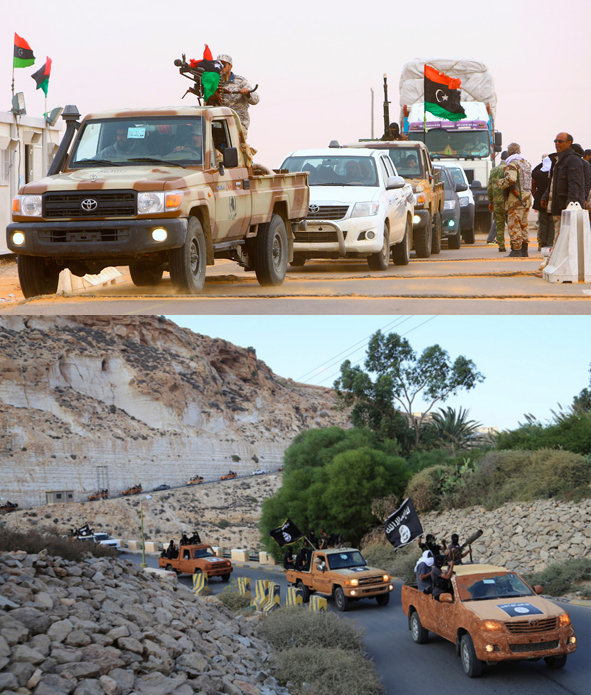
The very same technicals - armed trucks used in combat - bearing the Libyan "rebel" insignia, have literally just been painted over by images of ISIS' flag, like props on a Hollywood set being used in a bad sequel. With the US-British and European intervention in a destroyed Libya overrun by terrorists - a Libya we were promised by NATO was bringing brought peace, stability, "freedom," and "democracy" with its 2011 intervention, we see fully the danger of entrusting other nations to a similar fate wrought by Western intervention - most notably Syria.

Tony Cartalucci, Bangkok-based geopolitical researcher and writer, especially for the online magazine“New Eastern Outlook”.  

Wednesday, November 18, 2015

West Leverages Paris Attacks for Syria Endgame

November 18, 2015 (Tony Cartalucci - NEO) - The terrorist attacks carried out in the heart of the French capital, either coincidentally or intentionally, have served as the perfect point of leverage for the West on the very eve of the so-called "Vienna talks" regarding Syria.


With its serendipitously strengthened hand and with France taking a more prominent role, the West is attempting to reassert not only its narrative, but its agenda regarding the ongoing conflict in Syria, an agenda that has - as of late - been derailed by Russia's military intervention and recent gains made on the battlefield by Syrian military forces.

The London Guardian stated in its article "Paris attacks galvanise international efforts to end Syria war" that:
The Isis attacks in Paris have galvanised international efforts to end the war in Syria, with a new deadline set for negotiations between the warring parties and for a country-wide ceasefire. 

There is still no sign of agreement, however, on the key question of the future of the Syrian president, Bashar al-Assad.
It should seem extraordinary to the global public that even after the attacks in Paris, the West still insists on undermining the Syrian government toward its goal of "regime change," which includes continued material support to armed militants - all of which are extremists, and many of which have either coordinated with, or fought under the banner of Al Qaeda and even the self-proclaimed "Islamic State" (ISIS).

This is also considering the fact that the Syrian government is now currently engaged in battle with ISIS in and around Aleppo, and is currently threatening to sever its supply lines leading out of NATO-member Turkey's territory.


Regarding this point, the Guardian would even report:
It was clear, however, that Russia and the US have again had to agree to disagree about Assad. The Paris attacks “show that it doesn’t matter if you’re for Assad or against him,” said the Russian foreign minister, Sergei Lavrov. “Isis is your enemy.”

However, to explain the West's apparent failure to prioritize, the Guardian claims:
Isis, in their [the West's] view, is a symptom of political failings in both Iraq and Syria. The Vienna participants are to meet in Paris before the end of the year to review progress toward a ceasefire and the selection of delegations for the Syrian talks. 

In reality, ISIS is not a "symptom of political failings." It is the result of concerted, immense, multinational state-sponsorship. Entire armies of the immense scale ISIS operates on do not rise out of "political failings," they rise from huge, preexisting financial networks, region-wide logistical support, multinational political support, intelligence networking, and experienced military planning and organizational skills.

The West and its regional allies, namely Saudi Arabia, Qatar, and Turkey, clearly constitute this immense multinational state-sponsorship ISIS has so far enjoyed. A look at any map depicting the Syrian conflict shows ISIS supply lines running directly out of NATO-member Turkey's territory and in numerous reports, even out of the West's most prominent papers, it is even admitted that ISIS is supplied in Syria, via Turkey.

It is clear then that "political failings" are not the "cause" of ISIS except only in the sense that the "failure" to exact regime change in Syria has prompted the West to continue propping up ISIS and other terrorist groups until the government in Damascus falls - and only when Damascus' regional and global allies abandon it.

The West Got What it Wanted in Libya - And Created ISIS in the Process 

The West's claims during the Vienna talks that if only they get their way in Syria, the threat of ISIS will subside, is betrayed by the events surrounding the very rise of ISIS in Syria in the first place.

Just before the conflict reached critical mass in Syria during 2011, the US, UK, France, other NATO members, as well as Saudi Arabia, Qatar, and the United Arab Emirates (UAE), were already in the process of fully dividing and destroying Libya in pursuit of regime change.

They insisted that regime change was the only way to end the bitter fighting that had swept the country - regime change that just so happened to fulfill the long-held desire by Washington and Europe to see Libyan leader Muammar Qaddafi ousted from power.

Image: Libya got NATO-backed regime change, then Libya got ISIS. It is clear that giving NATO what it wants in Syria will bring neither peace to Syria nor stability to the world. 
Through arming what the West called "rebels," and through direct military intervention which included large-scale, nationwide airstrikes, naval bombardments, and even special forces, NATO devastated the country and turned it over literally to Al Qaeda. The West's "rebels" turned out to be sectarian extremists all along, and in fact - with NATO's help - they promptly took their weapons, fighters, and cash to begin the invasion of northern Syria via Turkey later that year.

The Business Insider would report in its article, "REPORT: The US Is Openly Sending Heavy Weapons From Libya To Syrian Rebels," that:
The administration has said that the previously hidden CIA operation in Benghazi involved finding, repurchasing and destroying heavy weaponry looted from Libyan government arsenals, but in October we reported evidence indicating that U.S. agents — particularly murdered ambassador Chris Stevens — were at least aware of heavy weapons moving from Libya to jihadist Syrian rebels. 

There have been several possible SA-7 spottings in Syria dating as far back as early summer 2012, and there are indications that at least some of Gaddafi's 20,000 portable heat-seeking missiles were shipped before now. 

On Sept. 6 a Libyan ship carrying 400 tons of weapons for Syrian rebels docked in southern Turkey. The ship's captain was "a Libyan from Benghazi" who worked for the new Libyan government. The man who organized that shipment, Tripoli Military Council head Abdelhakim Belhadj, worked directly with Stevens during the Libyan revolution.
Belhadj, it should be mentioned, was the commander of US State Department-listed foreign terrorist organization, the Libyan Islamic Fighting Group (LIFG) - which is literally Al Qaeda in Libya - and was so before, during, and after the 2011 Libyan war. Belhadj was also reportedly aligned with ISIS as it officially established itself in the shattered North African state. Fox News would report in its article, "Herridge: ISIS Has Turned Libya Into New Support Base, Safe Haven," that:
[Catherine] Herridge reported that one of the alleged leaders of ISIS in North Africa is Libyan Abdelhakim Belhadj, who was seen by the U.S. as a willing partner in the overthrow of Libyan dictator Muammar Gaddafi in 2011. 

"Now, it's alleged he is firmly aligned with ISIS and supports the training camps in eastern Libya," Herridge said.

It is clear that despite Western claims that regime change in Libya would be the beginning of the end for Libya's violence and instability, it was only the end of the beginning - and not only for chaos in Libya - but for other nations across North Africa and in Syria itself.

Using Another 9/11 to Justify Creating Another Libya 

NATO's intervention and regime change in Libya did not avert a refugee crisis, it helped create one. NATO's intervention and successful regime change in Libya did not make the region or the world safer, it turned the entire nation into a breeding ground for terrorist organizations with so-far unprecedented reach and operational capacity. NATO's goals in Libya did not prevent the refugee crisis, it helped start it. And with all of this in mind, having seen this and taken full stock of Libya's outcome, the West has nonetheless moved forward with precisely the same agenda in Syria.

In all reality, the West has no intention of bringing peace or stability to Syria. Their goal is to leave Syria as divided and destroyed as Libya, and to use the chaos and instability fostered there as a springboard for other targets of the West's proxy warfare - most likely Iran, Russia, and targets deeper in Central Asia.

The West promises that it will end the chaos in Syria, just like they promised it would end in Libya. It will not end in either.

With Libya's fate in mind, and a repeat performance clearly taking shape in Syria should the West get its way, it must be made clear that no matter how many innocent people are killed by terrorists the West itself helped create and perpetuate, they will not get an opportunity to turn Syria into the "Libya of the Levant," no matter how convenient and well-timed these killings are, no matter how deep they are within the heart of Europe or North America, and no matter how tragic and regrettable the aftermath is.

Tony Cartalucci, Bangkok-based geopolitical researcher and writer, especially for the online magazine“New Eastern Outlook”.    

Monday, March 9, 2015

Washington’s Al Qaeda Ally Now Leading ISIS in Libya

March 9, 2015 (Eric Draitser - NEO) - The revelations that US ally Abdelhakim Belhadj is now leading ISIS in Libya should come as no surprise to those who have followed US policy in that country, and throughout the region. It illustrates for the umpteenth time that Washington has provided aid and comfort to precisely those forces it claims to be fighting around the world.

According to recent reports, Abdelhakim Belhadj has now firmly ensconced himself as the organizational commander of the ISIS presence inside Libya. The information comes from an unnamed US intelligence official who has confirmed that Belhadj is supporting and coordinating the efforts of the ISIS training centers in eastern Libya around the city of Derna, an area long known as a hotbed of jihadi militancy.

While it may not seem to be a major story – Al Qaeda terrorist turns ISIS commander – the reality is that since 2011 the US and its NATO allies have held up Belhadj as a “freedom fighter.” They portrayed him as a man who courageously led his fellow freedom-lovers against the “tyrannical despot” Gaddafi whose security forces at one time captured and imprisoned many members of the Libyan Islamic Fighting Group (LIFG), including Belhadj.

Belhadj served the US cause in Libya so well that he can be seen receiving accolades from Sen. John McCain who referred to Belhadj and his followers as heroes. He was initially rewarded after the fall of Gaddafi with the post of military commander of Tripoli, though he was forced to give way to a more politically palatable “transitional government” which has since evaporated in that chaotic, war-ravaged country.


Belhadj’s history of terrorist activity includes such “achievements” as collaboration with Al Qaeda in Afghanistan and Iraq, and of course his convenient servitude to the US-NATO sponsored rampage across Libya that, among other things, caused mass killings of black Libyans and anyone suspected of being part of the Green Resistance (those loyal to the Libyan Arab Jamahiriya led by Gaddafi). Although the corporate media tried to make a martyr of Belhadj for his alleged torture via the CIA rendition program, the inescapable fact is that wherever he goes he leaves a violent and bloody wake.

While much of this information is known, what is of paramount importance is placing this news in a proper political context, one that illustrates clearly the fact that the US has been, and continues to be, the major patron of extremist militants from Libya to Syria and beyond, and that all talk of “moderate rebels” is merely rhetoric designed to fool an unthinking public.

The Enemy of My Enemy is My Friend…Until He Isn’t

There is ample documented evidence of Belhadj’s association with Al Qaeda and his terrorist exploits the world over. Variousreports have highlighted his experiences fighting in Afghanistan and elsewhere, and he himself has boasted of killing US troops in Iraq. However, it was in Libya in 2011 where Belhadj became the face of the “rebels” seeking to topple Gaddafi and the legal government of Libya.

As the New York Times reported:
The Libyan Islamic Fighting Group was formed in 1995 with the goal of ousting Colonel Qaddafi. Driven into the mountains or exile by Libyan security forces, the group’s members were among the first to join the fight against Qaddafi security forces… Officially the fighting group does not exist any longer, but the former members are fighting largely under the leadership of Abu Abdullah Sadik [aka Abdelhakim Belhadj].
So, not only was Belhadj a participant in the US-NATO war on Libya, he was one of its most powerful leaders, heading a battle-hardened jihadist faction that constituted the leading edge of the war against Gaddafi. Nowhere was this more clearly demonstrated than when the Libyan Islamic Fighting Group (LIFG) took the lead in the attack on Gaddafi’s compound at Bab al-Aziziya. In this regard, LIFG was provided intelligence, and likely also tactical support, from US intelligence and the US military.

This new information about Belhadj’s association with the suddenly globally relevant ISIS certainly bolsters the argument that this writer, among many others, has made since 2011 – that the US-NATO war on Libya was waged by terrorist groups overtly and tacitly supported by US intelligence and the US military. Moreover, it dovetails with other information that has surfaced in recent years, information that shines a light on how the US exploited for its own geopolitical purposes one of the most active terrorist hotbeds anywhere in the world.


According to the recent reports, Belhadj is directly involved with supporting the ISIS training centers in Derna. Of course Derna should be well known to anyone who has followed Libya since 2011, because that city, along with Tobruk and Benghazi, were the centers of anti-Gaddafi terrorist recruitment in the early days of the “uprising” all through the fateful year of 2011. But Derna was known long before that as a locus of militant extremism.

In a major 2007 study entitled “Al-Qa’ida’s Foreign Fighters in Iraq: A First Look at the Sinjar Records” conducted by the Combating Terrorism Center at the US Military Academy at West Point, the authors noted that:
Almost 19 percent of the fighters in the Sinjar Records came from Libya alone. Furthermore, Libya contributed far more fighters per capita than any other nationality in the Sinjar Records, including Saudi Arabia… The apparent surge in Libyan recruits traveling to Iraq may be linked the Libyan Islamic Fighting Group’s (LIFG) increasingly cooperative relationship with al-Qa’ida which culminated in the LIFG officially joining al-Qa’ida on November 3, 2007…The most common cities that the fighters called home were Darnah [Derna], Libya and Riyadh, Saudi Arabia, with 52 and 51 fighters respectively. Darnah [Derna] with a population just over 80,000 compared to Riyadh’s 4.3 million, has far and away the largest per capita number of fighters in the Sinjar records.
And so, the US military and intelligence community has known for nearly a decade (perhaps longer) that Derna has long been directly or indirectly controlled by jihadis of the LIFG variety, and that that city had acted as a primary recruiting ground for terrorism throughout the region. Naturally, such information is vital if we are to understand the geopolitical and strategic significance of the notion of ISIS training camps associated with the infamous Belhadj on the ground in Derna.

This leads us to three interrelated, and equally important, conclusions. First, Derna is once again going to provide foot soldiers for a terror war to be waged both in Libya, and in the region more broadly, with the obvious target being Syria. Second is the fact that the training sites at Derna will be supported and coordinated by a known US asset. And third, that the US policy of supporting “moderate rebels” is merely a public relations campaign designed to convince average Americans (and those in the West generally) that it is not supporting terrorism, despite all the evidence to the contrary.

The Myth of ‘Moderate Rebels’

The news about Belhadj and ISIS must not be seen in a vacuum. Rather, it should be still further proof that the notion of “moderates” being supported by the US is an insult to the intelligence of political observers and the public at large.

For more than three years now, Washington has trumpeted its stated policy of support to so-called moderate rebels in Syria – a policy which has at various times folded such diverse terror groups as the Al Farooq Brigades (of cannibalism fame) and Hazm (“Determination”) into one large “moderate” tent. Unfortunately for US propagandists and assorted warmongers however, these groups along with many others have since voluntarily or forcibly been incorporated into Jabhat al-Nusra and ISIS/ISIL.

Recently, there have been many reports of mass defections of formerly Free Syrian Army factions to ISIS, bringing along with them their advanced US-supplied weaponry. Couple that with the “poster boys” for Washington policy, the aforementioned Hazm group, now having become part of Jabhat al Nusra, the Al Qaeda linked group in Syria. Of course these are only a few of the many examples of groups that have become affiliated with either the ISIS or Al Qaeda brand in Syria, including Liwaa Al-Farouq, Liwaa Al-Qusayr, and Liwaa Al-Turkomen to name just a few.

What has become clear is that the US and its allies, in their unending quest for regime change in Syria, have been overtly supporting extremist elements that have now coalesced to form a global terror threat in ISIS, Nusra, and Al Qaeda.

But of course, this is nothing new, as the Belhadj episode in Libya demonstrates unequivocally. The man who was once Al Qaeda, then became a “moderate” and “our man in Tripoli,” has now become the leader of the ISIS threat in Libya. So too have “our friends” become our enemies in Syria. None of this should surprise anyone.

But perhaps John McCain would like to answer some questions about his long-standing connections with Belhadj and the “moderates” in Syria. Would Obama like to explain why his “humanitarian intervention” in Libya has become a humanitarian nightmare for that country, and indeed the whole region? Would the CIA, which has been extensively involved in all of these operations, like to come clean about just who they’ve been supporting and what role they’ve played in fomenting this chaos?

I doubt any such questions will ever be asked by anyone in the corporate media. Just as I doubt any answers will ever be furnished by those in Washington whose decisions have created this catastrophe. So, it is for us outside the corporate propaganda matrix to demand answers, and to never let the establishment suppress our voices…or the truth.

Eric Draitser is an independent geopolitical analyst based in New York City, he is the founder of StopImperialism.org and OP-ed columnist for RT, exclusively for the online magazine “New Eastern Outlook”.

Tuesday, January 27, 2015

Nigeria: Unraveling the Mystery of Boko Haram

January 28, 2015 (Eric Draitser - Counterpunch) The most entertaining mysteries are the ones with compelling protagonists, enigmatic and often surreptitious antagonists, and surprising or shocking conclusions. Indeed, without these essential elements, one is unlikely to read the story at all. However, when it comes to politics and geopolitics, somehow our mass media storytellers – the scores of journalists, military and counter-terrorism ‘experts,’ and establishment mouthpieces – fail to even point us in the right direction. Not only do they not follow the threads of the story, they prefer to pretend they simply aren’t there.


And so it is with the great ‘mystery’ of Boko Haram, a group that in just a few years has become one of the most recognizable terrorist entities in the world. Having carried out heinous massacres of men, women, and children, abducted thousands of innocents, and destroyed whole towns, Boko Haram now symbolizes just that perfect blend of barbarism, religious and ideological fundamentalism, and non-white skin, which come together to cast them, in the eyes of westerners especially, as the manifestation of evil – the devil incarnate that can only be destroyed by the forces of righteousness. You know, the ‘good guys.’

But what happens when there are no ‘good guys’ to be found? What happens when you follow the story only to find the most cynical of intentions from every player involved? Such is the case with this Boko Haram story, and indeed the regional politics and geopolitics of West Africa as a whole.

In trying to unravel the labyrinthine web of political, economic, and strategic threads connecting a number of significant actors, it becomes clear that no analysis of Boko Haram is worth reading unless it approaches the issue from three distinctly different, yet intimately connected, angles.


First, there is Nigeria’s domestic politics, and the issue of Boko Haram and the perception of the government and opposition’s responsibility for the chaos it has wreaked. With elections scheduled to take place in February, Boko Haram and national security have, quite understandably, become dominant issues in the public mind. The mutual finger-pointing and accusations provide an important backdrop for understanding how Boko Haram fits both into the public discourse, and into the strategies of political networks behind the scenes in Nigeria, and the region more broadly.


Second is the all-important regional political and economic chessboard. In West Africa – an area rich in strategic resources – there are a few interested parties who stand to gain from Boko Haram’s ongoing attacks which amount to a destabilization of the entire Nigerian state. Nigeria’s neighbor Chad has recently come under heavy scrutiny from Nigeria’s military apparatus for its purported role in financing and facilitating Boko Haram’s expansion. Chad sees in Nigeria potential oil profits as it expands its own oil extraction capabilities throughout the Chad Basin – a geographical region that includes significant territory in Chad, Nigeria, Cameroon, and Niger. Of course, major oil companies, not to mention powerful western nations such as France, have a vested interest in maintaining their profits from West African oil.

Finally and, perhaps most importantly, is the continental and global perspective. Nigeria, as Africa’s most dynamic economy, presents major opportunities and challenges for key global powers. For China, Nigeria represents one of its principal investment footholds in Africa. A key trading partner for Beijing, Nigeria has increasingly been moving out of the direct orbit of the West, transforming it from a reliable, if subservient, Western ally, into an obstacle to be overcome. Coinciding with these developments has been the continually expanding US military presence throughout Africa, one that is increasingly concentrated in West Africa, though without much media fanfare aside from the Ebola story.

The international media has seized on the heart-rending story of thegirls of Chibok – the ubiquitous #BringBackOurGirls meme – and for most people that is all they know about Boko Haram. However, such a superficial understanding of one of the most complex international stories in recent years does little to further the discourse, or bring about a resolution. Rather, a more nuanced understanding puts Boko Haram into a larger international context, one which can go a long way to dismantling the organization, and the air of mystery that surrounds it. While many of the details remain murky at best, with powerful players operating behind the scenes, the contours of a regional destabilization and a proxy war become discernible.

The Politics of Boko Haram

With national elections less than a month away, the competing factions of Nigeria’s political establishment are busily trying to scapegoat their opponents, with each side implying that the other is either in league with Boko Haram, or is deliberately trying to capitalize on the situation. The two major parties – the ruling People’s Democratic Party (PDP) led by President Goodluck Jonathan, and the All Progressives Congress (APC) – have made Boko Haram into a political hot potato, passing it back and forth in hopes that voters will associate it with their opponent.

Last September, before Boko Haram once again made international headlines with their most recent offensives, the political mudslinging was already fierce. The Chairman of the People’s Democratic Party Councillors Forum, Collins Onogu stated that:
Most of those who have been rendered homeless in the North Eastern part of the country by Boko Haram are PDP members. What is their offence? The spokesperson of APC…has neglected his duty and he is now making statements on behalf of Boko Haram….APC has been using the media to blackmail President Goodluck Jonathan, their plan is to make the country ungovernable for him, they have plans of diverting the attention of Nigerians but it will not work out.
While Onogu’s characterization of the issue is certainly debatable, it is quite clear the PDP sees the issue of Boko Haram as a major political liability for their party, and for President Jonathan. It is for this reason that Collins and other PDP leaders have repeatedly threatened to “reveal the names of APC members sponsoring Boko Haram.” It’s entirely possible that the PDP might do this purely to sabotage their opponents in the campaign. However, it is equally true that the PDP is desperately trying to deflect the blame for a crisis that has developed while the Government has been under their control. Either way, the PDP is smearing the APC in order to guilt them by association.

Conversely, the APC has not only denied all the charges, they have made their own counter-claims, alleging that former high-ranking PDP officials are intimately involved in financing Boko Haram. John Oyegun, national chairman of the APC said in September 2014:
Dr. Stephen Davis, a man hired by the President Jonathan-led Federal Government to negotiate with Boko Haram for the release of the Chibok girls decided to speak out, believing the best way to tackle the insurgency is to expose the sponsors. And who are they?…he named former Borno Governor Ali Modu Sheriff and a former Army Chief, Gen. Azubuike Ihejirika, as the sponsors of Boko Haram… The sponsors of Boko Haram are within the PDP and the Presidency. They are known friends of President Jonathan. He knows them and they know him.
These revelations, vehemently denied by the PDP and Nigerian President Jonathan’s administration, certainly raise important questions as to the networks supporting and financing Boko Haram, and when, where, and why they were originally organized. According to leaked intelligence information obtained by the Nigerian news outletPremium Times, the former governor of Borno State, and Goodluck Jonathan ally, Ali Modu Sheriff has been one of the principal financiers and organizers of Boko Haram, basing his operations out of Chad (more on Chad later). The dated communications obtained by Premium Times “painted a picture of what appears to be a powerful regional support structure involving the Chadian president, Nigerian officials and Niger Republic, and spearheaded by Mr. Sheriff whom the intelligence presents as a powerful figure within this circle.”

Add to this information the findings of a presidential panel commissioned by President Jonathan:

The Report traced the origin of private militias in Borno State in particular, of which Boko Haram is an offshoot, to politicians who set them up in the run-up to the 2003 general elections. The militias were allegedly armed and used extensively as political thugs. After the elections and having achieved their primary purpose, the politicians left the militias to their fate since they could not continue funding and keeping them employed. With no visible means of sustenance, some of the militias gravitated towards religious extremism, the type offered by Mohammed Yusuf.

Certainly there are a lot of questions to answer here. Is Sheriff simply a former ally who has since “gone rogue” and decided to establish his own private army to enrich himself and his foreign patron? Conversely, could it be that Sheriff continues to be connected, if perhaps only indirectly, with the government in Abuja? The communications between Sheriff’s network and Nigerian military officials as far back as 2011 does seem to suggest at least an indirect connection between them. As such, there is obviously a complex web of relations connecting various parties in Nigeria, as well as its neighbors, with Boko Haram.

According to a 2011 intelligence memo from field officers in Chad, “members of Boko Haram sect are sometimes kept in Abeche region in Chad and trained before being dispersed. This happens usually when Mr. Sheriff visits Abeche.” So, even the most conservative analysis would have to admit there is undeniably a connection between the domestic politics of Nigeria, especially within the ruling party, and international actors who have their own agenda. And it is those actors, and their motivations, that deserve careful analysis.

Regional Conflict, Resource War

West Africa’s vast riches have long since been a prize for colonial powers and post-colonial states alike. Nigeria alone has become a global player in terms of oil production – supplying at least 8 percent of US oil imports – though it is debatable whether that has been much of a blessing for the Nigerian people. Throughout the region, economic interests have been central to the policies and agendas of a number of states whose leaders have both dollar signs in their eyes, and hegemony on their minds. This has only accelerated in recent years, especially since the imperialist war that toppled former Libyan leader Muammar Gaddafi, perhaps the single force in Africa providing stability, and keeping peripheral actors such as Chad, Niger, and others more or less in line. Naturally, Gaddafi’s impact was seen a bit differently by those rulers whose ambitions suffered because of it.

Perhaps no leader has been more ambitious in recent years than Chadian President Idriss Déby who has played a central role in the entire Boko Haram story, from accusations that his government has provided them safe haven, to his possibly genuine, possibly disingenuous attempts to broker a ceasefire between the terror group and the Nigerian government. He has been linked with the aforementioned Ali Modu Sheriff, the alleged mastermind of the Boko Haram network. Intelligence information from a number of sources does seem to point to a direct connection. In addition, a 2009 US diplomatic cable published by Wikileaks revealed that:
A well-trained veteran Chadian extremist, Abu-Mahjin, who has limited ties to al-Qa’ida associates, recently traveled to Nigeria. He may be planning to conduct or facilitate a terrorist operation…recent tearline stated, ‘Nigerian-based probable Chadian extremist is keen to obtain more funds…it is not clear when he will receive this additional finance.’
Could it be that Abu-Mahjin acted as a de facto intermediary between certain elements in Nigeria and Chad? It is certainly plausible that, at the very least, the connection between Chad and Boko Haram goes back to the very transformation of that organization into a terrorist entity.

But what can Chad offer? And why would they?

To answer the former question, one must dive into recent history to see how Déby came to power. Curiously enough, his rise to the presidency was directly thanks to Gaddafi who, after years of war with Chad – war in which Déby himself led troops against Libyan forces – backed Déby against the former government of Hissène Habré who had been hosting a number of anti-Gaddafi Libyans with close ties to US intelligence, such as the once again relevant General Hifter. As Time magazine noted in 2001, “While the full scope of Déby’s relationship with Gaddafi remains hazy, it is known that Libya equipped Déby’s army with as many as 200 Toyota land cruisers fitted with 23-mm Soviet-made cannons.” It is quite likely that the military backing for Déby went far deeper than what is being acknowledged here.

In any event, the NATO-led war that toppled Gaddafi in 2011 radically changed the political character of the region. Suddenly, someone like Déby could pursue his own regional ambitions without the ever-watchful eye of Gaddafi who stood against any forces that sought to destabilize West Africa in the service of western corporations. With a long-established network of weapons and fighter smuggling, Chad became a major transit point for many of the weapons (and fighters) streaming out of Libya by the end of 2011. While much of the military hardware went through the Sahel region, likely into the arms of the equally shadowy Al Qaeda in the Islamic Maghreb (AQIM), it is probable that a significant amount of it went to Chad. The long-standing ties with elements of the Libyan military only increase the likelihood that Chad became a refuge and/or conduit for countless weapons and fighters.

So, as Libya collapsed, and weapons and fighters came streaming out, Chad all of a sudden found itself in a position of strength, able to finally pursue an agenda to enrich itself, or at least enrich Déby and the clique around him. But what is it that he wants?

In recent years, oil discoveries throughout the Chad Basin have transformed how the states of West Africa view their economic future. At the heart of the basin is Lake Chad, surrounded by the nations of Chad, Cameroon, and Niger. According to a 2010 assessment from the US Geological Survey (USGS), the Chad Basin has “estimated mean volumes of 2.32 billion barrels of oil, 14.65 trillion cubic feet of natural gas, 391 million barrels of natural gas liquids.” The potential size of these resources certainly has whet a few palettes, both in the region and internationally.

All the countries of the basin have expressed strong desire in recent years to begin exploiting the energy reserves there. However, thus far, Nigeria has been unable to do so due to the Boko Haram insurgency.E&P (Exploration & Production), the publication of Hart Energy, noted in March 2014:
Hopes of stepping up oil exploration in Nigeria’s Lake Chad Basin have been dashed by the brutal attacks of Islamic Boko Haram and the Ansaru sect terrorists in the country’s northeastern region…Between 2011 and 2013 the Nigerian government provided $240 million to facilitate oil and gas exploration activities in the Lake Chad Basin…Oil prospecting in the Lake Chad Basin was “yielding promising results and may lead to commercial exploration of oil and gas this year,” Nigeria’s Vice President Namadi Sambo said in 2013…But the deadly activities of the Boko Haram insurgents halted plans.
So, while Nigeria is forced to put the brakes on its oil exploration and development in the Chad Basin, its neighbors, most notably Chad, continue theirs. As Dr. Peregrino Brimah explained, “The Boko Haram insurgency has conveniently provided Chad, under the government of Idriss Déby, unfettered access to oil under Nigeria’s soils through 3D oil drilling from within its territorial borders, which the country exports.” So, in true Daniel Plainview “I drink your milkshake” style, Déby has engaged in siphoning off Nigeria’s oil wealth, and exporting it for massive profits for himself and his cronies. But of course, Chad is not alone in this endeavor, as it has company from Cameroon and Niger, both of whom are doing precisely the same thing.

Standing above and behind this practice is the former colonial power France – the one-time colonial master of Chad, Cameroon, and Niger. Today, France’s dominant role continues as its port of Le Havre is the final destination for the unrefined oil extracted from under the feet of West Africans. Needless to say, there are very powerful interests both in Africa and Europe who want to ensure that the flow of their precious oil continues unabated. Moreover, they will do anything to prevent the major oil exporting power of the region, namely Nigeria, from being able to cut in on their action.

And this regional rivalry is, at least in part, the reason why Boko Haram really has the potential to spark international conflict. Last October, after Nigerian military forces launched an offensive against Boko Haram, the ensuing battle spilled across the Nigeria-Cameroon border where, depending on who you believe, either Nigerian forces retreated, or they pursued Boko Haram suspects. In total, 107 Boko Haram militants were killed, along with 8 Cameroonian military officers and dozens of civilians. In this way, the resource war is transmogrified into a shooting war. The destabilization of the entire region is not far off from that.

It is precisely this danger of a regional destabilization that has so many observers around the world biting their nails. The obvious danger is that West Africa could become, like the Sahel and most of North Africa, a locus of extremism and terror. However, the most pressing question of all is why. In whose interest is it to see the whole region destabilized? What is the global and geopolitical context for understanding these decidedly complex and interconnected issues?

Part 2 of this article will examine the geopolitical and strategic context within which these events should be understood. It will detail how the US and certain European powers are exploiting the situation for their own gain.

Eric Draitser is the founder of StopImperialism.com. He is an independent geopolitical analyst based in New York City. You can reach him at ericdraitser@gmail.com.

Russian Gains in Bakhmut, Ukraine Overextended, & US Lectures India

 October 17, 2022 (The New Atlas) - Update for Russian military operations against Ukraine for October 17, 2022.  Russian forces are closing...