Showing posts with label BRICS. Show all posts

Tuesday, August 22, 2017

Venezuela: West's Battle Against Multipolarism Reaches Far

August 22, 2017 (Tony Cartalucci - LD) - The battle between the established unipolar "international order" dominated by Wall Street, Washington, and London and an emerging multipolar order appears fixated on Eastern Europe, the Middle East, and across the entirety of Asia. However, it extends to virtually every corner of the globe, from competition in the Arctic to politically-motivated controversies in Earth orbit.

The South American nation of Venezuela also seems far-removed from this ongoing competition engulfing the world's hot spots in the Middle East, Central and Asia, but the fate of this besieged nation is directly linked to the that of the rest of the world, either contributing to an emerging multipolar world order, or providing sanctuary and legitimacy to the established unipolar order currently dominated by Wall Street, Washington, and London.


The nation has been the target of US-backed subversion for decades. The latest iteration of American interference began with the rise of Venezuelan president Hugo Chavez and a failed US-backed coup in 2002 organized to oust him and place a US-controlled client regime in power.

Venezuela's "Opposition" are US-Backed Agitators  

Many of those involved in the failed 2002 coup are now leading US-backed protesters in the streets in a bid to overthrow the government of President Nicolás Maduro, who succeeded Chavez after his death in 2013.

The opposition includes former presidential contender, Henrique Capriles Radonski, who heads Primero Justicia (Justice First) which was co-founded by Leopoldo Lopez and Julio Borges, who like Radonski, have been backed for nearly a decade by the US State Department.

Primero Justicia and the network of foreign-funded NGOs that support it have been recipients of both direct and indirect foreign support for at least just as long.

All three co-founders are US educated - Radonski having attended New York's Columbia University (Spanish), Julio Borges attending Boston College and Oxford, and Leopoldo Lopez who attended the Harvard Kennedy School of Government (KSG), of which he is considered an alumni of.

The Harvard Kennedy School, which hosts the notorious Belfer Center, includes the following faculty and alumni of Lopez, co-founder of the current US-backed opposition in Venezuela:
John P. Holdren, Samantha Power, Lawrence Summers, Robert Zoellick, (all as faculty), as well as Ban Ki-Moon ('84), Paul Volcker ('51), Robert Kagan ('91), Bill O'Reilly ('96), Klaus Schwab ('67), and literally hundreds of senators, ambassadors, and administrators of Wall Street and London's current global spanning international order. 
Harvard's Kennedy School of Government (KSG) is one of several universities that form the foundation of both creating corporate-financier driven international policy, as well as cultivating legions of administrators to execute it. This includes creating cadres of individuals to constitute Wall Street and Washington's client regimes around the world. 

Venezuela's Problem, Like Other Targeted States, is US Sedition, not "Socialism" 

It is true that Venezuela is deemed a "socialist" nation, and its policy of heavily centralizing the economy has not only failed to alleviate the many longstanding socioeconomic conflicts inflicting Venezuelan society, but has also created an ample vector for Wall Street and Washington's meddling.

By placing all of Venezuela's proverbial "eggs" in one centralized "basket," the United States - through the use of various well-honed geopolitical and socioeconomic tools - has managed to knock that "basket" from the government in Caracas' hands and is now using its well-funded and organized opposition to crush whatever "eggs" survived the fall. 


Unfortunately for Venezuela, the Western political landscape is so deeply rooted in blind, poorly developed political ideology, practical geopolitical and geostrategic analysis has been overlooked across both traditional and alternative media platforms, and instead, many - including opponents of US-backed regime change worldwide - have found themselves cheering on what they believe is the self-inflicted collapse of the socialist Venezuelan government at the hands of "free market" protesters. 

In reality, they are cheering on yet another episode of US-backed regime change, wrapped in a protective layer of ideological, political, and economic rhetoric to justify otherwise unjustifiable, extraterritorial meddling, interference, chaos, division, and destruction. 

Venezuela's Place Within the Unipolar-Mulipolar World 

Depending on the ultimate fate of the Venezuelan government, the success of US-backed proxies, and the ability of Venezuela to reconstruct itself after decades of foreign-backed subversion, Venezuela can either enhance or set back the emerging multipolar world order.

Regardless of Venezuela's fate if and when the government in Caracas is toppled, the US-led unipolar international order will benefit. The elimination of competition, even at the cost of creating a center of regional destabilization is considered favorable versus allowing a bastion of alternative socioeconomic and geopolitical power to persist. And in many ways, the creation of a regional center of destabilization may help the US create "synergies" between the chaos it is fostering in Venezuela and in neighboring South and Central American nations the US has likewise targeted for geopolitical coercion and/or regime change. 

For Russia, China, other nations of BRICS, and even emerging economies across Southeast Asia and Central Asia, the loss of Venezuela as a means of counterbalance to US hegemony both in the region of the Americas and globally will allow the US to concentrate more resources toward remaining alternative centers of geopolitical and economic power it seeks to target.

This - not the nature of Venezuela's "socialist" government - is the focus of US efforts and is what defines the consequences of either US success or failure regarding regime change in Caracas. 

Any government, socialist or otherwise, operating outside of Wall Street, Washington, and London's sphere of influence is a target. Competition, not ideology defines and drives Western foreign policy - and for those who oppose this policy - it must be practical geopolitical and geostrategic analysis that defines conclusions and courses of action - not the ideological debates the US itself is using as a pretext and as rhetorical cover to justify its latest regime-change project.

Venezuela may be geographically far removed from the focal point of the great unipolar-multipolar struggle, but understanding how it fits into conflicts raging in Eastern Europe, the Middle East, and across Asia illustrates just how encompassing the "international order's" reach and ambitions really are - and how deadly dangerous they are to global peace, security, and stability.  

Sunday, June 14, 2015

East Must Provide Alternative to, Not Replace Western Hegemony

June 15, 2015 (Ulson Gunnar - NEO) - Recent news has shown China quickly gaining ground against a West which has for centuries maintained hegemony over Asia Pacific. Beyond Asia, China has been steadily expanding its influence throughout Africa and the Middle East. Together with Russia, Iran and other nations of the "East," they are constructing what is commonly referred to as a "multi-polar" world order.


This multi-polar world order stands in contrast to the unipolar order the West has sought to impose for decades after the end of the World Wars and is a continuation of Western imperialism carried out by the British and other European empires during the decline of the Ottoman Empire.

But is what the East doing truly building an alternative to the West's brand of hegemonic imperialism? Or is it simply more of the same under a different label? More over, is the West's behavior coaxing other nations to unify under a singular, consolidated banner, only to be rolled under the West's vision of an international order ruled from Washington, Wall Street, London and Brussels?

These are questions that must be asked and explored particularly by the people who gravitate toward the East the most. They understand the threat of Western hegemony and the very real damage it has and still is inflicting upon humanity. From the devastation of Iraq and Afghanistan, to the wars raging in Yemen, Syria and Libya, Western designs have taken unstable tinderboxes around the globe and turned them into raging infernos.

Naturally, people look for a force to counter such inhumane violence, bloodshed and shameless exploitation and manipulation. They see that counter in Russia, China and those in their spheres of influence. And while in the past these nations have indeed served as counterweights to the forces of fascism or imperialism, one must always be careful not to simply back one hegemon over another.

For Moscow, Beijing and across the other BRICS nations, they must understand that the support and success they enjoy is specifically because they offer what many believe is an alternative to, not a replacement for Western hegemony. The world sees BRICS as a viable alternative specifically because they are not setting up military bases in foreign lands, intervening militarily thousands of miles from their borders and working with nations instead of coercing them. As soon as they cease to uphold these principles, they will cease to serve as a relevant alternative to the West.

China in particular has been long criticized by the West for doing business with any nation regardless of their so-called human rights record. The West however, makes these criticisms because it disrupts their ability to exploit human rights as a pretense to meddle diplomatically, militarily and economically in any targeted country. Meanwhile, the West gladly has conducted long-term business with the most egregious human rights offenders on Earth, the Saudi regime chief among them.

China has repeatedly, sometimes even painfully reasserted the primacy of national sovereignty in ruling over all international relations. It must not only continue to reassert this message diplomatically, but also pragmatically throughout its foreign policy. Not only is it a matter of self-interest, preventing foreign interests from dictating to Beijing what it should do within its own borders, but it helps set a solid precedent in establishing a new multi-polar global order.

Supranational Institutions Old and New 

Russia, China and the rest of BRICS are themselves creating a variety of supranational institutions and military alliances to compete against those of the West, particularly the IMF, World Bank, NATO, and even the UN itself. However, while doing this, they must ensure the preservation, even the encouragement of national sovereignty as the primary organizing principle among these new institutions. And not just on paper, but especially in practice, whether it suits BRICS at the moment or not.

This is because whether those special interests behind BRICS and standing in apparent opposition to the West realize it or not, the very reason they have been given an opportunity by the global public is specifically because they are perceived as being different from the West and the Western way of using their global wealth and influence. And whether it serves their interests immediately or fully, they must fulfill these expectations or suffer the same backlash the West is now facing, both at home and abroad.

The world is changing economically, technologically and culturally. These shifts have not boded well for the concept of "globalization" or even supranational institutions. To seek to create doppelgangers of existing and failing Western supranational and international institutions seems folly at best.

Understanding this, and balancing competition with the West's existing and still potent institutions, against the changing dynamics of the coming future is essential for the survival and eventual success of BRICS and the multi-polar world they claim to want to create.

In a world where technology now empowers one individual to do what once required many people and tremendous resources, constitutes a shift in the balance of power between local communities, nations and global alliances and power brokers. Even if the people have yet to realize this, they will soon. The future of BRICS depends on a collective understanding that fighting this coming shift will lead BRICS to the same cliff the West is currently dangling over.

For the people themselves, they must understand that they have always been in the driver's seat, even if insidious hands have reached past them to take the wheel for the majority of this trip. Realizing that the people, not special interests have the ability to steer the world toward a path we would all like to see it on is our greatest bet. We need not obsessively support one bloc over another, subscribing almost religiously to political parties, personalities and brands, but should instead agree on a set of principles and only back those as long as they uphold those principles.

By attaching ourselves to political parties, personalities and brands, we stand only to be inevitably disappointed. On the other hand, principles are inextinguishable, indomitable and everlasting. In the ongoing game of geopolitics, if ever we want to finally break the continuous turning of the wheel of history, we must stop following those whose hands are turning that wheel, and follow the principles that always and forever lead forward.

When Russia, China and the rest of BRICS stand up for national sovereignty, non-interventionism and non-military expansionism, we should applaud them not because they are simply BRICS, but because of the principles they are upholding. When they fail to do so, we must also, and as equally as vocal, condemn them.  

Ulson Gunnar, a New York-based geopolitical analyst and writer especially for the online magazine “New Eastern Outlook”. 

Tuesday, January 20, 2015

Economic War, BRICS, and the Power of Self-Sufficiency

January 20, 2015 (Ulson Gunner - NEO) - The toughest, most resilient people as both individuals and as societies all generally have one thing in common - self-sufficiency. This by no means suggests isolationism, but rather the ability to survive, even thrive through one's own work using resources at their own disposal. 

As a principle, self-sufficiency, self-reliance, and individualism defined young nations like the United States, catapulting it upon the world stage as a global leader after spending time racked in debt and in England's shadow. By establishing its own industry, its own institutions (including those of a financial nature) and its own military might, the United States transcended the tangled webs of interdependency locking Europe's ever-shifting, fragile alliances together. 

The evolution of human civilization along the lines of socioeconomics and technology has changed the roles, effectiveness and relevancy of those industries and institutions that had once made America great and in turn, those nations that had attempted to emulate such features have now all found themselves within the same boat - the boat of globalization.

Globalization is the hitherto pinnacle of interdependency, crippling any nation that falls foul of those sitting at the center of this entangled geopolitical order. There are many examples of nations that haven fallen foul including Cuba, Iraq, Iran and more recently Russia. In each case, respective economies depended heavily upon imports or exports or both. The response in defense against crippling economic warfare is self-sufficiency. 


In Cuba, urban agriculture became a necessity long before it became a trend in urban centers elsewhere around the world. Iran has become independent in many aspects including arms manufacturing. Iraq, it can be said, was ultimately undone by sanctions combined with military invasion and occupation by the United States. Now in Russia, we see a nation first shifting its markets toward friendlier allies, then attempting to develop itself from within. 

Combined with the overall instability of a global system of interdependencies ran by an inept, greedy and self-destructive oligarchy centered upon Wall Street and London, economic warfare is a serious and continuous threat to all nations. And while headlines are dominated by America's economic war on Russia at the moment, amid that war many of the United State's closest allies have suffered as well. 


France had planned on selling Russia two Mistral-class amphibious assault ships for a total of 1.2 billion Euros. Because of pressure on France to support NATO's proxy war against Russia in Ukraine, the delivery of the vessels has been indefinitely suspended. In addition to losing the 1.2 billion Euros for the contract already paid for by Russia, there is an additional penalty of 251 million Euros. Because of France's tangling interdependencies with the US, European Union, and England, it is incapable of making a decision that represents its own best interests and those of the French people. 

Similar scenarios have played out across Southern Europe where Russia's South Stream Pipeline was to run but has now since been canceled due to US, British and EU pressure.

Likewise for Russia, instead of building their own amphibious assault ships, they have decided to depend on the French which was clearly a mistake.

In theory, for nations capable of building their own ships, cars, electronics or producing their own food and energy, the whims of foreign interests have much less impact. In practice, such nations are difficult to come by, and vulnerabilities in the form of sociopolitical and economic interdependencies are a feature of nearly every nation's geopolitical standings. 


Self-Sufficiency as a Matter of National Defense 

The BRICS nations, Brazil, Russia, India, China, and South Africa, as well as other growing developing nations particularly in Southeast Asia, would do well to not only learn the dangers of interdependencies, but the merit of proactive self-sufficiency, not as a knee-jerk reaction, but as a proactive form of national defense. 


Everything from industry to agriculture and even human health is becoming increasing dependent on advanced technology. Nations lagging behind in terms of education, research, and development are likely to fall prey to monopolies controlled from beyond their borders. A nation dependent on another is not only not truly a free and independent nation state, it is also immensely vulnerable to the meddling of those nations who control these monopolies. 

Washington and Riyadh's grip on the petrodollar is one example of this. Their ability to then manipulate global energy prices has been regularly used as an economic weapon against its enemies, most recently Russia. While a clumsy and unsustainable weapon to wield, the world would be a far better and more stable place if the firewalls of socioeconomic independence were stronger.

Should Russia prevail, it is hoped that while they will likely continue reaping the benefits of their resource-based export economy, they will also look inward for another source of strength to augment, then eventually replace their vulnerable interdependencies. Other BRICS nations would be wise to begin doing so long before it becomes a necessity. For nations like Brazil, who has invested decades in developing energy independence, such a proposition is much more in reach. 


Ultimately, self-sufficiency as an individual or as a nation or bloc of nations does not mean isolationism. It means being able to thrive without, and thriving twice as much with. While it is difficult to convince industries and entrepreneurs to steer toward this more sustainable ground, tying self-sufficiency in with national defense can allow for measures otherwise shortsighted business sectors would reject. In the long run, say in Russia, business leaders who eagerly pursued globalism as a means toward riches are surely regretting their shortsightedness now. Sanctions force Russia, under pressure, to implement measures that should have been put in place years ago.

Tying self-sufficiency to national security, particularly now in Russia where jobs and prosperity are in peril is not a long stretch, especially considering that Russia's current economic woes are part of what is essentially an attack on Russian sovereignty, peace and prosperity to begin with. 


Ulson Gunnar, a New York-based geopolitical analyst and writer especially for the online magazine “New Eastern Outlook”.

Saturday, August 23, 2014

Fighting Back Against Western Sanction

August 23, 2014 (Ulson Gunnar - NEO) - While the impact of sanctions leveled against Russia is being debated, one fact is perfectly clear; the dangerous interdependence cultivated by the concept of “globalization” leaves nations vulnerable amid a global order dominated by hegemonic special interests that use such interdependence as a weapon.

Two rounds of sanctions have been leveled against Russia targeting Russian banking, arms manufacturing, and oil industries. Even as the sanctions are marketed to the world as Russia “paying a price” for its role in “destabilizing” Ukraine, Russia has been busy cultivating ties and expanding markets that are increasingly found outside the West’s spheres of influence and therefore, beyond the reach of these sanctions. Russia is also looking inward to diversify its markets and seek socioeconomic independence.

Instead of viewing the sanctions as an impassable obstacle requiring capitulation to Wall Street and London, Russia has viewed them as a challenge to sever reliance on unstable markets. More so, Russia’s quest for alternative markets is a means of applying its own form of pressure back upon the West. While the West attempts to portray the sanctions as “cutting off Russia,” the restrictions do at least as much to isolate the West itself.

Multipolar World Vs Western Hegemony

In a unipolar world, supranational geopolitical blocs like the EU (European Union), the African Union, ASEAN (Association of Southeast Asian Nations), and regional free trade agreements serve to consolidate and open up the collective socioeconomic potential of the planet to those at the top of this international order. Currently, this constitutes the special interests on Wall Street, in the city of London, and among the special interests converging in Brussels. Interdependence is intentionally cultivated among the various members of individual blocs and between supranational blocs themselves. This ensures that leverage is constantly maintained over each individual national entity, making individual nations incapable of sidestepping collective initiatives of the blocs they are a part of.


In the European Union, this can be clearly seen as individual nations benefiting from ties with Moscow are attempting with limited success to rebel against broader EU sanctions against Russian industries.

The use of sanctions across several supranational blocs, including North America, the EU, and to a lesser extent, the West’s proxies in nations like East Asia’s Japan, had at one point critically threatened those nations targeted by them. Nations like Iran or Cuba who have suffered under Western sanctions for decades are clearly behind because of them. Behind, but not out.

As technology enables each individual nation to procure wealth on its own it once depended on trade with other nations for, the impact of sanctions is diminishing. The impact of sanctions is also undermined by a growing alternative international order outside of the West’s unipolar paradigm. BRICS, the nations of Brazil, Russia, India, China, and South Africa, constitute the leading edge of the rise of the developing world. No longer satisfied with subservience to the Wall Street-London global order, nor eager to find themselves entangled beneath another global empire led by another global superpower, these nations are attempting to redefine international relations in more traditional, multilateral terms.

Becoming self-sufficient economically while redefining international ties in a less interdependent manner, appears to be the defining aspect of the emerging multipolar world BRICS is attempting to create. The creation of international trade outside the traditional framework of the IMF, the World Trade Organization, and other institutions created by the West, for the West, has gradually eroded the impact of sanctions, penalties, and monopolies empowered by Western domination over international finance and global trade.

More to Do

While Russia seems to be taking Western sanctions in stride, the fact that the United States and Europe are targeting Russia in the first place is a warning to all members of BRICS as well as to developing nations around the world. In the capitals of nations residing outside the Wall Street-London international order, the possibility that any one of them could be next should be at the center of economic planning and the future of their respective foreign policy.

Creating alternative markets outside this international order could be a short-term stop gap. In Russia’s case, growing ties with China in terms of energy exports ensures a lasting alternative market for Russian natural gas that is set only to grow in the future as the West attempts to cutoff and isolate both Moscow and Beijing.

Seeking to create economic opportunities and progress domestically could be a more long-term and lasting solution. Russia’s decision to ban the import of food products from nations targeting it with recent sanctions gives BRICS an opportunity to expand in the void left by European, American, and Australian agricultural industries. It also gives an opportunity for Russian producers to expand their operations domestically. In the immediate aftermath of Russia banning imports from the West, stocks in Russia’s agricultural industry soared. While such spikes are more due to speculation than an actual jump in value, the fact that these producers now have an incentive to expand may create long-term value to justify investor confidence today.

But rather than waiting for sanctions to begin disrupting the socioeconomic status quo of a nation residing outside Western hegemony, a disruption the sanctions are designed specifically to create, why shouldn’t BRICS and other developing nations begin the process of developing their domestic markets and alternative international trading regimes beforehand?

If Russia, the largest nation geographically, the ninth most populous, and with one of the most formidable conventional and nuclear military forces on Earth, can be targeted for sanctions aimed to cripple its economy, then any nation can be targeted. Russia, with its resources and leadership is able to cope and adapt to these sanctions and even perhaps come out stronger in spite of them. Other nations might not weather such adversity so gracefully. Across BRICS and other nations in the developing world, a concerted effort must be made to move away from the interdependence of globalization and back toward greater multilateral trade regimes and greater domestic economic self-sufficiency.

Ulson Gunnar is a New York-based geopolitical analyst and writer especially for the online magazine “New Eastern Outlook”

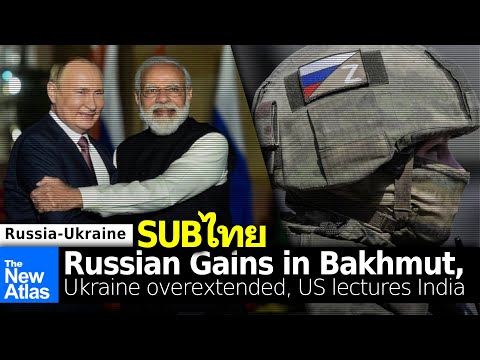
Russian Gains in Bakhmut, Ukraine Overextended, & US Lectures India

 October 17, 2022 (The New Atlas) - Update for Russian military operations against Ukraine for October 17, 2022.  Russian forces are closing...