Showing posts with label Venezuela. Show all posts

Thursday, January 24, 2019

US Regime Change in Venezuela: The Documented Evidence

January 25, 2019 (Tony Cartalucci - LD) - The Latin American nation of Venezuela faces dangerous destabilization with the United States and its allies having recognized opposition figure Juan Guaido as "president" and declaring actual Venezuelan president - Nicolas Maduro - no longer recognized.


In response, President Maduro has demanded US diplomatic personnel to leave the country.

Protests and counter-protests have reportedly taken to the streets as both sides attempt to seize the psychological and political initiative.

Why Venezuela? 

According to US Secretary of State Mike Pompeo - the impetus for Washington's sudden interest in Venezuela is the suffering of the Venezuelan people.

Reuters in their article titled, "Pompeo calls on Venezuela's Maduro to step down, urges support from military," would claim: 
In a statement, Pompeo said Washington would support opposition leader Juan Guaido as he establishes a transitional government and prepares the country for elections. 

“The Venezuelan people have suffered long enough under Nicolas Maduro’s disastrous dictatorship,” Pompeo said. “We call on Maduro to step aside in favor of a legitimate leader reflecting the will of the Venezuelan people.”  
In truth, Washington's motivation is the fact that according to The Organization of the Petroleum Exporting Countries (OPEC) - Venezuela has the largest proven oil reserves on Earth - more than Saudi Arabia and accounting for nearly a quarter of all OPEC production.


The US doesn't necessarily need this oil in terms of energy - but in terms of maintaining a US-led unipolar international order - controlling or crippling nations with large amounts of hydrocarbons prevents the emergence of a multipolar world nations across the developing world seek, led by reemerging global power - Russia - and newly emerging global power - China.

A Venezuela governed by a stable political order able to produce wealth from its massive oil reserves - and dedicated to a multipolar alternative to Washington's current international order is intolerable for Wall Street and Washington and explains the vast amount of time, energy, money, and resources the US has invested in destabilizing and overthrowing first President Hugo Chavez - with a coup attempt in 2002 - and now President Maduro. 

US Meddling in Venezuela 

Even the Western media has admitted that the US has long meddled in Venezuela's internal affairs by funding the opposition.


The UK Independent in a recent article titled, "Venezuela military chief declares loyalty to Maduro and warns US not to intervene," would admit (emphasis added):
The US has a long history of interfering with democratically elected governments in Latin America and in Venezuela it has sought to weaken the elected governments of both Mr Maduro and Mr Chavez. 

Some of the effort has been in distributing funds to opposition groups through organisations such as the National Endowment for Democracy, while some has been in the form of simple propaganda. 

Mark Weisbrot, co-director of the Centre for Economic and Policy Research in Washington, said that for the past 20 years it had been US policy to seek a change of government in Caracas. Mr Trump’s recognition of Mr Guaido was the most obvious effort to undermine the government.
The US National Endowment for Democracy's (NED) own current webpage admits to extensively interfering in every imaginable aspect of Venezuela's internal political affairs with funds directed at:
  • Building Strategic Capacity for Local Democratic Actors 
  • Cohesive Strategic Communications
  • Defending Human Rights Victims
  • Developing Tools for Agile Communication
  • Empowering Citizens through Local and National Policy Dialogue
  • Facilitating Humanitarian Aid Relief
  • Formulating a Comprehensive Public Policy Reform Package
  • Fostering Scenario Planning and Strategic Analysis
  • Fostering Small Business Enterprise in Defense of Democracy and Free Markets
  • Improving Democratic Governance in Venezuela
  • Improving Local Democratic Governance
  • Leadership Empowerment and Socio-Political Participation
  • Monitoring Human Rights Conditions
  • Monitoring the Human Rights Situation
  • Promoting Access to Justice and Public Services
  • Promoting Checks and Balances
  • Promoting Citizen Journalism
  • Promoting Citizen Participation and Freedom of Expression
  • Promoting Democratic Governance
  • Promoting Democratic Values
  • Promoting Dialogue and Reconciliation
  • Promoting Freedom of Association
  • Promoting Freedom of Expression and Access to Information
  • Promoting Human Rights
  • Promoting Independent Journalism
  • Promoting Political Engagement and Advocacy
  • Promoting the Rule of Law
It is clear that the US is funding virtually every aspect of opposition operations - from media and legal affairs, to indoctrination and political planning, to interference in the economy and the leveraging of "human rights" to shield US-funded agitators from any attempt to arrest them.

At one point during US regime change efforts, NED-funded front, Sumate, would even organize a recall referendum against President Chavez - which he won. The Washington Post in a 2006 article titled, "Chavez Government Probes U.S. Funding," would admit:
[Sumate] organized a recall referendum in 2004 that Chavez won and also is a vociferous critic of the government and the electoral system.
The article also admits that:
USAID which hired the Maryland-based company Development Alternatives Inc. to administer the grants has declined to identify many Venezuelan recipients, saying they could be intimidated or prosecuted.
While the nature of the US government's extensive meddling in Venezuela remains intentionally covert - admissions surrounding Sumate's activities illustrate how even entire referendums are organized through the use of US money and guided by US directives.

Image: Maria Corina Machado, founder of Sumate, an alleged Venezuelan election monitoring group, funded by the US National Endowment for Democracy (NED), meeting with US President George Bush who presided over the failed 2002 coup attempt seeking to oust President Hugo Chavez.
NED and other organizations operating in parallel - including convicted financial criminal George Soros' Open Society Foundations - seek to entirely overwrite Venezuelan institutions, governance, and law, replacing it with an obedient US-sponsored client regime and system of administration. 

US support is not confined to broad efforts to build up the opposition - but also specific efforts to aid senior opposition leaders.

A leaked 2004 US State Department document titled, "Status of Capriles and Sumate Cases," made it clear that NED funding was ongoing even then, and that the US State Department was required to provide aid to NED-funded front Sumate being prosecuted for the very obvious treason they were engaged in. It also illustrated US State Department support for senior opposition leader Henrique Capriles Radonski. 

Capriles - along with Leopoldo Lopez - served as mentors to current opposition leader Juan Guaido who is now openly being offered some $20 million by the US State Department in aid.

US Efforts to Cripple Venezuela's Economy 

Reuters in an article titled, "Pompeo urges regional bloc to support Venezuela's Guaido," would claim: 
[Pompeo] pledged $20 million towards humanitarian aid for Venezuela, where economic collapse, hyperinflation, and food and medicine shortages have sparked an exodus of millions of people.
The paradoxical nature of this supposed aid is that the United States had deliberately caused this economic collapse, hyperinflation, and food and medicine shortages in the first place - specifically to undermine and destabilize first President Chavez' government and now Maduro's. 

The US Treasury Department aimed sanctions specifically at (PDF) Venezuela's central bank and Petroleos de Venezuela, S.A. (PdVSA) - Venezuela's state-owned oil and gas company to restrict financing and to block transfers - while the US and allied OPEC members acted in concert to lower global oil prices - not only to cripple Venezuela's oil-based economy - but those of other US adversaries including Iran and Russia. 


While the Western media repeatedly claims US sanctions have been reserved for Venezuelan officials only, the Washington Post itself would admit in an article titled, "Venezuela’s oil gives Maduro little leverage against the United States," that (emphasis added):
"Seventy-five percent of cash-generating oil exports are coming here,” said Scott Modell, the managing director of Rapidan Energy and a former CIA officer in Latin America. Though Venezuela exports considerable amounts of crude oil to major diplomatic allies like Russia and China, almost all of the profits are used to service preexisting debts. “They don’t get cash for that, and they are desperate for cash,” Modell said. 
The article also stated:
Citgo’s ownership has long been a source of tension between the United States and Venezuela. In August 2017, the Trump administration signed an executive order that blocked the repatriation of dividends, and sanctions on Venezuelan officials have placed Citgo in an increasingly fraught position. 

Just under half of PDVSA’s shares in the company were used as collateral for a $1.5 billion loan the Venezuelan government took out from Russian energy giant Rosneft in 2016. Foreign creditors have suggested they may try to acquire parts of Citgo to service their debts. 

Modell said that there is debate in the United States about whether the U.S. government could seize the company itself. Some opposed this, arguing that Citgo should be an asset available for a post-Maduro Venezuela that could help provide a “petroeconomic recovery” for the ailing country. 

It is clear that significant efforts have been made to cripple Venezuela's ability to profit from its oil with even the US media and those it interviews admitting the US is unsure of just how far to go - realizing that once the damaging sanctions are reversed, remaining, intact infrastructure will allow Venezuela to "provide a "petroeconomic recover" for the ailing country." 

In other instances of economic warfare, large sums of Venezuelan gold have been withheld in the UK which refuses to return it to the Venezuelan government, The Times reports. 

Efforts within Venezuela through US-funded opposition groups, focus on hording certain essential goods creating artificial shortages while armed gangs hired by wealthy business and land owners ravage state-backed farmers and industries to further exasperate prices, supply, and demand.

A Washington Post article titled, "Venezuela’s paradox: People are hungry, but farmers can’t feed them," refers to the armed gangs merely as "criminals" but links to Venezuela Analysis which gives a fuller but contradictory version of events.

Venezuela Analysis' article, "Venezuelan Farmers on Disputed Land Say They Have No Intention of Vacating," depicts efforts by farmers to use land reclaimed from wealthy owners to produce agricultural goods, but who are targeted by hired mercenaries, attacked and driven off. In other cases, wealthy oligarchs are able to secure concessions from courts to consolidate control over farmlands used to produce food.

The Venezuelan government has been increasingly resorting to price controls and emergency measures to compensate in the face of overwhelming economic warfare but with varied success.


Economic destabilization is a key component in US regime change efforts - witnessed in all of Washington's past and current confrontations including against Iraq, Libya, Syria, Iran, North Korea, and Russia for an array of alleged offenses centered around "human rights" and fabricated threats to US national security.

Conversely - nations like Saudi Arabia whom even former US Secretary of State Hillary Clinton admitted is "providing clandestine financial and logistic support to ISIL and other radical Sunni groups in the region," and undeniably among the worst human rights abusers on Earth - has escaped not only sanctions, but even the most basic condemnation for its serial violations of international law and rights abuses. 

This stark contrast helps illustrate the true, politically-motivated nature of US sanctions arrayed against targeted nations with but the thinnest rhetorical veneer applied to obtain public support. 

Where even powerful nations like Russia and China must work for years to create alternatives to US-dollar domination across global finances - a nation like Venezuela already destabilized from decades of US-fomented chaos stands to suffer greatly in the face of sanctions and economic warfare - now coupled with another overt US-backed coup attempt.

Imperialism, Not "Socialism"  

Venezuela sits on an ocean of proven oil reserves. It has been openly slated for regime change by the US and has been for years with documented evidence proving the current opposition vying for power is funded by Washington, for Washington's, not Venezuela's benefit. 

Sanctions and economic warfare have been aimed at Venezuela just as the US has done with the numerous other nations it has overthrown, invaded, and otherwise destroyed - or those that it is trying to overthrow and destroy.

There is no missing puzzle piece that makes Venezuela an exception to what is another textbook case of US-backed regime change.

Attempts to claim Venezuela's crisis was precipitated by "socialism" - even if one is able to ignore the voluminous amounts of evidence proving US subversion has instead - still doesn't add up.

China is also socialist - communist in fact - with a high degree of central planning and nationalized industry. It possesses the largest high-speed rail network on Earth, has a space program with the ability to launch people into orbit, and has the world's second largest economy. 

Conversely, the US hasn't a single mile of high-speed rail, currently pays the Russian Federation to launch its astronauts into orbit, and has thoroughly squandered its place as largest global economy in pursuit of aspirations toward unrealized global domination.

There is clearly more that contributes to a nation's success or failure than being "socialist" or "capitalist" - whatever either term even really means. For Venezuela, its failures are a direct and clear result of US imperialism. And only through exposing and rolling back US meddling, can Venezuela's fortunes be reversed. 

Tuesday, August 22, 2017

Venezuela: West's Battle Against Multipolarism Reaches Far

August 22, 2017 (Tony Cartalucci - LD) - The battle between the established unipolar "international order" dominated by Wall Street, Washington, and London and an emerging multipolar order appears fixated on Eastern Europe, the Middle East, and across the entirety of Asia. However, it extends to virtually every corner of the globe, from competition in the Arctic to politically-motivated controversies in Earth orbit.

The South American nation of Venezuela also seems far-removed from this ongoing competition engulfing the world's hot spots in the Middle East, Central and Asia, but the fate of this besieged nation is directly linked to the that of the rest of the world, either contributing to an emerging multipolar world order, or providing sanctuary and legitimacy to the established unipolar order currently dominated by Wall Street, Washington, and London.


The nation has been the target of US-backed subversion for decades. The latest iteration of American interference began with the rise of Venezuelan president Hugo Chavez and a failed US-backed coup in 2002 organized to oust him and place a US-controlled client regime in power.

Venezuela's "Opposition" are US-Backed Agitators  

Many of those involved in the failed 2002 coup are now leading US-backed protesters in the streets in a bid to overthrow the government of President Nicolás Maduro, who succeeded Chavez after his death in 2013.

The opposition includes former presidential contender, Henrique Capriles Radonski, who heads Primero Justicia (Justice First) which was co-founded by Leopoldo Lopez and Julio Borges, who like Radonski, have been backed for nearly a decade by the US State Department.

Primero Justicia and the network of foreign-funded NGOs that support it have been recipients of both direct and indirect foreign support for at least just as long.

All three co-founders are US educated - Radonski having attended New York's Columbia University (Spanish), Julio Borges attending Boston College and Oxford, and Leopoldo Lopez who attended the Harvard Kennedy School of Government (KSG), of which he is considered an alumni of.

The Harvard Kennedy School, which hosts the notorious Belfer Center, includes the following faculty and alumni of Lopez, co-founder of the current US-backed opposition in Venezuela:
John P. Holdren, Samantha Power, Lawrence Summers, Robert Zoellick, (all as faculty), as well as Ban Ki-Moon ('84), Paul Volcker ('51), Robert Kagan ('91), Bill O'Reilly ('96), Klaus Schwab ('67), and literally hundreds of senators, ambassadors, and administrators of Wall Street and London's current global spanning international order. 
Harvard's Kennedy School of Government (KSG) is one of several universities that form the foundation of both creating corporate-financier driven international policy, as well as cultivating legions of administrators to execute it. This includes creating cadres of individuals to constitute Wall Street and Washington's client regimes around the world. 

Venezuela's Problem, Like Other Targeted States, is US Sedition, not "Socialism" 

It is true that Venezuela is deemed a "socialist" nation, and its policy of heavily centralizing the economy has not only failed to alleviate the many longstanding socioeconomic conflicts inflicting Venezuelan society, but has also created an ample vector for Wall Street and Washington's meddling.

By placing all of Venezuela's proverbial "eggs" in one centralized "basket," the United States - through the use of various well-honed geopolitical and socioeconomic tools - has managed to knock that "basket" from the government in Caracas' hands and is now using its well-funded and organized opposition to crush whatever "eggs" survived the fall. 


Unfortunately for Venezuela, the Western political landscape is so deeply rooted in blind, poorly developed political ideology, practical geopolitical and geostrategic analysis has been overlooked across both traditional and alternative media platforms, and instead, many - including opponents of US-backed regime change worldwide - have found themselves cheering on what they believe is the self-inflicted collapse of the socialist Venezuelan government at the hands of "free market" protesters. 

In reality, they are cheering on yet another episode of US-backed regime change, wrapped in a protective layer of ideological, political, and economic rhetoric to justify otherwise unjustifiable, extraterritorial meddling, interference, chaos, division, and destruction. 

Venezuela's Place Within the Unipolar-Mulipolar World 

Depending on the ultimate fate of the Venezuelan government, the success of US-backed proxies, and the ability of Venezuela to reconstruct itself after decades of foreign-backed subversion, Venezuela can either enhance or set back the emerging multipolar world order.

Regardless of Venezuela's fate if and when the government in Caracas is toppled, the US-led unipolar international order will benefit. The elimination of competition, even at the cost of creating a center of regional destabilization is considered favorable versus allowing a bastion of alternative socioeconomic and geopolitical power to persist. And in many ways, the creation of a regional center of destabilization may help the US create "synergies" between the chaos it is fostering in Venezuela and in neighboring South and Central American nations the US has likewise targeted for geopolitical coercion and/or regime change. 

For Russia, China, other nations of BRICS, and even emerging economies across Southeast Asia and Central Asia, the loss of Venezuela as a means of counterbalance to US hegemony both in the region of the Americas and globally will allow the US to concentrate more resources toward remaining alternative centers of geopolitical and economic power it seeks to target.

This - not the nature of Venezuela's "socialist" government - is the focus of US efforts and is what defines the consequences of either US success or failure regarding regime change in Caracas. 

Any government, socialist or otherwise, operating outside of Wall Street, Washington, and London's sphere of influence is a target. Competition, not ideology defines and drives Western foreign policy - and for those who oppose this policy - it must be practical geopolitical and geostrategic analysis that defines conclusions and courses of action - not the ideological debates the US itself is using as a pretext and as rhetorical cover to justify its latest regime-change project.

Venezuela may be geographically far removed from the focal point of the great unipolar-multipolar struggle, but understanding how it fits into conflicts raging in Eastern Europe, the Middle East, and across Asia illustrates just how encompassing the "international order's" reach and ambitions really are - and how deadly dangerous they are to global peace, security, and stability.  

Wednesday, August 2, 2017

Voting Machine Maker Says Venezuela Polls Rigged, Offers No Evidence

August 3, 2017 (Tony Cartalucci - LD) - London-based voting machine maker Smartmatic claims the recent polls carried out in Venezuela this week were rigged. In their 5 minute video statement, however, they failed to provide any evidence.


AP article titled, "Election report: Venezuela vote 'probably rigged'," claims:
The number of Venezuelans who participated in the election for an all-powerful constituent assembly was tampered with - off by at least 1 million votes - in an official count, the head of a voting technology company asserted Wednesday, a finding certain to sow further discord over the super-body that has generated months of nationwide protests. 

Smartmatic CEO Antonio Mugica said results recorded by his systems and those reported by Venezuela's National Electoral Council indicate "without any doubt" that official turnout figure of more than 8 million participants was manipulated.
Mugica, however, claims in his full statement  (video here) that (emphasis added):
Our automated election system is designed to make it evident when results are manipulated, however, there must be people auditing the system and watching for that evidence. During the National Constituent Assembly elections there were no auditors from the opposition parties as they did not want to participate.
Thus, at best Mugica and Smartmatic can warn that irregularities might have occurred, since no one from the opposition was there to audit the final tallies and report any potential inconsistencies. 


Since no opposition auditors were there, no evidence has been provided that such irregularities occurred. Neither AP's article nor Mugica's full statement provide any evidence or explanation as to how Smartmatic "estimated" the final count regarding participation was off by "one million votes." Mugica doesn't even explain whether it was one million more than reported, or one million less. 

Smartmatic either failed to reveal information it has regarding the final count, or has simply lied on behalf of the Venezuelan opposition and the powerful foreign interests sponsoring it from Washington, London, and Brussels. 

This latest announcement, absent of any evidence to substantiate these accusations, calls into question Smartmatic's professionalism, ethics, and impartiality. Other nations considering Smartmatic machines must consider the possibility that the company's CEO may attempt to use his machines and their role in tallying votes to manipulate their internal politics as well.

This announcement also once again calls the Western media into question for failing to note the very obvious inconsistencies between Mugica's conclusions and the lack of evidence provided to substantiate them. 

Sunday, July 30, 2017

US Regime Change in Venezuela: The Truth is Easy if You Follow the Money

July 31, 2017 (Tony Cartalucci - LD) - Venezuela's ongoing crisis is not driven by political ideology - it is not a battle of socialism versus capitalism or dictatorship versus democracy - it is the result of two centers of political power possessing opposing interests and colliding geopolitically.


The nation of Venezuela is currently under the control of Venezuelans who derive their support, wealth, and power from Venezuela itself - its people and its natural resource. This political order also receives aid and support from Venezuela's economic and military partners both in the region and around the globe.

The opposition opposed to the current political order and seeking to supplant it represents foreign interests and more specifically, the United States and its European allies.


The Opposition is Pro-Washington, Not "Pro-Democracy"

As early as 2002, US-backed regime change targeting then Venezuelan president Hugo Chavez, sought to violently overthrow Venezuela's political order and replace it with one obedient to Washington. Current leaders of the opposition were not only involved in the 2002 failed coup, many are documented to have received political and financial support from the United States government ever since.

Image: Maria Corina Machado, founder of Sumate, an alleged Venezuelan election monitoring group, funded by the US National Endowment for Democracy (NED), meeting with US President George Bush who presided over the failed coup attempt seeking to oust President Hugo Chavez.  

This includes several founders of the opposition party, Primero Justicia (Justice First), including Leopoldo Lopez, Julio Borges, and Henrique Capriles Radonski. The latter of the three has been prominently featured in Western media coverage lately.

US State Department documents reveal that the department itself along with US-funded fronts posing as nongovernmental organizations (NGOs) have been providing Venezuela's opposition with support.

This includes a  report titled, "Status of Capriles and Sumate Cases," referring to the above mentioned Henrique Capriles Radonski and Sumate, a US National Endowment for Democracy (NED) funded front posing as an election monitor.


Currently, NED's own website features an extensive list of activities it is engaged in within Venezuela's borders. It includes leveraging human rights for political gain, electoral manipulation, building opposition fronts, and expanding pro-opposition media. While each activity is labelled with benign titles, it is clear that none of these activities are done impartially, and as State Department documents reveal, these activities are done specifically for the benefit of the US-backed opposition.

Wall Street and Washington's Open Conspiracy 

After the death of Chavez in 2013, US-based special interests openly conspired to finally overturn the political order he built. Corporate-financier policy think tank, the American Enterprise Institute (AEI) created a checklist of US foreign policy goals it sought to achieve in Venezuela. They included:
  • The ouster of narco-kingpins who now hold senior posts in government
  • The respect for a constitutional succession
  • The adoption of meaningful electoral reforms to ensure a fair campaign environment and a transparent vote count in expected presidential elections; and
  • The dismantling of Iranian and Hezbollah networks in Venezuela
In reality, AEI is talking about dismantling entirely the obstacles that have prevented the US and the corporate-financier interests that direct it, from installing a client regime and extracting entirely Venezuela's wealth while obstructing, even dismantling the geopolitical independence and influence achieved by Chavez in Venezuela, throughout South America, and beyond.


The think tank would continue by stating:
Now is the time for US diplomats to begin a quiet dialogue with key regional powers to explain the high cost of Chávez’s criminal regime, including the impact of chavista complicity with narcotraffickers who sow mayhem in Colombia, Central America, and Mexico. Perhaps then we can convince regional leaders to show solidarity with Venezuelan democrats who want to restore a commitment to the rule of law and to rebuild an economy that can be an engine for growth in South America.
By "Venezuelan democrats," AEI means proxies created, funded, and directed by Washington, including Primero Justicia and the street mobs and paramilitary units it commands.

More recently, another Wall Street-Washington policy think tank, the Brookings Institution, would publish in a paper titled, "Venezuela: A path out of crisis," a 5-point plan toward escalating the crisis in Venezuela (emphasis added):

1. The United States could expand its assistance to countries that until now have been dependent on Venezuelan oil, as a means to decrease regional support for and dependence on the Maduro government.
2. The United States could increase monetary assistance to credible civil society organizations and nongovernmental organizations able to deliver food and medicines to Venezuelans. By doing so, the United States should make clear that international pressure aims to support democracy, not punish the Venezuelan people.
3. The United States could support efforts by the opposition in Venezuela to build an “off-ramp” that would split moderate elements of the government away from hardliners, encouraging the former to acquiesce to a transition to democracy by lowering their costs of exiting government.
4. The United States could coordinate with international institutions such as the International Monetary Fund (IMF) to offer financial incentives for holding free and fair elections in 2018, and for the opposition to unify and compete in those elections. Such coordination would also involve developing and publicizing a credible plan to restart Venezuela’s economy.
5. As a last resort, the United States could consider raising economic costs to the government through an expanded sanctions regime that aims to limit Venezuelan earnings from oil exports and block further financing. This policy is risky, given that the Maduro government would be able to more credibly shift blame for the economic crisis onto the United States, and should be accompanied by well-publicized efforts to deliver humanitarian aid through credible civil society and nongovernmental organizations.
While the Western media attempts to frame Venezuela's crisis as a result of "socialism" and "dictatorship," it is clear by reading the West's own policy papers that it is owed instead to a systematic assault on Venezuela's sociopolitical stability and economic viability, spanning decades.

Venezuela is not the first nation in South America that the United States has sought to overturn by undermining its economy.


Within the CIA's own online archives under a section titled, "CIA Activities in Chile," it is admitted that in the 1970s, similar tactics were used to undermine and overturn the government of Chile. It states specifically: (emphasis added):
According to the Church Committee report, in their meeting with CIA Director Richard Helms and Attorney General John Mitchell on 15 September 1970 President Nixon and his National Security Advisor, Henry Kissinger, directed the CIA to prevent Allende from taking power. They were “not concerned [about the] risks involved,” according to Helms’ notes. In addition to political action, Nixon and Kissinger, according to Helms’s notes, ordered steps to “make the economy scream.” 

These Cold War attitudes persisted into the Pinochet era. After Pinochet came to power, senior policymakers appeared reluctant to criticize human rights violations, taking to task US diplomats urging greater attention to the problem. US military assistance and sales grew significantly during the years of greatest human rights abuses. According to a previously released Memorandum of Conversation, Kissinger in June 1976 indicated to Pinochet that the US Government was sympathetic to his regime, although Kissinger advised some progress on human rights in order to improve Chile’s image in the US Congress. 
Considering America's extensive list of interventions, wars, and occupations it is currently involved in worldwide and the manner in which each was presented to the public - with ideology and humanitarian concerns used to manipulate public perception, and considering Venezuela's opposition is a documented recipient of US support, it is clear that yet another intervention is under way, this time in South America.

Unipolar vs Multipolar

In a world moving toward multipolarism and greater decentralization on all levels, Venezuela's collapse and a victory for Washington would undo an increasingly balanced distribution of geopolitical power - both in South and Central America, as well as across the world.

As a major oil producing nation, US control over its people and natural resources would further allow the US and its allies to manipulate energy prices toward achieving future goals - particularly in terms of encircling, isolating, and dismantling other centers of political power dependent on oil production for economic prosperity.


One needs not be a fan of "socialism" to understand that the ultimate outcome of Venezuela's collapse will be a further concentration of power in Washington and Wall Street's hands. Such power, regardless of whatever ideology it is superficially wielded behind, will always be abused. Regardless of the alleged form of government a nation may take, as long as it is a step away from unipolar globalization, it is a step in the right direction.

The crisis in Venezuela is not one of socialism versus capitalism or dictatorship versus democracy - it is one of hegemony versus national sovereignty, of centralized unipolar power versus an increasingly multipolar world.

A sovereign and independent Venezuela allowed to pursue its own destiny is one in which its own people will naturally seek to decentralize and distribute power. While the current government may not provide the ideal conditions to accomplish this, conditions under a US client regime - as US-wrecked Libya, Afghanistan, or Iraq prove - would be significantly less ideal.

For geopolitical analysts, moving away from ideological talking points and examining the actual government and opposition, their interests, associations, and funding, as well as their base motives reveals a much simpler and consistent narrative, one that any analyst could discern, and a discernment that will stand the test of scrutiny and time. Those entrenched in left/right ideology risk being betrayed by the government's floundering desperation and the true nature of an opposition that most certainly is not "capitalist" or "pro-democracy." 

Wednesday, May 24, 2017

US Policymakers Openly Plot Against Venezuela

May 24, 2017 (Tony Cartalucci - LD) - The US media has been paying increasing attention to the unfolding crisis in the South American nation of Venezuela. As the US media has done elsewhere, it is attempting to portray the unfolding crisis as a result of a corrupt dictatorship fighting against a "pro-democracy" opposition. 


In reality, it is simply a repeat of US-driven regime change aimed at toppling Venezuela's independent state institutions and replacing them with institutions created by and for US special interests. 

The "opposition" is comprised of US-backed political parties and US-funded fronts posing as nongovernmental organizations (NGOs) many of which are listed on the US State Department's National Endowment for Democracy (NED) website.

The UK Independent in a 2016 article titled, "Venezuela accuses US of plotting coup as Washington warns of 'imminent collapse'," would even admit:
...observers of the region point out that the US has a long history of seeking to interfere in the politics of Venezuela, as well as elsewhere in Latin America. 
In addition to supporting those who ousted Mr Chavez in 2002, the US poured hundreds of thousands of dollars to his opponents via the so-called National Endowment for Democracy.
To understand America's actual role amid Venezuela's unfolding crisis, one must read policy papers produced by organizations called "think tanks" which devise and promote US policy. 

The Brookings Institution is a Fortune 500-funded policy think tank. It is populated by policymakers who represent the collective ambitions of some of the world's most powerful corporate-financier interests including big-oil, defense, agricultural monopolies, pharmaceutical corporations, media interests, and more. 

Image: Just some of the Brookings Institution's corporate-financier sponsors.

Brookings and think tanks similar to it, have regularly produced policy and media guidelines later disseminated across the Western media and Western legislatures through public relations firms and lobbyists. Think tanks are where the real agenda of the West is agreed upon and promoted from.

A recent piece featured upon the Brookings Institution's website titled, "Venezuela: A path out of crisis," lays out a 5-point plan toward escalating Venezuela's already precarious situation (emphasis added): 
1. The United States could expand its assistance to countries that until now have been dependent on Venezuelan oil, as a means to decrease regional support for and dependence on the Maduro government.

2. The United States could increase monetary assistance to credible civil society organizations and nongovernmental organizations able to deliver food and medicines to Venezuelans. By doing so, the United States should make clear that international pressure aims to support democracy, not punish the Venezuelan people.

3. The United States could support efforts by the opposition in Venezuela to build an “off-ramp” that would split moderate elements of the government away from hardliners, encouraging the former to acquiesce to a transition to democracy by lowering their costs of exiting government.

4. The United States could coordinate with international institutions such as the International Monetary Fund (IMF) to offer financial incentives for holding free and fair elections in 2018, and for the opposition to unify and compete in those elections. Such coordination would also involve developing and publicizing a credible plan to restart Venezuela’s economy.

5. As a last resort, the United States could consider raising economic costs to the government through an expanded sanctions regime that aims to limit Venezuelan earnings from oil exports and block further financing. This policy is risky, given that the Maduro government would be able to more credibly shift blame for the economic crisis onto the United States, and should be accompanied by well-publicized efforts to deliver humanitarian aid through credible civil society and nongovernmental organizations.
It is a prescription for further economic isolation, US-funded political subversion, and with its reference to "a transition to democracy," an oblique call for regime change.


The US media - particularly organizations operating from under right cover - have portrayed Venezuela's economic crisis as primarily related to "socialism" and corruption. In reality, factors that would have only impeded the full realization of Venezuela's economic progress have been intentionally compounded through US sanctions, economic sabotage, and political subversion to precipitate the currently unfolding socioeconomic and humanitarian crisis.

Venezuela would not be the first nation the US targeted for economic implosion in South America.

The US Central Intelligence Agency (CIA) in its own online archives available to the public under a section titled, "CIA Activities in Chile," would admit (emphasis added):
According to the Church Committee report, in their meeting with CIA Director Richard Helms and Attorney General John Mitchell on 15 September 1970 President Nixon and his National Security Advisor, Henry Kissinger, directed the CIA to prevent Allende from taking power. They were “not concerned [about the] risks involved,” according to Helms’ notes. In addition to political action, Nixon and Kissinger, according to Helms’s notes, ordered steps to “make the economy scream.”

These Cold War attitudes persisted into the Pinochet era. After Pinochet came to power, senior policymakers appeared reluctant to criticize human rights violations, taking to task US diplomats urging greater attention to the problem. US military assistance and sales grew significantly during the years of greatest human rights abuses. According to a previously released Memorandum of Conversation, Kissinger in June 1976 indicated to Pinochet that the US Government was sympathetic to his regime, although Kissinger advised some progress on human rights in order to improve Chile’s image in the US Congress.
With violence increasing in the streets of Venezuela and many of the rhetorical tactics used to set the stage for violent  regime change and humanitarian catastrophe in Libya and Syria now being used to topple the government in Caracas - the world must get ahead of the propaganda and begin exposing this open conspiracy against yet another sovereign nation.

Venezuela's political system is for the Venezuelan people themselves to decide - without US interference. A government dominated by US-backed opposition members will leave Venezuela as an extension of US corporate-financier special interests, not an alternative or check against them This only serves in inviting further abuse by these interests not only in South America, but all around the world - Afghanistan, Syria, Iraq, Yemen, Libya, and Ukraine for example - where America's unwarranted wealth and influence is sowing instability, conflict, and catastrophe.  

Wednesday, March 6, 2013

Chavez & Thaksin: A Tale of Two Socialists and Western Hypocrisy

March 6, 2012 (LD) - Confounding was the Australian's (newspaper) recent op-ed titled, "Death of a ruthless autocrat," in regards to the late Hugo Chavez. Confounding not for the op-ed's condemnation of socialist policies or its criticism of Hugo Chavez, an obstruction to Western corporate-financier interests in South America for over a decade, but because of the obscene hypocrisy displayed throughout, from a newspaper and a corporate-financier-academic establishment in Australia that coddles a figure in nearby Thailand that is every bit as guilty of everything it accuses Chavez of.

Image: When is blood-red socialism ok (Thailand) and when is it "ruthless autocracy" (Venezuela)? The answer depends on whether or not you serve Wall Street and London's international order. Contrary to popular belief, socialism is not a unified global ideology and is instead like any tool - only as good or bad as the hands it finds itself in. The use of socialism by two governments no more indicates an affiliation than would guns in the hands of two opposing armies on a battlefield.
....

The piece begins with:
HE was lionised as a hero by the Western Left, of course, but it would be hard to find a leader in recent history who more comprehensively betrayed the wellbeing of his country than Venezuelan president Hugo Chavez. He was driven by an irrational, demagogic and self-defeating antagonism towards Washington that blinded him to his nation's best interests.
The rambling narrative of the Australian equates to condemning Venezuela for not opening itself up to Western exploitation, domination by corporate-financier monopolies, and the folly of its challenging of the West's campaign of global aggression from Mali, Libya, and Syria, to Pakistan, Afghanistan, and Iraq.


In fact, the Australian itself makes a point of condemning Chavez for his support of Saddam Hussein, who's nation was occupied by the West during a brutal 10 year war, following a decade of sanctions that in total cost the lives of over 2 million Iraqis (including half a million children) and still counting.  The Australian implies that Chavez was wrong to support Iraq, despite documented evidence that the Western assault on Iraq was waged upon a patently false pretense.

The Australian condemns Chavez' "populist economics" and ends its piece by stating:
Thumbing your nose at Washington and aligning your country with the world's worst dictatorships is a recipe for disaster. Those who come after Mr Chavez should see that and change course.
Thumbing your nose at Washington and its interests is indeed a recipe for disaster, as has been thumbing your nose at brutal empires throughout human history. Your nation will become the target of covert military operations, terrorism, political subversion, and economic sabotage, the very root of Venezuela's current malaise. Thumb your nose long and hard enough at the West, and you may even become subject to an outright invasion, as was the case in Iraq, Libya, Vietnam, and Afghanistan. Or, you may suffer a long-term proxy war, as Syria now faces. 

In reality, the Australian reveals what Hugo Chavez was really guilty of. Not of being a "ruthless autocrat," or of being a socialist, but of being independent and for having the nerve to challenge the extraterritorial interests of an increasingly violent and unhinged West.

Thaksin Shinawatra - Populist, Socialist, Ruthless Autocrat, and Darling of the West.
 
Of course, the most preposterous statement of the Australian's op-ed would easily be, "but it would be hard to find a leader in recent history who more comprehensively betrayed the wellbeing of his country than Venezuelan president Hugo Chavez." The Australian might start with Thaksin Shinawatra of Thailand, propped up and coddled by the West since the 1990's, and to this day given free passage throughout the West despite being a convicted criminal and a fugitive from the law in his native country.

The Australian's editorial board itself has lent support to his despotic, nepotist regime, currently led by his own sister, Yingluck Shinawatra, defending him as a progressive, pro-democratic force in Thailand. In a 2011 Australian news article preceding Thailand's national elections, no where is found the same venomous language directed at Chavez in describing Thaksin's own populist/socialist schemes. No mention at all is made of Thaksin's grotesque human rights record - the worst in Thai history, his intimidation of the press, and his habitual assault on any and all who challenge him.

Indeed, while the Australian calls Hugo Chavez a "ruthless autocrat," it was Thaksin Shinawatra of Thailand who mass murdered 3,000 innocent people over the course of 90 days during a so-called "war on drugs" where police were sent into the streets to conduct extrajudicial executions. It would later be determined that most of the those murdered were not even involved in the drug trade. Human Rights Watch (HRW) would confirm this in their 2008 report titled, "Thailand’s 'war on drugs'," a follow up to the much more extensive 2004 report, "Not Enough Graves."

To this day Thaksin counts his "war on drugs" as one of the many highlights of his 2001-2006 stint in office.  And while the Australian fails to remind readers of this inconvenient fact, other Western propagandists, such as the Economist, boldly defend the mass murder that took place under his ruthless regime. In its op-ed titled, "Thailand's drug wars: Back on the offensive," the Economist states: 
Faced with soaring methamphetamine abuse, Mr Thaksin ordered the police to draw up blacklists of suspected traffickers and “to act decisively and without mercy”.
The Economist would also go on to say: 
On the streets of Khlong Toey, the largest slum in Bangkok, there is nostalgia for Mr Thaksin's iron-fisted drugs policy. The 2003 crackdown drove up prices, smashed trafficking networks and forced addicts into rehabilitation programmes. In drug-ravaged communities, where the ends tend to justify the means, that was enough to turn Mr Thaksin into a hero.
The Economist finishes its op-ed by lamenting that the then military-led government which ousted Thaksin in 2006, had not kept up Thaksin's abhorrent, extrajudicial campaign of mass murder:
You might expect a military junta with sweeping powers to have kept up the fight against such illicit activity. Anti-narcotics officials say that drug seizures have risen since the military coup in September 2006.
And more recently, the Huffington Post hosted Stanley Weiss of the Business Executives for National Security (BENS) and his op-ed titled, "The Oracle of Thailand," where he praises Thaksin Shinawatra's populist-socialist policies and suggests the US would be better off if it applied his "Thaksinomics" across America. Weiss openly admits that Thaksin Shinwatra, despite being a convicted criminal and living in exile, is running the country by nepotist proxy. Yet, he defends what he considers a brilliant exploitation of Thailand's desperately poor, notoriously under-educated rural population, spinning it as:
The great innovation of Thaksin and Pansak (along with U.S.-trained academic Somkid Jatusripitak) was "the increased role of government in the allocation of credit," as Chulalongkorn University Professor Pasuk Phongpaichit writes. But not just anywhere: "Thaksinomics" focused the government's attention on the poor and rural areas of Thailand. Arguing that "a country is a company and a company is a country," the self-described "CEO Prime Minister" approached the national economy like a business, looking for ways, as Pasuk explains, to "mobilize any dormant or unexploited assets including unused natural resources and neglected human resources."

Tapping unused reserves of credit in the state banking system, the team created one rural credit fund after another. To lower household expenses, they offered low-cost housing and health insurance; provided subsidized credit for buying taxis and provided loans for children to get to school.
One might wonder how that is any different than what Hugo Chavez did in Venezuela, who also won over the population in part by using state money to subsidize his support base. The difference is simple: Hugo Chavez used socialism to co-opt the population in opposition to the Wall Street-London international order, while Thaksin Shinwatra co-opted Thailand's rural poor on behalf of Wall Street and London's interests.Weiss' BENS front is lined with representatives of America's Fortune 500 who have played a pivotal role in both Thaksin' rise to power, and his continued relevance in Thai politics.

Thaksin had been prime minister from 2001-2006. Long before Thaksin Shinwatra would become prime minister in Thailand, he was already working his way up the Wall Street-London ladder of opportunity, while simultaneously working his way up in Thai politics. He was appointed by the Carlyle Group as an adviser while holding public office, and attempted to use his connections to boost his political image. Thanong Khanthong of Thailand's English newspaper "the Nation," wrote in 2001:

"In April 1998, while Thailand was still mired in a deep economic morass, Thaksin tried to use his American connections to boost his political image just as he was forming his Thai Rak Thai Party. He invited Bush senior to visit Bangkok and his home, saying his own mission was to act as a "national matchmaker" between the US equity fund and Thai businesses. In March, he also played host to James Baker III, the US secretary of state in the senior Bush administration, on his sojourn in Thailand."
Upon becoming prime minister in 2001, Thaksin would begin paying back the support he received from his Western sponsors. In 2003, he would commit Thai troops to the US invasion of Iraq, despite widespread protests from both the Thai military and the public. Thaksin would also allow the CIA to use Thailand for its abhorrent rendition program.

In 2004, Thaksin attempted to ramrod through a US-Thailand Free-Trade Agreement (FTA) without parliamentary approval, backed by the US-ASEAN Business Council who just before 2011's elections that saw Thaksin's sister Yingluck Shinawatra brought into power, hosted the leaders of Thaksin’s "red shirt" "United Front for Democracy against Dictatorship" (UDD).


Image: The US-ASEAN Business Council, a who’s-who of corporate fascism in the US, had been approached by leaders of Thaksin Shinwatra's "red shirt" street mobs. (click image to enlarge)
….
The council in 2004 included 3M, war profiteering Bechtel, Boeing, Cargill, Citigroup, General Electric, IBM, the notorious Monsanto, and currently also includes banking houses Goldman Sachs and JP Morgan, Lockheed Martin, Raytheon, Chevron, Exxon, BP, Glaxo Smith Kline, Merck, Northrop Grumman, Monsanto’s GMO doppelganger Syngenta, as well as Phillip Morris.

Photo: Deposed autocrat, Thaksin Shinawatra before the CFR on the even of the 2006 military coup that would oust him from power. Since 2006 he has had the full, unflinching support of Washington, Wall Street and their immense propaganda machine in his bid to seize back power.
….

Thaksin would remain in office until September of 2006. On the eve of the military coup that ousted him from power, Thaksin was literally standing before the Fortune 500-funded Council on Foreign Relations giving a progress report in New York City.


Since the 2006 coup that toppled his regime, Thaksin has been represented by US corporate-financier elites via their lobbying firms including, Kenneth Adelman of the Edelman PR firm (Freedom House, International Crisis Group, PNAC), James Baker of Baker Botts (CFR), Robert Blackwill of Barbour Griffith & Rogers (CFR), Kobre & Kim, and currently Robert Amsterdam of Amsterdam & Peroff (Chatham House).

Robert Amsterdam of Amsterdam & Peroff, would also simultaneously represent Thaksin's "red shirt" UDD movement, and was present for the inaugural meeting of the so-called "academic" Nitirat group, attended mostly by pro-Thaksin red shirts (who literally wore their red shirts to the meeting). Additional support for Thaksin and his UDD street-front is provided by the US State Department via National Endowment for Democracy-funded "NGO" Prachatai."

Time to Grow Up 

It is time for the general population to refine their understanding of socioeconomic-political processes. Socialism is not an internationally unified political ideology. It is a set of tools that is only as good or as bad as the hands that wield them. And just because these tools can be found in two different hands, does not mean that both hands serve the same agenda - no more so than would guns in two opposing armies' hands indicate a mutual agenda or alliance. 

Hugo Chavez used socialism to build a support base, because if he didn't, Wall Street and London would do it themselves with their proxy opposition front in Venezuela - just as they have done in Thailand with Thaksin Shinwatra.

The proof is in the West's own narrative, where they hypocritically celebrate Thaksin Shinawatra's "Thaksinomics" while condemning Chavez' "Chavismo." It would appear that socialism is only "ok" if it is used to co-opt the population for the interests of Wall Street and London. "Thumb your nose" at the West, and it doesn't matter what socioeconomic strategy you employ, you are a "ruthless autocrat" whose days are numbered and whose memory will be immediately defiled upon your passing.   

Governments do not adhere to political ideologies, they simply use them when and where profitable. In the US where a corporate-financier oligarchy literally writes the policy for politicians on both sides of the aisle, the use of socialism and "free market" economics is done in tandem to achieve a multitude of goals that would be impossible using only one or the other. While the West itself placates its population with socialism, such policies are condemned when employed contra to their interests, especially when used to galvanize a population against Western advances - as was the case in Chavez' Venezuela.

In reality, socialism is but a single tool. An entire nation cannot be sustained upon it, no more than an entire house can be built using only a hammer. The true test of a government is not whether it uses socialism or not, but with what other tools it employs it. A nation must seek to build upon socialism's stop-gaps with sustainable, pragmatic solutions. Outside of Wall Street and London's international order, many nations are doing just that, but progress is difficult to gauge when the West arrays the summation of its influence and power against such progress.

The general population's habit of perceiving socialism, capitalism, or any other socioeconomic system as a unifying ideology is folly. The ruling elite, whichever side they stand on, do not see such systems as unifying ideologies, but merely tools. It is time for the general population to look at how these tools are used, and whose hands they are actually in, instead of fixating on the tool itself as being inherently "good" or "bad."

The story of Chavez and Thaksin illustrates the double standards and hypocrisy hidden in plain sight and casts doubts on narratives proposing anyone using "socialism" is part of a unified global cabal. Such a notion falls flat unless financial and political ties can be documented. In the case of Hugo Chavez and Venezuela, the chasm between his movement and the West's use of socialism couldn't be any deeper or wider.

Tuesday, March 5, 2013

US Plots Conquest of Venezuela in Wake of Chavez' Death

March 6, 2013 (LD) - US corporate-financier funded think-tank, the American Enterprise Institute (AEI), declared in its "post-Chávez checklist for US policymakers," that the US must move quickly to reorganize Venezuela according to US interests. Upon its checklist were "key demands":
  • The ouster of narco-kingpins who now hold senior posts in government
  • The respect for a constitutional succession
  • The adoption of meaningful electoral reforms to ensure a fair campaign environment and a transparent vote count in expected presidential elections; and
  • The dismantling of Iranian and Hezbollah networks in Venezuela
In reality, AEI is talking about dismantling entirely the obstacles that have prevented the US and the corporate-financier interests that direct it, from installing a client regime and extracting entirely Venezuela's wealth while obstructing, even dismantling the progress and geopolitical influence achieved by the late President Hugo Chavez throughout South America and beyond.

The AEI "checklist" continues by stating:
Now is the time for US diplomats to begin a quiet dialogue with key regional powers to explain the high cost of Chávez’s criminal regime, including the impact of chavista complicity with narcotraffickers who sow mayhem in Colombia, Central America, and Mexico. Perhaps then we can convince regional leaders to show solidarity with Venezuelan democrats who want to restore a commitment to the rule of law and to rebuild an economy that can be an engine for growth in South America.
Of course, by "Venezuelan democrats," AEI means Wall Street-backed  proxies like Henrique Capriles Radonski and his Primero Justicia (Justice First) political front, two entities the Western media is already gearing up to support ahead of anticipated elections.


West Has Positioned Proxies to Strip Venezuela to the Bones After Chavez' Passing

Primero Justicia (Justice First) was co-founded by Leopoldo Lopez and Julio Borges, who like Radonski, have been backed for nearly a decade by the US State Department. Primero Justicia and the network of foreign-funded NGOs that support it have been recipients of both direct and indirect foreign support for at least just as long.


Image: US State Department document (archived) illustrating the role National Endowment for Democracy (NED)-funded NGOs play in supporting US-backed opposition figures in Venezuela. The US regularly fails to transparently list who is included in extensive funding NED provides opposition groups in Venezeula, so documents like this give a rare glimpse into the names and dynamics actually involved. As was suspected, NED money is going into networks providing support for current presidential candidate, Henrique Capriles Radonski.  In this particular document, NED-funded Sumate's legal trouble is described in relation to its attempted defense of Radonski. At the time this document was written, Radonski was in jail pending trial for his role in facilitating the 2002 US-backed failed coup against President Hugo Chavez. The document may still be online at the US State Department's official website here.
....

All three co-founders are US educated - Radonski having attended New York's Columbia University (Spanish), Julio Borges attending Boston College and Oxford (Spanish), and Leopoldo Lopez who attended the Harvard Kennedy School of Government (KSG), of which he is considered an alumni of (and here).

The Harvard Kennedy School, which hosts the notorious Belfer Center, includes the following faculty and alumni of  Lopez, co-founder of the current US-backed opposition in Venezuela:

John P. Holdren, Samantha Power, Lawrence Summers, Robert Zoellick, (all as faculty), as well as Ban Ki-Moon ('84), Paul Volcker ('51), Robert Kagan ('91), Bill O'Reilly ('96), Klaus Schwab ('67), and literally hundreds of senators, ambassadors, and administrators of Wall Street and London's current global spanning international order. Harvard's Kennedy School of Government (KSG) is clearly one of several universities that form the foundation of both creating corporate-financier driven globalist-international policy, as well as cultivating legions of administrators to execute it.

To understand fully the implications of Lopez' education it helps to understand the leadership and principles guiding Harvard's mission statements, best exemplified by KSG' Belfer Center, which to this day, lends its public support to Lopez and his Primero Justicia opposition party.


Image: John P. Holdren (bearded, left), an advocate for population reduction through forced sterilization overseen by a "planetary regime," is just one of many "colorful" characters to be found within the halls of Harvard's Kennedy School of Government from which Primero Justicia co-founder Leopoldo Lopez of Venezuela graduated. To this day, KSG provides forums in support of US-backed opposition bids at seizing power in Venezuela. 
....

Named after Robert Belfer of the Belco Petroleum Corporation and later, director of the failed Enron Corporation, the Belfer Center describes itself as being "the hub of the Harvard Kennedy School's research, teaching, and training in international security affairs, environmental and resource issues, and science and technology policy." Robert Belfer still sits in as an International Council Member.

Belfer's director, Graham Allison provides an example of self-serving corporatism steering US policy. He was a founder of the Trilateral Commission, a director of the Council on Foreign Relations (CFR), a consultant to the RAND Corporation, Director of the Getty Oil Company, Natixis, Loomis Sayles, Hansberger, Taubman Centers, Inc., and Belco Oil and Gas, as well as a member of the advisory boards of Chase Bank, Chemical Bank, Hydro-Quebec, and the shady International Energy Corporation, all according to his official Belfer Center bio.

Other questionable personalities involved as Belfer alumnus are Goldman Sachs, CFR member, and former-World Bank president Robert Zoellick. Sitting on the board of directors is CFR member and former Goldman Sachs consultant, Ashton Carter. There is also former director of Citigroup and Raytheon, former Director of Central Intelligence and CFR member John Deutch, who required a pardon by Clinton to avoid prosecution over a breach of security while fumbling his duties at the CIA. Meanwhile, Nathaniel Rothschild of Atticus Capital and RIT Capital Partners, Paul Volcker of the Federal Reserve, and former DHS Secretary Michael Chertoff all serve as Belfer Center's "advisers."

Last but not least, there is John P. Holdren, also a Council on Foreign Relations member, science adviser to both President Clinton and President Obama, and co-author with Paul Ehrilich, of the now notorious "Ecoscience." When Holdren isn't brand-building for "Climate Disruption," he is dreaming of a Malthusian fueled totalitarian global government that forcibly sterilizes the world's population. He feared, erroneously, that overpopulation would be the end of humanity. He claimed in his hubris filled, fact deficient book, "The No Growth Society," that by the year 2040, the United States would have a dangerously unsustainable population of 280 million he called "much too many." The current US population is over 300 million, and despite reckless leadership and policies, it is still sustainable.

One could argue that Lopez' education is in his past, independent of his current political activities, however, the interests driving the agenda of the Belfer Center are demonstrably still backing his Primero Justicia party's bid for seizing power in Venezuela. Lopez, Radonski, and Borges are to this day still receiving substantial funding and support through NGO networks funded directly by the US State Department's National Endowment for Democracy, and is clearly favored by the Western press. Furthermore, the CFR, Heritage Foundation, and other corporate-financier driven think-tanks have all come out in support of Radonski and Primero Justicia, in their bid to "restore democracy" American-style in Venezuela.

With Chavez' passing, the names of these opposition figures will become mainstays of Western reporting ahead of anticipated elections the West is eager to have held - elections the West is well positioned to manipulate in favor of Lopez, Radonski, and Borges.

Whatever one may have thought about Venezuelan President Hugo Chavez and his policies, he nationalized his nation's oil, forcing out foreign multinational corporations, diversified his exports to reduce dependency on Western markets (with US exports at a 9 year low), and had openly opposed corporate-financier neo-imperialism across the globe. He was an obstruction to Western hegemony - an obstruction that has provoked overt, depraved jubilation from his opponents upon his death.

And while many critics are quick to claim President Chavez' policies are a "failure," it would be helpful to remember that the US, on record, has arrayed its vast resources both overtly and covertly against the Venezuelan people over the years to ensure that any system outside the West's sphere of influence inevitably fails.

Dark Days Ahead.

 Dark days indeed lay ahead for Venezuela, with the AEI "checklist" foreshadowing an "uprising," stating:
As Venezuelan democrats wage that struggle against chavismo, regional leaders must make clear that Syria-style repression will never be tolerated in the Americas. We should defend the right of Venezuelans to struggle democratically to reclaim control of their country and its future. Only Washington can make clear to Chinese, Russian, Iranian, and Cuban leaders that, yes, the United States does mind if they try to sustain an undemocratic and hostile regime in Venezuela. Any attempt to suppress their self-determination with Chinese cash, Russian arms, Iranian terrorists, or Cuban thuggery will be met with a coordinated regional response.
US military contractors and special forces had been caught operating in and around Venezuela. Just as there were warning signs in Syria years before the 2011 conflict began, the US' intentions of provoking bloodshed and regime change in Venezuela stretch back as far as 2002. Just as Syria is now facing a Western-engineered proxy war, Venezuela will too, with the AEI already declaring US plans to wage a Syria-style proxy war in South America.

The AEI also reminds readers of the West's faux-human rights, "economic development," and "democracy promotion" racket Hugo Chavez had ejected from Venezuela and displaced across parts of South America, and the West's desire to reestablish it: 
US development agencies should work with friends in the region to form a task force of private sector representatives, economists, and engineers to work with Venezuelans to identify the economic reforms, infrastructure investments, security assistance, and humanitarian aid that will be required to stabilize and rebuild that country. Of course, the expectation will be that all the costs of these activities will be borne by an oil sector restored to productivity and profitability.

Finally, we need to work with like-minded nations to reinvigorate regional organizations committed to democracy, human rights, anti-drug cooperation, and hemispheric solidarity, which have been neutered by Chávez’s destructive agenda.
 As the US openly funds, arms, and backs Al Qaeda in Syria, conducts global renditions, operates an international archipelago of torture dungeons, and is only now wrapping up a decade of subjugation and mass murder in Iraq and Afghanistan that is still claiming lives and jeopardizing the future of millions to this day, it is difficult to discern just who the AEI's target audience is. It is most likely those who can read between the lines - the corporate-financier vultures waiting for the right moment to strip Venezuela to the bone.

The fate of Venezuela lies in its people's hands. Covert destabilization must be faced by the Venezuelan people, while the alternative media must do its best to unravel the lies already being spun ahead of long-planned operations in "post-Chavez Venezuela." For the rest of us, we must  identify the corporate-financier interests driving this agenda, - interests we most likely patronize on a daily basis, and both boycott and permanently replace them to erode the unwarranted influence they have used, and will continue to use against the Venezuelan people, as well as people across the globe. 

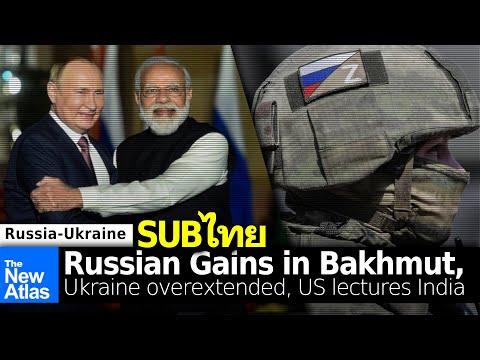
Russian Gains in Bakhmut, Ukraine Overextended, & US Lectures India

 October 17, 2022 (The New Atlas) - Update for Russian military operations against Ukraine for October 17, 2022.  Russian forces are closing...