Showing posts with label americas. Show all posts

Monday, May 23, 2022

US Multi-Domain Operations – War by Additional Means

May 23, 2022 (Brian Berletic - New Eastern OutlookThe United States has clearly transitioned militarily several times throughout its history, from the Cold War preparing to fight the Soviet Union using massive maneuver warfare to using the military that existed at the end of the Cold War to decimate the Iraqi army in the 1990’s, to shifting to a “small wars” force fighting in Afghanistan and Iraq for 20 years.


As the “War on Terror” began to fade, America’s need to pivot again to large scale conflict with peer or near-peer competitors was driven by the reemergence of Russia as a global power and the rise of China upon the global stage. In many ways the last 20 years of “small wars” was a failed attempt to encircle and contain these two competitors.

What emerged from the US Army’s Training and Doctrine Command (TRADOC) was the concept of “multi-domain operations.” Laid out in a seminal 2018 paper titled, “The U.S. Army in Multi-Domain Operations 2028,” US military planners would articulate the perceived threat:

In a new era of great power competition, our nation’s adversaries seek to achieve their strategic aims, short of conflict, by the use of layered stand-off in the political, military and economic realms to separate the U.S. from our partners. Should conflict come, they will employ multiple layers of stand-off in all domains–land, sea, air, space and cyberspace–to separate U.S. forces and our allies in time, space, and function in order to defeat us.

 To meet this threat, US military planners claim:

The central idea in solving this problem is the rapid and continuous integration of all domains of warfare to deter and prevail as we compete short of armed conflict. If deterrence fails, Army formations, operating as part of the Joint Force, penetrate and dis-integrate enemy anti-access and area denial systems; exploit the resulting freedom of maneuver to defeat enemy systems, formations and objectives and to achieve our own strategic objectives; and consolidate gains to force a return to competition on terms more favorable to the US, our allies and partners.

To achieve this, the US military is standing up what it calls “Multi-Domain Task Forces.” The 2018 paper would explain:

In 2017, the Chief of Staff of the Army (CSA) directed the design and testing of Multi-Domain Task Forces (MDTFs) as forward stationed formations able to execute aspects of MDO. Designed to deliver long-range precision joint strike as well as integrate air and missile defense, electronic warfare, space, cyber, and information operations, the MDTF operates across all domains, the EMS, and the information environment in both competition and conflict to provide the Joint Force and coalition with new capabilities to enable the defeat adversaries’ anti-access and area denial strategies. Given its capability to compete and provide an initial penetration, the MDTF, as a forerunner to other multi-domain formations now in development, is the essential first step to realizing an MDO capable Army by 2028.

MDTFs are slated to be positioned in Asia vis-a-vis China as well as in Europe vis-a-vis Russia.

Multi-Domain Operations Extends Far Beyond the US Military

The US essentially seeks global primacy by pursuing regional primacy within various US military commands. Unlike other nations who divide their own sovereign territory into multiple areas of responsibility, the US divides the entire planet into “commands” including Northern Command (NORTHCOM), Southern Command (SOUTHCOM), Africa Command (AFRICOM), European Command (EUCOM) which includes all of Russia, Central Command (CENCOM) which covers the Middle East and Central Asia, and Pacific Command (PACOM) which encompasses all of Asia including China as well as Australia and New Zealand.

Pursuing global primacy is done through what is essentially a constant state of war. War is defined by Merriam-Webster as both, “a state of usually open and declared armed hostile conflict between states or nations,” and, “a struggle or competition between opposing forces or for a particular end.” While these represent two definitions of a single word, they also represent the two possible states in which the US pursuit of global primacy exists.

The US Army’s TRADOC refers to this as “competition” and “conflict.” During both states of operation the US military along with the US government and adjacent organizations are active and it is merely what activity is taking place that defines which state the US is currently in.

This is not a new idea. It was Prussian General Carl von Clausewitz in his work, “On War,” who stated, “War is not merely a political act, but also a real political instrument, a continuation of political commerce, a carrying out of the same by other means.”

While the US military through multi-domain operations seeks to operate during “competition” and “conflict” across multiple domains (air, land, sea, space, and cyberspace), the US as a nation does this on a much larger scale, and in addition to the US military, through a large number of other organizations, agencies, departments, and even proxies and does so across a much larger number of domains – essentially across all domains.

During the “competition” phase the US seeks to “expand the competitive space.” Not only does the military play a role in doing this through its own multi-domain operations, other agencies, organizations, and institutions do as well. The National Endowment for Democracy (NED) for example, funds the creation and expansion of political forces within a targeted nation to coerce or overthrow a government to reduce “stand-off” obstacles – “stand-off” meaning anything inhibiting the US from moving anywhere on Earth or doing anything it wants while it does so.

These activities take place across a variety of domains, both physical (air, land, sea, and space) and intangible (economics, politics, information space, and cyberspace). Just as Clausewitz pointed out, the transition from “competition” to “conflict” and the means used during both is driven by a constant political end. For example, the US sought regime change in Iraq for years prior to its invasion in 2003. It used a variety of methods prior to all-out war in an attempt to accomplish this including the arming and backing of armed proxies and economic sanctions before resorting to direct military invasion itself.

Thus the US is at constant war – whether that is an actual “state of usually open and declared armed hostile conflict” with another state as was the case with Iraq from 2003 onward, or “a struggle or competition” between itself and others including its declared adversaries of Russia and China.

The latter – war as a struggle or competition – often includes hostilities conducted through proxies. The US is currently waging a proxy war against Russia in both Ukraine and Syria. While the US proxy war in Syria is primarily targeting the Syrian government for removal, it is because Syria in turn is a crucial ally of Russia.

The US is also waging hostilities against China through a number of proxies.

For years the US has backed armed separatists in Pakistan’s Baluchistan province. These militants in turn have waged a campaign of armed violence against not only Pakistani security forces but also Chinese engineers and other representatives working on the China-Pakistan Economic Corridor (CPEC) which in turn is part of Beijing’s much larger Belt and Road Initiative (BRI).

In direct war, the US would use its warplanes to bomb Chinese infrastructure across Pakistan. In this state of indirect war, the US instead uses Baluchistan-based militants to do so. While the means differ, the end is the same.

Likewise in Myanmar the US is using the so-called “National Unity Government” (NUG) and its “People’s Defense Force” (PDF) to not only wage a war of regime change against the government of Myanmar, but also to attack Chinese investments including BRI infrastructure running through Myanmar’s territory.

Were the US waging war directly against Myanmar, it would use its warplanes to strike at critical infrastructure like cellular phone towers. Instead, US-backed “PDF” fighters are targeting these towers with both explosions – as reported by Reuters in late 2021- and by simply dismantling them and carrying away the equipment. In both instances the US wants to degrade Myanmar’s infrastructure as a means of ultimately defeating the current sitting government, and in turn further isolating China, and is doing so through proxies.

Off the coast of the Chinese mainland the US is using the breakaway province of Taiwan as a staging ground for US weapons ahead of what looks like what will be another Ukraine-style proxy war.

What will eventually spur the US to shift from war in terms of indirect hostilities and other forms of competition to actual and direct armed hostilities is whether or not the US is able to achieve its end through more indirect means before resorting to more direct, but riskier and more costly means.

The implications of this reality, all but openly stated and expressed by the US through its adoption of multi-domain operations, on the national security planning of nations around the globe is profound.

National security policy cannot simply revolve around soldiers, tanks, planes, and ships. It must address all of the means the US uses to execute war be it in a state of “competition” or a state of “conflict.” The US Army’s 2018 TRADOC paper mentions multiple domains including “social media,” a seemingly benign domain that escapes the scope of most national security policy papers or even the responsibility of a nation’s national security agencies entirely. Yet it is a crucial domain through which the US wages both states of “war” it perpetually finds itself in. This is only one example of many domains that escape the attention required by national security planners.

Understanding the full-spectrum nature of the threat the US poses to the world will spur discussion and action toward a full-spectrum defense. Not only will nations then be able to keep the US perpetually in a state of “competition” disallowing it to resort to “conflict” because of sufficient credible deterrents, nations will be able to maintain favorable leverage against the United States and other nations during that state of “competition.”

Until then, nations leave themselves at great risk in an increasingly dangerous global security environment where the United States is all but openly preparing full-scale war with its peer and near-peer competitors through increasingly disruptive indirect means of warfare. Only time will tell whether nations take this threat seriously and uphold their respective responsibilities to defend against it.

Brian Berletic is a Bangkok-based geopolitical researcher and writer, especially for the online magazine “New Eastern Outlook”.

Wednesday, May 13, 2020

The Covid-19 Chronicles: USA

Author's note: This is part of The Covid-19 Chronicles Series covering how nations and regions are responding to the Coronavirus Disease 2019 (Covid-19) crisis. 

May 13, 2020 (Gunnar Ulson - NEO) - The US is claimed to be hardest hit by Covid-19 with, at the time of writing, over 80,000 deaths attributed to the virus. The nation is also suffering from socioeconomic disaster as lockdowns have driven millions of Americans into not only unemployment, but predictable poverty and hunger as a result.


The crisis has been pounced upon by special interests to help propel various sociopolitical and economic agendas rather than confront and overcome the crisis, leading many to suspect the crisis itself has been deliberately overblown.

Health Impact

At face value the US would seem to be hit by an unprecedented health crisis. Hysteria spread by the mass media focusing on the numbers of infected and dead are provided to a panicked public without context.

Indeed, over 80,000 people have so far died with infections at nearly 1.5 million (confirmed).

Yet a quick look at basic statistics provided by the US government's own Center for Disease Control (CDC) shows that Covid-19's impact on human health including total deaths has not even surpassed recent flu season burdens. For example, according to the CDC's website, the 2017-2018 flu season (running from December 2017 to March 2018) left anywhere between 46,000 to 95,000 dead.

Deaths attributed to Covid-19 have been recorded for 2 full months longer with questionable methods used to attribute Covid-19 as the cause for death.


The death rate has been reported at anywhere between 1% to as high as 5% to 6%. Missing from these seemingly concerning numbers is the fact that widespread testing has not been undertaken. The few instances where it has been done has shown that the number of infected is many times higher than official reports. This means that the death rate is much lower and more comparable to the annual flu than any sort of novel and particularly dangerous pathogen.

Testing in California and New York have revealed that in these states alone millions are likely to have been infected by Covid-19 and simply showed little to no symptoms.

A CBS article titled, "Study shows 13.9% of people tested in New York state have coronavirus antibodies, Cuomo says," admits:
New York's first survey of coronavirus antibodies shows that 13.9% of those tested in the state had coronavirus antibodies in their system, meaning they have contracted and recovered from the virus, New York Governor Andrew Cuomo said Thursday. That suggests that 2.7 million people have been infected statewide.
In other words, there are likely more people infected in New York state alone than infected nationwide according to "official" reports.

If information regarding how widespread Covid-19 actually is and how dangerous it is or isn't, is not accurate, how can the United States formulate appropriate measures to respond to the outbreak?

Measures

Despite what appears to be nothing more than a bad cold or flu, the US has ground its society to a halt with lockdowns and social distancing measures.

"Non-essential" occupations have been encouraged to work from home or to not work at all. The food and beverage industry for example, the second largest employer in the United States, has been ground to a halt with employees furloughed for what has now been weeks or even months. Many of these employees do not expect to return to work until at least June.

In Los Angeles, county officials have extended "stay at home" measures for another 3 months meaning that people will have been shut in for nearly half a year if and when in late August people are allowed to return to their normal lives!

Social distancing is being enthusiastically enforced by police around the nation. In New York City, in order to "protect" people, those not practicing social distancing have been beaten, tased and even arrested. The physical and legal damage done "saving" the public from Covid-19 appears to be more extreme than the actual threat of Covid-19 itself.

Since most New Yorkers (and most people around the entirety of the United States) likely have been infected by the virus anyway, social distancing and lockdowns are more of a psychological exercise than one of isolating the pathogen and stopping its spread, an exercise aimed at addressing public panic, but public panic deliberately fuelled by the media and the government.

Socioeconomic Impact

For the United States, a nation's whose economy was already in steep decline and losing ground to emerging economies around the globe, most notably China, these lockdowns amount to a self-inflicted mortal wound no conceivable plan of action can reverse.

Had Covid-19 been the deadly pathogen many may believe it is owed to mass media misinformation, the United States stood ill-prepared for it. This was not merely the doing of the current US administration, but a problem known for well over a decade with US presidents from George Bush Jr. to Barack Obama to current US President Donald Trump taking turns ignoring it.

The New York Times reported that things like ventilator shortages were known for at least 13 years and instead of rectifying the problem, large biomedical corporations were allowed by the US government to buy out small contractors tasked with fixing the shortage and ending programs to develop cheap ventilators in order to maintain artificial scarcity and the high prices (and profits) associated with it.

While Covid-19 appears to be far less dangerous than claimed by the mass media, the impact of measures taken by the US government and local state governments has created what is a disaster now being compared to the Great Depression.

Rather than rectifying it by simply rolling back lockdowns and social distancing measures, or even finding ways to aid the millions left unemployed, special interests are taking turns exploiting the crisis by blaming political opponents or even international competitors (like China). They are also looking for ways to cash in, with America's deeply corrupt pharmaceutical industry being the most prominent example already teeing up massive profiteering by offering "vaccines" to solve Covid-19 fears.

The US, rather than uniting and overcoming whatever Covid-19 actually is, be it a pathogen or an unprecedented wave of widespread panic, has instead allowed itself to become divided and distracted, as well as exposed to the very worst sort of socioeconomic predators lurking amid America's economic and political landscape.

It is difficult to predict what will happen in the weeks, months and even years to come regarding the state of America socioeconomically considering just how widespread and deep the damage being done now is. A nation as large as the United States plunging so quickly has never historically boded well for that nation nor the world it finds itself free falling in. The US already faced many challenges regarding its decline both at home economically and abroad geopolitically.

Covid-19 has simply exposed and accelerated the process, compounding an already uncertain future with a new degree of damage, danger and desperation.

Gunnar Ulson, a New York-based geopolitical analyst and writer especially for the online magazine “New Eastern Outlook”. 

Monday, December 9, 2019

The American Empire Will Fall, Not America Itself

December 12, 2019 (Gunnar Ulson - NEO) - The collapse of an entire nation is as spectacular as it is rare. For a nation to simply cease to exist it must suffer such absolute defeat across the entire spectrum of what constitutes a nation; economically, militarily, culturally, socially and politically.


What is much more common is a transition from existing, prevailing socioeconomic, political and military orders to new ones driven by new, emerging special interests. It can happen quickly and violently, or take place as a long-term process with ups and downs and both constructive and destructive processes intertwining.

For the United States, a massive nation with the third largest population on the planet, the largest military and still currently the largest economy, for it to suffer such full-spectrum defeat is impossible.

What is not impossible is for the small handful of special interests currently directing US policy foreign and domestic, to find itself displaced by a new order consisting of entirely different kinds of special interests and, hopefully, special interests that better reflect the best interests of the United States as a whole and function more sustainably among the nations of the world rather than hovering above them.

It is a process that is already ongoing.

America's Prevailing Order is Fading 

The current special interests driving US foreign and domestic policy are centered around Wall Street and Washington and represent an increasingly unrealistic, unsustainable, archaic network based on traditional banking, energy and manufacturing monopolies.

Many of the tools used by these special interests to maintain and expand their power and influence including mass media, extensive lobbying, networks dedicated to political subversion abroad and political distractions at home find themselves increasingly ineffective as both the American people and nations around the globe become increasingly familiar with them and as they begin developing effective countermeasures.

While US special interests dedicate a seemingly immense amount of time countering "Russian" or "Chinese" "propaganda," it is primarily alternative media from the United States and its partner nations that have done the most to expose and diminish the unwarranted influence wielded from Wall Street and Washington. Wikileaks is a prime example of this.

As America's elite and their networks weaken, alternatives continue to grow stronger.

An unsustainable socioeconomic and political model, coupled with equally unsustainable military campaigns abroad along with a political and media strategy that is no longer even remotely convincing even to casual observers demarks what is an irreversible decline of America's current, prevailing order.

America's Elite Face Challenges from Within as Well as From Abroad

The topic of Chinese corporations out-competing long-established US monopolies has become an increasingly common topic across global media. It is indeed this process that has precipitated the seemingly pointless and futile US-led trade war against China, a futile exercise that seems to only highlight the decline of America's established elite rather than address it.

Corporations like Huawei, despite facing serious setbacks owed to US sanctions and efforts to undermine them, still move forward, while their US competitors continue to struggle. This is because despite setbacks, Huawei is built upon a solid foundation of business and economic fundamentals, while its American counterparts, despite their initial advantages owed to a lack of competition, have neglected and continue to neglect such fundamentals.

But Chinese corporations aren't the only challengers America's established elite face.

Within the US itself some of the most innovative and disruptive companies in the world are cropping up, challenging not only foreign competition but also long-established monopolies based in the US.


Electric vehicle manufacturer Tesla is a perfect example of this. Its breakneck pace of innovation, high-profile successes and the disruptive impact it is having on traditional car manufacturing is setting back the American car industry first and foremost. It also poses a serious threat to the petroleum-centric energy model the US has adopted and propagated globally for over a century.


American car manufacturing monopolies have spent decades developing a model of planned obsolescence and marketing gimmicks as a stand-in for genuine consumer value and innovation. The industry has become a means of simply making as much money as possible and to increase profits each year, with "making cars" merely the means through which this money and the influence it buys is being accumulated.

Tesla has for years now been growing both in terms of business and in terms of sociopolitical influence. US car manufacturing monopolies have attempted to ape the most superficial aspects of Tesla's appeal, but have entirely failed to examine or replicate the substance that drives the new company's success.

Just as the US elite have attempted to use what could be described as "dirty tricks" rather than direct competition to deal with competitors like Huawei abroad, similar "dirty tricks" have been employed against disruptive companies within the US itself like Tesla. Attempts by faux-unions to complicate Tesla's US-based factories are one example of this.

US-based aerospace manufacturer SpaceX is another example of an American-bred competitor directly challenging (and threatening) long-established US monopolies, in this case aerospace monopolies like Lockheed Martin, Boeing and Northrop Grumman.


SpaceX is not only driving aerospace innovation forward at breakneck speeds, it is driving down the overall cost of access to space at the same time. It is doing this at such impressive rates that established aerospace monopolies like Lockheed, Boeing and Northrop, even with their immense lobbying networks, are unable to dissuade SpaceX customers (including the US government itself) from purchasing rides on its rockets.

Bloated monopolies who have become overly reliant on maintaining profits through lobbying and political games have little means to overhaul their massive organizations in the face of real competition as it emerges. Because of this, the prevailing order driving US policy faces an insurmountable obstacle that already appears to have resulted in terminal decline and displacement.

Those doing the displacing stand to assume the position at the levers of American power and influence, with an opportunity to set an entirely new course into the future that will have a fundamental impact on both the American nation and its people, and the nations of the world it will interact with.

America's New Order May Seek Genuine Competition and Collaboration 

Tesla and SpaceX are prominent examples, but by no means the only examples of the ongoing transition that is increasingly evident within America. There are emerging innovations and companies threatening virtually every area America's current elite dominate. From the alternative media targeting the deeply rooted corporate media of America, to a growing movement of local organic farmers chipping away at America's massive agricultural monopolies, there are already many tangible examples of a transition taking place; a positive transition that those interested in truly addressing the negative aspects of America's current role globally can invest in or contribute toward.

In what is perhaps a hopeful sign of the new America that might emerge as this process continues forward is the fact that emerging disruptors like Tesla are not afraid of collaborating with other nations, seeking to simply do business rather than construct a global spanning network aimed at dominating others. Tesla's massive Gigafactory going into operation in Shanghai, China takes place as the US attempts to sever China's access to the economic benefits of doing business with the US for purely political and hegemonic purposes.

Despite the apparent hostilities between the US and nations like Russia and China, the consensus in nations targeted by America's current prevailing order is one of simply wanting to do business on equal terms. Whatever hostility may exist is reserved not for America as a nation or as a people, but toward the handful of special interests obstructing constructive competition and collaboration between these nations and the US.

In the near to intermediate future, this process will continue to resemble a bitter struggle as US special interests attempt to maintain their grip on power, fighting against inevitable decline and displacement, and against competitors both abroad and within the US itself.

Beyond that, there is a hopeful future where the US finds itself a constructive member of a multipolar world, constructively competing against and collaborating with nations rather than attempting to assert itself over them.

Because of this, it is important for nations and peoples to refrain from unnecessary, broad hostilities and to instead patiently weather current efforts emanating from Wall Street and Washington. It is important to establish ties and relations with US interests genuinely interested in true competition and collaboration and who represent America's future, and to distinguish them from deeply rooted US interests that represent America's abusive past and and are responsible for America's current decline.

The foreign policies of Moscow, Beijing and even of many emerging and developing nations may seem overly passive or appeasing, but around the capitals of the world many are aware of the transition taking place in America and are attempting to position themselves advantageously for the fall of the American Empire so they can do business with those who assume the levers of power in America once it does.

Gunnar Ulson, a New York-based geopolitical analyst and writer especially for the online magazine “New Eastern Outlook”. 

Monday, September 11, 2017

September 11, 2001: Questions to Ask if You Still Believe the Official Narrative

September 11, 2017 (Tony Cartalucci - LD) - The attacks of September 11, 2001 (9/11) left nearly 3,000 dead in NYC, Washington D.C. and over Pennsylvania. The attacks transformed America into a deepening police state at home and a nation perpetually at war abroad.


The official narrative claims that 19 hijackers representing Al Qaeda took over 4 commercial aircraft to carry out attacks on New York City's World Trade Center and the Pentagon in Washington D.C.

The event served as impetus for the invasion and occupation of Afghanistan which continues to present day. It also led directly to the invasion and occupation of Iraq. Attempts to cite the attack to precipitate a war with Iran and other members of the so-called "Axis of Evil" (Libya, Syria, North Korea, and Cuba) have also been made.

And if this is the version of reality one subscribes to, several questions remain worth asking.

1. Can the similarities between 9/11 and plans drawn up by the US Department of Defense (DoD) and Joint Chiefs of Staff (JCS) in 1962 under the code name "Operation Northwoods" be easily dismissed? 

The US DoD and JCS wrote a detailed plan almost identical to the 9/11 attacks as early as 1962 called "Operation Northwoods" where the US proposed hijacking commercial airliners, committing terrorist attacks, and blaming Cuba to justify a US military intervention.


Far from a fringe conspiracy theory, mainstream media outlets including ABC News would cover the document in articles like, "U.S. Military Wanted to Provoke War With Cuba," which would report:
In the early 1960s, America's top military leaders reportedly drafted plans to kill innocent people and commit acts of terrorism in U.S. cities to create public support for a war against Cuba. 

Code named Operation Northwoods, the plans reportedly included the possible assassination of Cuban émigrés, sinking boats of Cuban refugees on the high seas, hijacking planes, blowing up a U.S. ship, and even orchestrating violent terrorism in U.S. cities. 

The plans were developed as ways to trick the American public and the international community into supporting a war to oust Cuba's then new leader, communist Fidel Castro.

A full PDF copy of the document is available via George Washington University's archives and states specifically regarding the hijacking of commercial aircraft:

An aircraft at Eglin AFB would be painted and numbered as an exact duplicate for a civil registered aircraft belonging to a CIA proprietary organization in the Miami area. At a designated time the duplicate would be substituted for the actual civil aircraft and would be loaded with the selected passengers, all boarded under carefully prepared aliases. The actual registered aircraft would be converted to a drone. 
The document also cites the USS Maine in describing the sort of event the DoD-JCS sought to stage, a US warship whose destruction was used to maliciously provoke the Spanish-American War. It should be noted, that unlike the DoD-JCS document's suggestion that airliner-related casualties be staged, the USS Maine explosion killed 260 sailors. It is likely that DoD and JCS would not risk engineering a provocation that leads to major war but allow low-level operators left alive with the knowledge of what they had participated in.

Considering that the US sought to deceive the public in order to provoke an unjustifiable war that would undoubtedly kill thousands or tens of thousands of innocent people, and that other proposals did include killing innocent people, it is worth considering that US policymakers would also be just as willing to extinguish innocent lives when staging the hijacking of aircraft to provoke such a war.

2. Why did US policymakers draw up extensive plans to reassert US global hegemony - including regime change in Afghanistan, Iraq, Iran, Libya, Somalia, Sudan, and Yemen - without any conceivable pretext until 9/11 conveniently unfolded? 

In 2000, US policymakers from the Project for a New American Century (PNAC) sought a sweeping plan to reassert America as a global hegemon. In a 90-page document titled, "Rebuilding America's Defense: Strategy, Forces and Resources For a New Century" (PDF), a strategy for maintaining what it called "American military preeminence" would be laid out in detail.


It involved global moves the United States - in 2000 - could never justify, including placing US troops in Southeast Asia, building a global missile defense network prohibited by treaties signed during the Cold War, and the containment of developing nations that would eventually end up rolling back US global hegemony in the near future, including Iran, Iraq, China, North Korea, Libya, and Syria.


The report noted the difficulties of proposing and executing the transformations necessary to achieve the objectives laid out in the document. It would be explicitly stated that:

Further, the process of transformation, even if it brings revolutionary change, is likely to be a long one, absent some catastrophic and catalyzing event – like a new Pearl Harbor. 
In fact, the entire body of the document is an uncanny description of the post-9/11 "international order," an order unimaginable had the events of 9/11 not transpired.

It should also be remembered that wars predicated on 9/11 like the invasion and occupation of Afghanistan, were admittedly planned before 9/11 took place.

The Guardian in its 2004 article, "Bush team 'agreed plan to attack the Taliban the day before September 11'," would report:
The day before the September 11 attacks, the Bush administration agreed on a plan to oust the Taliban regime in Afghanistan by force if it refused to hand over Osama bin Laden, according to a report by a bipartisan commission of inquiry. The report pointed out that agreement on the plan, which involved a steady escalation of pressure over three years, had been repeatedly put off by the Clinton and Bush administrations, despite the repeated failure of attempts to use diplomatic and economic pressure.

While it seems inconceivable that the American or global public would tolerate the multi-trillion dollar 16 year war that the invasion of Afghanistan has become without the attacks on 9/11, such a war was admittedly in the making - in fact - years before 9/11 unfolded.


Similarly, the invasion of Iraq in 2003 was strongly linked to the aftermath of 9/11, but was likewise decided upon long before 9/11 unfolded.

CNN in its article, "O'Neill: Bush planned Iraq invasion before 9/11," would report:

The Bush administration began planning to use U.S. troops to invade Iraq within days after the former Texas governor entered the White House three years ago, former Treasury Secretary Paul O'Neill told CBS News' 60 Minutes.
This echos similar statements made by US Army General Wesley Clark who repeatedly warned that the US sought global-spanning war post-Cold War to assert its hegemony over the planet, and fully sought to use 9/11 as a pretext to do it.

General Clark would list seven nations slated for regime change post 9/11, including Iraq, Iran, Libya, Somalia, Sudan, and Yemen - all nations now either at war or facing war with the United States and its proxies - or in the case of Libya - entirely divided and destroyed in the wake of US military operations.

3. If primarily Saudi hijackers with Saudi money and Saudi organization perpetrated the attacks of 9/11, why has the United States waged war or threatened war with every nation in the Middle East except Saudi Arabia and its allies? 

Not only has the United States made no moves against Saudi Arabia for its apparent role in the 9/11 attacks - spanning the administrations of US President George Bush, Barack Obama, and Donald Trump - the United States has sold Saudi Arabia billions in arms, provided military support and protection to Saudi Arabia's military and government, partnered with Saudi Arabia in its ongoing conflict with Yemen - all while US government documents and leaked e-mails between US politicians reveal Saudi Arabia is still a state sponsor of Al Qaeda - the organization officially blamed for the 9/11 attacks.


Indeed, a 2012 US Defense Intelligence Agency (DIA) report would explicitly admit:
If the situation unravels there is the possibility of establishing a declared or undeclared Salafist principality in eastern Syria (Hasaka and Der Zor), and this is exactly what the supporting powers to the opposition want, in order to isolate the Syrian regime, which is considered the strategic depth of the Shia expansion (Iraq and Iran).
The DIA memo then explains exactly who this "Salafist principality's" supporters are:
The West, Gulf countries, and Turkey support the opposition; while Russia, China, and Iran support the regime.
This "Salafist principality" is now known as the "Islamic State," an affiliate of Al Qaeda still operating with significant state sponsorship everywhere from Syria, Iraq, and Libya, to the Philippines and beyond.

Coincidentally, Saudi-armed and funded terrorists in the Philippines has served as a pretext for US military assets to begin expanding their presence in Southeast Asia, just as the aforementioned 2000 PNAC document had sought.

Additionally, in a 2014 e-mail between US Counselor to the President John Podesta and former US Secretary of State Hillary Clinton, it would be admitted that two of America's closest regional allies - Saudi Arabia and Qatar - were providing financial and logistical support to the Islamic State.

The e-mail, leaked to the public through Wikileaks, stated:

...we need to use our diplomatic and more traditional intelligence assets to bring pressure on the governments of Qatar and Saudi Arabia, which are providing clandestine financial and logistic support to [the Islamic State] and other radical Sunni groups in the region.
While the e-mail portrays the US in a fight against the very "Salafist" (Islamic) "principality" (State) it sought to create and use as a strategic asset in 2012, the fact that Saudi Arabia and Qatar are both acknowledged as state sponsors of the terrorist organization - and are both still enjoying immense military, economic, and political support from the United States and its European allies - indicates just how disingenuous America's "war on terror" really is. 
If the US truly believed Al Qaeda carried out the deadly attacks of 9/11, why does it count among its closest allies two of Al Qaeda's largest and most prolific state sponsors?

Together - by honestly answering these three questions - we are left considering the very real possibility that 9/11 was not a terrorist attack carried out by foreign terrorists, but rather an attack engineered by special interests within the United States itself.

If we reject that conclusion, we must ask ourselves why the US DoD and JCS would take the time to draft plans for false flag attacks if they did not believe they were viable options US policymakers might seriously consider. At the very least we must ask why those at the DoD and JCS could be caught signing and dating a conspiracy to commit unspeakable terrorism to justify an unjust war and not only avoid criminal charges, but remain employed within the US government.

We must also ask ourselves why US policymakers would draft long-term plans for reasserting American global hegemony without any conceivable pretext to justify such plans. Even in the wake of 9/11, the US government found it difficult to sell the invasion of Iraq to the American public and its allies. Without 9/11, such salesmanship would have been impossible. In Syria - with 9/11 disappearing into the distant past - US regime change efforts have all but stalled.  

Finally, we must find adequate explanations as to why those sponsoring the supposed perpetrators of 9/11 have remained recipients of unwavering American support, weapon sales, and both political and military protection. We must attempt to answer why militants fighting in Syria under the banner of Al Qaeda have been able to openly operate out of NATO-member Turkey's territory for the past 6 years, side-by-side US Central Intelligence Agency (CIA) personnel who are admittedly fueling the conflict with weapons, money, and training "accidentally" ending up in Al Qaeda's hands.

It is clear - that at the very least - the official narrative in no shape, form, or way adds up. If the official narrative doesn't add up, what does?

Tuesday, August 22, 2017

Venezuela: West's Battle Against Multipolarism Reaches Far

August 22, 2017 (Tony Cartalucci - LD) - The battle between the established unipolar "international order" dominated by Wall Street, Washington, and London and an emerging multipolar order appears fixated on Eastern Europe, the Middle East, and across the entirety of Asia. However, it extends to virtually every corner of the globe, from competition in the Arctic to politically-motivated controversies in Earth orbit.

The South American nation of Venezuela also seems far-removed from this ongoing competition engulfing the world's hot spots in the Middle East, Central and Asia, but the fate of this besieged nation is directly linked to the that of the rest of the world, either contributing to an emerging multipolar world order, or providing sanctuary and legitimacy to the established unipolar order currently dominated by Wall Street, Washington, and London.


The nation has been the target of US-backed subversion for decades. The latest iteration of American interference began with the rise of Venezuelan president Hugo Chavez and a failed US-backed coup in 2002 organized to oust him and place a US-controlled client regime in power.

Venezuela's "Opposition" are US-Backed Agitators  

Many of those involved in the failed 2002 coup are now leading US-backed protesters in the streets in a bid to overthrow the government of President Nicolás Maduro, who succeeded Chavez after his death in 2013.

The opposition includes former presidential contender, Henrique Capriles Radonski, who heads Primero Justicia (Justice First) which was co-founded by Leopoldo Lopez and Julio Borges, who like Radonski, have been backed for nearly a decade by the US State Department.

Primero Justicia and the network of foreign-funded NGOs that support it have been recipients of both direct and indirect foreign support for at least just as long.

All three co-founders are US educated - Radonski having attended New York's Columbia University (Spanish), Julio Borges attending Boston College and Oxford, and Leopoldo Lopez who attended the Harvard Kennedy School of Government (KSG), of which he is considered an alumni of.

The Harvard Kennedy School, which hosts the notorious Belfer Center, includes the following faculty and alumni of Lopez, co-founder of the current US-backed opposition in Venezuela:
John P. Holdren, Samantha Power, Lawrence Summers, Robert Zoellick, (all as faculty), as well as Ban Ki-Moon ('84), Paul Volcker ('51), Robert Kagan ('91), Bill O'Reilly ('96), Klaus Schwab ('67), and literally hundreds of senators, ambassadors, and administrators of Wall Street and London's current global spanning international order. 
Harvard's Kennedy School of Government (KSG) is one of several universities that form the foundation of both creating corporate-financier driven international policy, as well as cultivating legions of administrators to execute it. This includes creating cadres of individuals to constitute Wall Street and Washington's client regimes around the world. 

Venezuela's Problem, Like Other Targeted States, is US Sedition, not "Socialism" 

It is true that Venezuela is deemed a "socialist" nation, and its policy of heavily centralizing the economy has not only failed to alleviate the many longstanding socioeconomic conflicts inflicting Venezuelan society, but has also created an ample vector for Wall Street and Washington's meddling.

By placing all of Venezuela's proverbial "eggs" in one centralized "basket," the United States - through the use of various well-honed geopolitical and socioeconomic tools - has managed to knock that "basket" from the government in Caracas' hands and is now using its well-funded and organized opposition to crush whatever "eggs" survived the fall. 


Unfortunately for Venezuela, the Western political landscape is so deeply rooted in blind, poorly developed political ideology, practical geopolitical and geostrategic analysis has been overlooked across both traditional and alternative media platforms, and instead, many - including opponents of US-backed regime change worldwide - have found themselves cheering on what they believe is the self-inflicted collapse of the socialist Venezuelan government at the hands of "free market" protesters. 

In reality, they are cheering on yet another episode of US-backed regime change, wrapped in a protective layer of ideological, political, and economic rhetoric to justify otherwise unjustifiable, extraterritorial meddling, interference, chaos, division, and destruction. 

Venezuela's Place Within the Unipolar-Mulipolar World 

Depending on the ultimate fate of the Venezuelan government, the success of US-backed proxies, and the ability of Venezuela to reconstruct itself after decades of foreign-backed subversion, Venezuela can either enhance or set back the emerging multipolar world order.

Regardless of Venezuela's fate if and when the government in Caracas is toppled, the US-led unipolar international order will benefit. The elimination of competition, even at the cost of creating a center of regional destabilization is considered favorable versus allowing a bastion of alternative socioeconomic and geopolitical power to persist. And in many ways, the creation of a regional center of destabilization may help the US create "synergies" between the chaos it is fostering in Venezuela and in neighboring South and Central American nations the US has likewise targeted for geopolitical coercion and/or regime change. 

For Russia, China, other nations of BRICS, and even emerging economies across Southeast Asia and Central Asia, the loss of Venezuela as a means of counterbalance to US hegemony both in the region of the Americas and globally will allow the US to concentrate more resources toward remaining alternative centers of geopolitical and economic power it seeks to target.

This - not the nature of Venezuela's "socialist" government - is the focus of US efforts and is what defines the consequences of either US success or failure regarding regime change in Caracas. 

Any government, socialist or otherwise, operating outside of Wall Street, Washington, and London's sphere of influence is a target. Competition, not ideology defines and drives Western foreign policy - and for those who oppose this policy - it must be practical geopolitical and geostrategic analysis that defines conclusions and courses of action - not the ideological debates the US itself is using as a pretext and as rhetorical cover to justify its latest regime-change project.

Venezuela may be geographically far removed from the focal point of the great unipolar-multipolar struggle, but understanding how it fits into conflicts raging in Eastern Europe, the Middle East, and across Asia illustrates just how encompassing the "international order's" reach and ambitions really are - and how deadly dangerous they are to global peace, security, and stability.  

Wednesday, August 2, 2017

Voting Machine Maker Says Venezuela Polls Rigged, Offers No Evidence

August 3, 2017 (Tony Cartalucci - LD) - London-based voting machine maker Smartmatic claims the recent polls carried out in Venezuela this week were rigged. In their 5 minute video statement, however, they failed to provide any evidence.


AP article titled, "Election report: Venezuela vote 'probably rigged'," claims:
The number of Venezuelans who participated in the election for an all-powerful constituent assembly was tampered with - off by at least 1 million votes - in an official count, the head of a voting technology company asserted Wednesday, a finding certain to sow further discord over the super-body that has generated months of nationwide protests. 

Smartmatic CEO Antonio Mugica said results recorded by his systems and those reported by Venezuela's National Electoral Council indicate "without any doubt" that official turnout figure of more than 8 million participants was manipulated.
Mugica, however, claims in his full statement  (video here) that (emphasis added):
Our automated election system is designed to make it evident when results are manipulated, however, there must be people auditing the system and watching for that evidence. During the National Constituent Assembly elections there were no auditors from the opposition parties as they did not want to participate.
Thus, at best Mugica and Smartmatic can warn that irregularities might have occurred, since no one from the opposition was there to audit the final tallies and report any potential inconsistencies. 


Since no opposition auditors were there, no evidence has been provided that such irregularities occurred. Neither AP's article nor Mugica's full statement provide any evidence or explanation as to how Smartmatic "estimated" the final count regarding participation was off by "one million votes." Mugica doesn't even explain whether it was one million more than reported, or one million less. 

Smartmatic either failed to reveal information it has regarding the final count, or has simply lied on behalf of the Venezuelan opposition and the powerful foreign interests sponsoring it from Washington, London, and Brussels. 

This latest announcement, absent of any evidence to substantiate these accusations, calls into question Smartmatic's professionalism, ethics, and impartiality. Other nations considering Smartmatic machines must consider the possibility that the company's CEO may attempt to use his machines and their role in tallying votes to manipulate their internal politics as well.

This announcement also once again calls the Western media into question for failing to note the very obvious inconsistencies between Mugica's conclusions and the lack of evidence provided to substantiate them. 

Sunday, July 30, 2017

US Regime Change in Venezuela: The Truth is Easy if You Follow the Money

July 31, 2017 (Tony Cartalucci - LD) - Venezuela's ongoing crisis is not driven by political ideology - it is not a battle of socialism versus capitalism or dictatorship versus democracy - it is the result of two centers of political power possessing opposing interests and colliding geopolitically.


The nation of Venezuela is currently under the control of Venezuelans who derive their support, wealth, and power from Venezuela itself - its people and its natural resource. This political order also receives aid and support from Venezuela's economic and military partners both in the region and around the globe.

The opposition opposed to the current political order and seeking to supplant it represents foreign interests and more specifically, the United States and its European allies.


The Opposition is Pro-Washington, Not "Pro-Democracy"

As early as 2002, US-backed regime change targeting then Venezuelan president Hugo Chavez, sought to violently overthrow Venezuela's political order and replace it with one obedient to Washington. Current leaders of the opposition were not only involved in the 2002 failed coup, many are documented to have received political and financial support from the United States government ever since.

Image: Maria Corina Machado, founder of Sumate, an alleged Venezuelan election monitoring group, funded by the US National Endowment for Democracy (NED), meeting with US President George Bush who presided over the failed coup attempt seeking to oust President Hugo Chavez.  

This includes several founders of the opposition party, Primero Justicia (Justice First), including Leopoldo Lopez, Julio Borges, and Henrique Capriles Radonski. The latter of the three has been prominently featured in Western media coverage lately.

US State Department documents reveal that the department itself along with US-funded fronts posing as nongovernmental organizations (NGOs) have been providing Venezuela's opposition with support.

This includes a  report titled, "Status of Capriles and Sumate Cases," referring to the above mentioned Henrique Capriles Radonski and Sumate, a US National Endowment for Democracy (NED) funded front posing as an election monitor.


Currently, NED's own website features an extensive list of activities it is engaged in within Venezuela's borders. It includes leveraging human rights for political gain, electoral manipulation, building opposition fronts, and expanding pro-opposition media. While each activity is labelled with benign titles, it is clear that none of these activities are done impartially, and as State Department documents reveal, these activities are done specifically for the benefit of the US-backed opposition.

Wall Street and Washington's Open Conspiracy 

After the death of Chavez in 2013, US-based special interests openly conspired to finally overturn the political order he built. Corporate-financier policy think tank, the American Enterprise Institute (AEI) created a checklist of US foreign policy goals it sought to achieve in Venezuela. They included:
  • The ouster of narco-kingpins who now hold senior posts in government
  • The respect for a constitutional succession
  • The adoption of meaningful electoral reforms to ensure a fair campaign environment and a transparent vote count in expected presidential elections; and
  • The dismantling of Iranian and Hezbollah networks in Venezuela
In reality, AEI is talking about dismantling entirely the obstacles that have prevented the US and the corporate-financier interests that direct it, from installing a client regime and extracting entirely Venezuela's wealth while obstructing, even dismantling the geopolitical independence and influence achieved by Chavez in Venezuela, throughout South America, and beyond.


The think tank would continue by stating:
Now is the time for US diplomats to begin a quiet dialogue with key regional powers to explain the high cost of Chávez’s criminal regime, including the impact of chavista complicity with narcotraffickers who sow mayhem in Colombia, Central America, and Mexico. Perhaps then we can convince regional leaders to show solidarity with Venezuelan democrats who want to restore a commitment to the rule of law and to rebuild an economy that can be an engine for growth in South America.
By "Venezuelan democrats," AEI means proxies created, funded, and directed by Washington, including Primero Justicia and the street mobs and paramilitary units it commands.

More recently, another Wall Street-Washington policy think tank, the Brookings Institution, would publish in a paper titled, "Venezuela: A path out of crisis," a 5-point plan toward escalating the crisis in Venezuela (emphasis added):

1. The United States could expand its assistance to countries that until now have been dependent on Venezuelan oil, as a means to decrease regional support for and dependence on the Maduro government.
2. The United States could increase monetary assistance to credible civil society organizations and nongovernmental organizations able to deliver food and medicines to Venezuelans. By doing so, the United States should make clear that international pressure aims to support democracy, not punish the Venezuelan people.
3. The United States could support efforts by the opposition in Venezuela to build an “off-ramp” that would split moderate elements of the government away from hardliners, encouraging the former to acquiesce to a transition to democracy by lowering their costs of exiting government.
4. The United States could coordinate with international institutions such as the International Monetary Fund (IMF) to offer financial incentives for holding free and fair elections in 2018, and for the opposition to unify and compete in those elections. Such coordination would also involve developing and publicizing a credible plan to restart Venezuela’s economy.
5. As a last resort, the United States could consider raising economic costs to the government through an expanded sanctions regime that aims to limit Venezuelan earnings from oil exports and block further financing. This policy is risky, given that the Maduro government would be able to more credibly shift blame for the economic crisis onto the United States, and should be accompanied by well-publicized efforts to deliver humanitarian aid through credible civil society and nongovernmental organizations.
While the Western media attempts to frame Venezuela's crisis as a result of "socialism" and "dictatorship," it is clear by reading the West's own policy papers that it is owed instead to a systematic assault on Venezuela's sociopolitical stability and economic viability, spanning decades.

Venezuela is not the first nation in South America that the United States has sought to overturn by undermining its economy.


Within the CIA's own online archives under a section titled, "CIA Activities in Chile," it is admitted that in the 1970s, similar tactics were used to undermine and overturn the government of Chile. It states specifically: (emphasis added):
According to the Church Committee report, in their meeting with CIA Director Richard Helms and Attorney General John Mitchell on 15 September 1970 President Nixon and his National Security Advisor, Henry Kissinger, directed the CIA to prevent Allende from taking power. They were “not concerned [about the] risks involved,” according to Helms’ notes. In addition to political action, Nixon and Kissinger, according to Helms’s notes, ordered steps to “make the economy scream.” 

These Cold War attitudes persisted into the Pinochet era. After Pinochet came to power, senior policymakers appeared reluctant to criticize human rights violations, taking to task US diplomats urging greater attention to the problem. US military assistance and sales grew significantly during the years of greatest human rights abuses. According to a previously released Memorandum of Conversation, Kissinger in June 1976 indicated to Pinochet that the US Government was sympathetic to his regime, although Kissinger advised some progress on human rights in order to improve Chile’s image in the US Congress. 
Considering America's extensive list of interventions, wars, and occupations it is currently involved in worldwide and the manner in which each was presented to the public - with ideology and humanitarian concerns used to manipulate public perception, and considering Venezuela's opposition is a documented recipient of US support, it is clear that yet another intervention is under way, this time in South America.

Unipolar vs Multipolar

In a world moving toward multipolarism and greater decentralization on all levels, Venezuela's collapse and a victory for Washington would undo an increasingly balanced distribution of geopolitical power - both in South and Central America, as well as across the world.

As a major oil producing nation, US control over its people and natural resources would further allow the US and its allies to manipulate energy prices toward achieving future goals - particularly in terms of encircling, isolating, and dismantling other centers of political power dependent on oil production for economic prosperity.


One needs not be a fan of "socialism" to understand that the ultimate outcome of Venezuela's collapse will be a further concentration of power in Washington and Wall Street's hands. Such power, regardless of whatever ideology it is superficially wielded behind, will always be abused. Regardless of the alleged form of government a nation may take, as long as it is a step away from unipolar globalization, it is a step in the right direction.

The crisis in Venezuela is not one of socialism versus capitalism or dictatorship versus democracy - it is one of hegemony versus national sovereignty, of centralized unipolar power versus an increasingly multipolar world.

A sovereign and independent Venezuela allowed to pursue its own destiny is one in which its own people will naturally seek to decentralize and distribute power. While the current government may not provide the ideal conditions to accomplish this, conditions under a US client regime - as US-wrecked Libya, Afghanistan, or Iraq prove - would be significantly less ideal.

For geopolitical analysts, moving away from ideological talking points and examining the actual government and opposition, their interests, associations, and funding, as well as their base motives reveals a much simpler and consistent narrative, one that any analyst could discern, and a discernment that will stand the test of scrutiny and time. Those entrenched in left/right ideology risk being betrayed by the government's floundering desperation and the true nature of an opposition that most certainly is not "capitalist" or "pro-democracy." 

Friday, June 16, 2017

US Election Meddling: Smoke and Mirrors

June 16, 2017 (Ulson Gunnar - NEO) - For a magician, the greater the illusion attempted, the more showmanship that's required to distract audiences from that fact that it is indeed just an illusion. For US politics, something very similar applies, particularly regarding the latest, ongoing narrative surrounding alleged Russian meddling in the 2016 US presidential election.


Having concluded over half a year ago, had there been actual evidence of state-sponsored election interference by Russia, it would have surfaced and the necessity for a lengthy and dramatic public spectacle would not only be absent, it would obstruct real measures needed to protect America's political process from future foreign influence.

However, actual evidence has not surfaced.

Instead, complex conspiracy theories buttressed by the most tenuous documentation have been spun and promoted in the midst of public hearings, political rearrangements in the White House and other theatrics designed to keep the public engaged and convinced of the notion that Russia's government actually attempted to manipulate the results of America's presidential election.

However, the entire spectacle and the narrative driving it, is based entirely on the assumption that Russia's government believes the office of US President is of significant importance enough so as to risk meddling in it in the first place. It also means that Russia believed the office of US President was so important to influence, that the substantial political fallout and consequences if caught were worth the risk.

In reality, as US President Donald Trump has thoroughly demonstrated, the White House holds little to no sway regarding US foreign policy.

While President Trump promised during his campaign leading up to the 2016 election cooperation with Russia, a withdrawal from undermining and overthrowing the government in Damascus, Syria and a reversal of decades of US support for the government of Saudi Arabia, he now finds himself presiding over an administration continuing to build up military forces on Russia's borders in Eastern Europe, is currently and repeatedly killing Syrian soldiers in Syria and has sealed a record arms deal with Saudi Arabia amounting to over 110 billion US dollars.

It is clear that the foreign policy executed by US President George Bush, continued by President Barack Obama and set to continue under US presidential candidate Hillary Clinton, is instead being faithfully executed by President Trump.

Any and all efforts to skew the electoral process either through leaked e-mails or through hacking electronic voting machines would have carried a political risk that far outweighed what is clearly a negligible outcome.

Cui Bono? 

For US foreign and domestic policy, however, the grand illusion of Russia meddling in America's political process helps in at least three fundamental ways.

First, it provides a distraction for the American public. While President Trump continues the policies of previous administrations in the service of the unelected special interests that actually determine and benefit from US foreign policy, the "US election meddling" narrative provides a diversion that prevents President Trump's backtracking and hypocrisy from taking precedence in public debates.

Second, creating hysteria over the possibility that a foreign nation might have interfered with America's political process helps reinforce the illusion that America's political process is legitimate and meaningful in the first place. It buttresses the notion that America's destiny is determined by the electorate and the representatives it puts in office, not the multi-billion dollar multi-national corporations and financial institutions that lobby America's legislative bodies and place their representatives within each presidential cabinet regardless of who the American public vote into office.


And third, accusing Russia of interfering in America's political process helps perpetuate the adversarial nature of US-Russian relations, justifying the continued existence and expansion of NATO and all of the conflicts it both fuels and feeds off of. In addition to geopolitical objectives, this process reaps billions in defense contracts and opens up new potential markets for US corporations and financial institutions.

Ultimately, the co-opting or elimination of Russian competitors across a multitude of industries globally would give existing US monopolies and even tighter grip on the planet, its resources and its people.


For Russia who already faces an all but openly declared policy of encirclement, containment and undermining by the US, including crippling economic sanctions and an array of politically subversive (not to mention ironic) activities sponsored openly by the US through fronts like the National Endowment for Democracy (NED), excuses like alleged Russian meddling in America's presidential election only gives Washington continued apparent justification for its incremental efforts toward taking apart Russia as a reemerging world power.

Accusations of foreign meddling amid the domestic political affairs of a sovereign nation are serious. However, evidence is required not only to level accusations against a nation for doing so, but are essential before undertaking subsequent measures against the accused nation. While the United States openly manipulates the political processes of nations worldwide through organizations like NED which literally creates and directs opposition parties globally, it has failed to produce convincing evidence or even assign a rational motive regarding its accusations against Russia.

Were Russia determined to challenge American hegemony worldwide, it would not do it by interfering in an already rigged and irrelevant US election, but by creating alternatives to the industrial, military, financial and institutional monopolies the US uses globally to achieve, maintain and expand hegemony. Russia is already doing this, which is why the US seeks justification for confronting Moscow, revealing the true culprits and motive behind the "US election meddling" narrative.

Ulson Gunnar, a New York-based geopolitical analyst and writer especially for the online magazine “New Eastern Outlook”.  

Wednesday, May 24, 2017

US Policymakers Openly Plot Against Venezuela

May 24, 2017 (Tony Cartalucci - LD) - The US media has been paying increasing attention to the unfolding crisis in the South American nation of Venezuela. As the US media has done elsewhere, it is attempting to portray the unfolding crisis as a result of a corrupt dictatorship fighting against a "pro-democracy" opposition. 


In reality, it is simply a repeat of US-driven regime change aimed at toppling Venezuela's independent state institutions and replacing them with institutions created by and for US special interests. 

The "opposition" is comprised of US-backed political parties and US-funded fronts posing as nongovernmental organizations (NGOs) many of which are listed on the US State Department's National Endowment for Democracy (NED) website.

The UK Independent in a 2016 article titled, "Venezuela accuses US of plotting coup as Washington warns of 'imminent collapse'," would even admit:
...observers of the region point out that the US has a long history of seeking to interfere in the politics of Venezuela, as well as elsewhere in Latin America. 
In addition to supporting those who ousted Mr Chavez in 2002, the US poured hundreds of thousands of dollars to his opponents via the so-called National Endowment for Democracy.
To understand America's actual role amid Venezuela's unfolding crisis, one must read policy papers produced by organizations called "think tanks" which devise and promote US policy. 

The Brookings Institution is a Fortune 500-funded policy think tank. It is populated by policymakers who represent the collective ambitions of some of the world's most powerful corporate-financier interests including big-oil, defense, agricultural monopolies, pharmaceutical corporations, media interests, and more. 

Image: Just some of the Brookings Institution's corporate-financier sponsors.

Brookings and think tanks similar to it, have regularly produced policy and media guidelines later disseminated across the Western media and Western legislatures through public relations firms and lobbyists. Think tanks are where the real agenda of the West is agreed upon and promoted from.

A recent piece featured upon the Brookings Institution's website titled, "Venezuela: A path out of crisis," lays out a 5-point plan toward escalating Venezuela's already precarious situation (emphasis added): 
1. The United States could expand its assistance to countries that until now have been dependent on Venezuelan oil, as a means to decrease regional support for and dependence on the Maduro government.

2. The United States could increase monetary assistance to credible civil society organizations and nongovernmental organizations able to deliver food and medicines to Venezuelans. By doing so, the United States should make clear that international pressure aims to support democracy, not punish the Venezuelan people.

3. The United States could support efforts by the opposition in Venezuela to build an “off-ramp” that would split moderate elements of the government away from hardliners, encouraging the former to acquiesce to a transition to democracy by lowering their costs of exiting government.

4. The United States could coordinate with international institutions such as the International Monetary Fund (IMF) to offer financial incentives for holding free and fair elections in 2018, and for the opposition to unify and compete in those elections. Such coordination would also involve developing and publicizing a credible plan to restart Venezuela’s economy.

5. As a last resort, the United States could consider raising economic costs to the government through an expanded sanctions regime that aims to limit Venezuelan earnings from oil exports and block further financing. This policy is risky, given that the Maduro government would be able to more credibly shift blame for the economic crisis onto the United States, and should be accompanied by well-publicized efforts to deliver humanitarian aid through credible civil society and nongovernmental organizations.
It is a prescription for further economic isolation, US-funded political subversion, and with its reference to "a transition to democracy," an oblique call for regime change.


The US media - particularly organizations operating from under right cover - have portrayed Venezuela's economic crisis as primarily related to "socialism" and corruption. In reality, factors that would have only impeded the full realization of Venezuela's economic progress have been intentionally compounded through US sanctions, economic sabotage, and political subversion to precipitate the currently unfolding socioeconomic and humanitarian crisis.

Venezuela would not be the first nation the US targeted for economic implosion in South America.

The US Central Intelligence Agency (CIA) in its own online archives available to the public under a section titled, "CIA Activities in Chile," would admit (emphasis added):
According to the Church Committee report, in their meeting with CIA Director Richard Helms and Attorney General John Mitchell on 15 September 1970 President Nixon and his National Security Advisor, Henry Kissinger, directed the CIA to prevent Allende from taking power. They were “not concerned [about the] risks involved,” according to Helms’ notes. In addition to political action, Nixon and Kissinger, according to Helms’s notes, ordered steps to “make the economy scream.”

These Cold War attitudes persisted into the Pinochet era. After Pinochet came to power, senior policymakers appeared reluctant to criticize human rights violations, taking to task US diplomats urging greater attention to the problem. US military assistance and sales grew significantly during the years of greatest human rights abuses. According to a previously released Memorandum of Conversation, Kissinger in June 1976 indicated to Pinochet that the US Government was sympathetic to his regime, although Kissinger advised some progress on human rights in order to improve Chile’s image in the US Congress.
With violence increasing in the streets of Venezuela and many of the rhetorical tactics used to set the stage for violent  regime change and humanitarian catastrophe in Libya and Syria now being used to topple the government in Caracas - the world must get ahead of the propaganda and begin exposing this open conspiracy against yet another sovereign nation.

Venezuela's political system is for the Venezuelan people themselves to decide - without US interference. A government dominated by US-backed opposition members will leave Venezuela as an extension of US corporate-financier special interests, not an alternative or check against them This only serves in inviting further abuse by these interests not only in South America, but all around the world - Afghanistan, Syria, Iraq, Yemen, Libya, and Ukraine for example - where America's unwarranted wealth and influence is sowing instability, conflict, and catastrophe.  

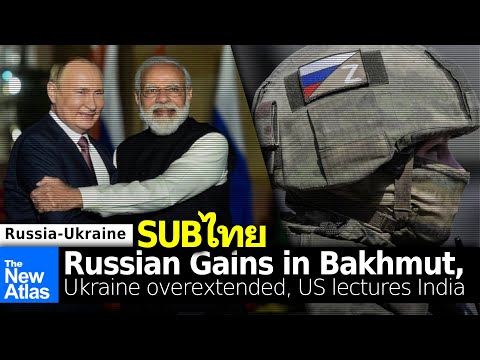
Russian Gains in Bakhmut, Ukraine Overextended, & US Lectures India

 October 17, 2022 (The New Atlas) - Update for Russian military operations against Ukraine for October 17, 2022.  Russian forces are closing...