Showing posts with label UnconventionalWarfare. Show all posts

Monday, May 23, 2022

US Multi-Domain Operations – War by Additional Means

May 23, 2022 (Brian Berletic - New Eastern Outlook) The United States has clearly transitioned militarily several times throughout its history, from the Cold War preparing to fight the Soviet Union using massive maneuver warfare to using the military that existed at the end of the Cold War to decimate the Iraqi army in the 1990’s, to shifting to a “small wars” force fighting in Afghanistan and Iraq for 20 years.


As the “War on Terror” began to fade, America’s need to pivot again to large scale conflict with peer or near-peer competitors was driven by the reemergence of Russia as a global power and the rise of China upon the global stage. In many ways the last 20 years of “small wars” was a failed attempt to encircle and contain these two competitors.

What emerged from the US Army’s Training and Doctrine Command (TRADOC) was the concept of “multi-domain operations.” Laid out in a seminal 2018 paper titled, “The U.S. Army in Multi-Domain Operations 2028,” US military planners would articulate the perceived threat:

In a new era of great power competition, our nation’s adversaries seek to achieve their strategic aims, short of conflict, by the use of layered stand-off in the political, military and economic realms to separate the U.S. from our partners. Should conflict come, they will employ multiple layers of stand-off in all domains–land, sea, air, space and cyberspace–to separate U.S. forces and our allies in time, space, and function in order to defeat us.

 To meet this threat, US military planners claim:

The central idea in solving this problem is the rapid and continuous integration of all domains of warfare to deter and prevail as we compete short of armed conflict. If deterrence fails, Army formations, operating as part of the Joint Force, penetrate and dis-integrate enemy anti-access and area denial systems; exploit the resulting freedom of maneuver to defeat enemy systems, formations and objectives and to achieve our own strategic objectives; and consolidate gains to force a return to competition on terms more favorable to the US, our allies and partners.

To achieve this, the US military is standing up what it calls “Multi-Domain Task Forces.” The 2018 paper would explain:

In 2017, the Chief of Staff of the Army (CSA) directed the design and testing of Multi-Domain Task Forces (MDTFs) as forward stationed formations able to execute aspects of MDO. Designed to deliver long-range precision joint strike as well as integrate air and missile defense, electronic warfare, space, cyber, and information operations, the MDTF operates across all domains, the EMS, and the information environment in both competition and conflict to provide the Joint Force and coalition with new capabilities to enable the defeat adversaries’ anti-access and area denial strategies. Given its capability to compete and provide an initial penetration, the MDTF, as a forerunner to other multi-domain formations now in development, is the essential first step to realizing an MDO capable Army by 2028.

MDTFs are slated to be positioned in Asia vis-a-vis China as well as in Europe vis-a-vis Russia.

Multi-Domain Operations Extends Far Beyond the US Military

The US essentially seeks global primacy by pursuing regional primacy within various US military commands. Unlike other nations who divide their own sovereign territory into multiple areas of responsibility, the US divides the entire planet into “commands” including Northern Command (NORTHCOM), Southern Command (SOUTHCOM), Africa Command (AFRICOM), European Command (EUCOM) which includes all of Russia, Central Command (CENCOM) which covers the Middle East and Central Asia, and Pacific Command (PACOM) which encompasses all of Asia including China as well as Australia and New Zealand.

Pursuing global primacy is done through what is essentially a constant state of war. War is defined by Merriam-Webster as both, “a state of usually open and declared armed hostile conflict between states or nations,” and, “a struggle or competition between opposing forces or for a particular end.” While these represent two definitions of a single word, they also represent the two possible states in which the US pursuit of global primacy exists.

The US Army’s TRADOC refers to this as “competition” and “conflict.” During both states of operation the US military along with the US government and adjacent organizations are active and it is merely what activity is taking place that defines which state the US is currently in.

This is not a new idea. It was Prussian General Carl von Clausewitz in his work, “On War,” who stated, “War is not merely a political act, but also a real political instrument, a continuation of political commerce, a carrying out of the same by other means.”

While the US military through multi-domain operations seeks to operate during “competition” and “conflict” across multiple domains (air, land, sea, space, and cyberspace), the US as a nation does this on a much larger scale, and in addition to the US military, through a large number of other organizations, agencies, departments, and even proxies and does so across a much larger number of domains – essentially across all domains.

During the “competition” phase the US seeks to “expand the competitive space.” Not only does the military play a role in doing this through its own multi-domain operations, other agencies, organizations, and institutions do as well. The National Endowment for Democracy (NED) for example, funds the creation and expansion of political forces within a targeted nation to coerce or overthrow a government to reduce “stand-off” obstacles – “stand-off” meaning anything inhibiting the US from moving anywhere on Earth or doing anything it wants while it does so.

These activities take place across a variety of domains, both physical (air, land, sea, and space) and intangible (economics, politics, information space, and cyberspace). Just as Clausewitz pointed out, the transition from “competition” to “conflict” and the means used during both is driven by a constant political end. For example, the US sought regime change in Iraq for years prior to its invasion in 2003. It used a variety of methods prior to all-out war in an attempt to accomplish this including the arming and backing of armed proxies and economic sanctions before resorting to direct military invasion itself.

Thus the US is at constant war – whether that is an actual “state of usually open and declared armed hostile conflict” with another state as was the case with Iraq from 2003 onward, or “a struggle or competition” between itself and others including its declared adversaries of Russia and China.

The latter – war as a struggle or competition – often includes hostilities conducted through proxies. The US is currently waging a proxy war against Russia in both Ukraine and Syria. While the US proxy war in Syria is primarily targeting the Syrian government for removal, it is because Syria in turn is a crucial ally of Russia.

The US is also waging hostilities against China through a number of proxies.

For years the US has backed armed separatists in Pakistan’s Baluchistan province. These militants in turn have waged a campaign of armed violence against not only Pakistani security forces but also Chinese engineers and other representatives working on the China-Pakistan Economic Corridor (CPEC) which in turn is part of Beijing’s much larger Belt and Road Initiative (BRI).

In direct war, the US would use its warplanes to bomb Chinese infrastructure across Pakistan. In this state of indirect war, the US instead uses Baluchistan-based militants to do so. While the means differ, the end is the same.

Likewise in Myanmar the US is using the so-called “National Unity Government” (NUG) and its “People’s Defense Force” (PDF) to not only wage a war of regime change against the government of Myanmar, but also to attack Chinese investments including BRI infrastructure running through Myanmar’s territory.

Were the US waging war directly against Myanmar, it would use its warplanes to strike at critical infrastructure like cellular phone towers. Instead, US-backed “PDF” fighters are targeting these towers with both explosions – as reported by Reuters in late 2021- and by simply dismantling them and carrying away the equipment. In both instances the US wants to degrade Myanmar’s infrastructure as a means of ultimately defeating the current sitting government, and in turn further isolating China, and is doing so through proxies.

Off the coast of the Chinese mainland the US is using the breakaway province of Taiwan as a staging ground for US weapons ahead of what looks like what will be another Ukraine-style proxy war.

What will eventually spur the US to shift from war in terms of indirect hostilities and other forms of competition to actual and direct armed hostilities is whether or not the US is able to achieve its end through more indirect means before resorting to more direct, but riskier and more costly means.

The implications of this reality, all but openly stated and expressed by the US through its adoption of multi-domain operations, on the national security planning of nations around the globe is profound.

National security policy cannot simply revolve around soldiers, tanks, planes, and ships. It must address all of the means the US uses to execute war be it in a state of “competition” or a state of “conflict.” The US Army’s 2018 TRADOC paper mentions multiple domains including “social media,” a seemingly benign domain that escapes the scope of most national security policy papers or even the responsibility of a nation’s national security agencies entirely. Yet it is a crucial domain through which the US wages both states of “war” it perpetually finds itself in. This is only one example of many domains that escape the attention required by national security planners.

Understanding the full-spectrum nature of the threat the US poses to the world will spur discussion and action toward a full-spectrum defense. Not only will nations then be able to keep the US perpetually in a state of “competition” disallowing it to resort to “conflict” because of sufficient credible deterrents, nations will be able to maintain favorable leverage against the United States and other nations during that state of “competition.”

Until then, nations leave themselves at great risk in an increasingly dangerous global security environment where the United States is all but openly preparing full-scale war with its peer and near-peer competitors through increasingly disruptive indirect means of warfare. Only time will tell whether nations take this threat seriously and uphold their respective responsibilities to defend against it.

Brian Berletic is a Bangkok-based geopolitical researcher and writer, especially for the online magazine “New Eastern Outlook”.

Saturday, April 20, 2013

NYT: FBI Hatches Terror Plots

NYT reports in 2012 FBI's habit of fabricating terror attacks to make high-profile arrests - now Boston suspects' family claims sons were led every step of the way by the FBI. 


April 21, 2013 (LD) - In an April 2012 New York Times article titled, "Terrorist Plots, Hatched by the F.B.I.," it is revealed that many of the high-profile terror attacks foiled by the FBI, were in fact fabricated from start to finish by the FBI itself. The article states:
The United States has been narrowly saved from lethal terrorist plots in recent years — or so it has seemed. A would-be suicide bomber was intercepted on his way to the Capitol; a scheme to bomb synagogues and shoot Stinger missiles at military aircraft was developed by men in Newburgh, N.Y.; and a fanciful idea to fly explosive-laden model planes into the Pentagon and the Capitol was hatched in Massachusetts.

But all these dramas were facilitated by the F.B.I., whose undercover agents and informers posed as terrorists offering a dummy missile, fake C-4 explosives, a disarmed suicide vest and rudimentary training. Suspects naïvely played their parts until they were arrested. 
The report would also reveal that a fabricated, then foiled attack in Portland in 2010, even included a van and an inert bomb parked next to a real crowd of thousands during the city's annual Christmas tree lighting ceremony:
When an Oregon college student, Mohamed Osman Mohamud, thought of using a car bomb to attack a festive Christmas-tree lighting ceremony in Portland, the F.B.I. provided a van loaded with six 55-gallon drums of “inert material,” harmless blasting caps, a detonator cord and a gallon of diesel fuel to make the van smell flammable. An undercover F.B.I. agent even did the driving, with Mr. Mohamud in the passenger seat. To trigger the bomb the student punched a number into a cellphone and got no boom, only a bust.
Indeed, the only missing ingredient separating Portland from Boston, was the FBI's decision of what to fill the 55-gallon drums with. (For more details on other FBI cases, see: FBI's History of Handing "Terror Suspects" Live Explosives)

The NYT piece continues, describing how the FBI picks its targets:
Typically, the stings initially target suspects for pure speech — comments to an informer outside a mosque, angry postings on Web sites, e-mails with radicals overseas — then woo them into relationships with informers, who are often convicted felons working in exchange for leniency, or with F.B.I. agents posing as members of Al Qaeda or other groups.
The article also explains how some targets "seem ambivalent, incompetent and adrift, like hapless wannabes looking for a cause that the informer or undercover agent skillfully helps them find." Disturbingly, the NYT reports what appears to be the coaxing of one target toward violence they would otherwise never have considered:
“He was searching for answers within his Islamic faith,” said his lawyer, Clinton W. Calhoun III, who has appealed his conviction. “And this informant, I think, twisted that search in a really pretty awful way, sort of misdirected Cromitie in his search and turned him towards violence.”
A year after the NYT article was written, the Boston Marathon would be attacked by two explosive devices, killing three and injuring many more. The suspects, Tamerlan Tsarnaev and brother Dzhokar Tsarnaev, would be announced by the FBI a day after a bizarre press conference cancellation and a security scare at the federal courthouse where a suspect was allegedly being brought.

An explanation for the FBI's bizarre behavior may be owed to the fact that it now turns out that at least one of the suspects in the Boston bombing had caught the attention of Russian investigators in 2011 who then contacted the FBI to investigate the matter. The FBI would indeed interview Tamerlan Tsarnaev, several family members, and conduct investigations into Tsarnaev's background, phone conversations, and Internet activity. This was all finally disclosed on April 19, 2013 in an official statement that can be found on FBI.gov:
The two individuals believed to be responsible for the Boston Marathon bombings on Monday have been positively identified as Tamerlan Tsarnaev, now deceased, and Dzhokar Tsarnaev, now in custody. These individuals are brothers and residents of Massachusetts. Tamerlan Tsarnaev was a legal permanent resident and Dzhokar Tsarnaev is a naturalized U.S. citizen. Charges have not yet been filed against Dzhokar Tsarnaev and he is presumed innocent. 
Tamerlan Tsarnaev, age 26, was previously designated as Suspect 1, wearing a black hat. Dzhokar A. Tsarnaev, age 19, was designated as Suspect 2, wearing a white hat. Both were born in Kyrgyzstan.
Once the FBI learned the identities of the two brothers today, the FBI reviewed its records and determined that in early 2011, a foreign government asked the FBI for information about Tamerlan Tsarnaev. The request stated that it was based on information that he was a follower of radical Islam and a strong believer, and that he had changed drastically since 2010 as he prepared to leave the United States for travel to the country’s region to join unspecified underground groups.
In response to this 2011 request, the FBI checked U.S. government databases and other information to look for such things as derogatory telephone communications, possible use of online sites associated with the promotion of radical activity, associations with other persons of interest, travel history and plans, and education history. The FBI also interviewed Tamerlan Tsarnaev and family members. The FBI did not find any terrorism activity, domestic or foreign, and those results were provided to the foreign government in the summer of 2011. The FBI requested but did not receive more specific or additional information from the foreign government.
The FBI's bizarre behavior grew more suspicious when CBS reported that initially the FBI denied it had any prior contact with the Tsarnaev's. In their report, "CBS News: FBI Interviewed Tamerlan Tsarnaev 2 Years Ago," CBS claimed:
CBS News reports although the FBI initially denied contacting Tsarnaev, the brothers’ mother said they had in an interview with Russia Today.
That interview with Russia Today, in an article titled, "'They were set up, FBI followed them for years'- Tsarnaevs' mother to RT," stated of the suspects' mother:
But her biggest suspicion surrounding the case was the constant FBI surveillance she said her family was subjected to over the years. She is surprised that having been so stringent with the entire family, the FBI had no idea the sons were supposedly planning a terrorist act.
She would say of the FBI to Russia Today: 
“They used to come [to our] home, they used to talk to me…they were telling me that he [the older, 26-y/o Tamerlan] was really an extremist leader and that they were afraid of him. They told me whatever information he is getting, he gets from these extremist sites… they were controlling him, they were controlling his every step…and now they say that this is a terrorist act! Never ever is this true, my sons are innocent!”

Additionally, the suspects' uncle, Ruslan Tsarni, told NBC news in an article titled, "Uncle: Mentors 'radicalized' older Boston bombing suspect," that:
"I strongly believe they were just puppets and executors of something of bigger scale."

“There certainly were mentors. I was shocked when I heard his words, his phrases, when every other word he starts sticking in words of God. I question what he’s doing for work, (and) he claimed he would just put everything in the will of God. It was a big concern to me. He called me 'confused' when I started explaining to him, make yourself useful to yourself and to your family and maybe you’ll have extra to share with everybody else.

"It wasn’t devotion, it was something, as it’s called, being radicalized. Not understanding what he is talking (about). He is just using words for the sake of the words and not understanding the meaning of it.’’
Perhaps, these two young suspects were "looking for a cause," that an "informer or undercover agent skillfully helped them find." 

Clearly now, it is confirmed by the FBI itself, in an official statement found on their website, that they did indeed contacted the suspect and his family. The FBI also claims it, "did not find any terrorism activity, domestic or foreign,"  but clearly there must have been some evidence of at least some "pure speech — comments to an informer outside a mosque, angry postings on Web sites, e-mails with radicals overseas."

The FBI refuses to elaborate on the case, prompting even journalists across the mainstream media to ask important questions. Business Insider's article, "The FBI Needs To Explain Why It Failed To Monitor Boston Bombing Suspect Despite A Clear Warning," asks the following questions:
  • Given the explicit warning, why didn't the FBI continue to monitor Tsarnaev?
  • Why didn't the FBI follow up with the foreign government when it didn't get the additional information it requested?
  • How common is a warning from a foreign government about a specific person like this? Does the FBI get thousands of them?
  • What made the FBI effectively clear Tsarnaev — and what might the FBI change  to avoid making this mistake again?
  • Will the FBI conduct a full investigation into what happened?
The answer to these questions may help answer what transpired between 2011 when the FBI allegedly closed the case, and the 2013 bombings - including answering whether or not the Tsarnaev brothers were part of yet another FBI entrapment. Perhaps such suspicion may seem unwarranted, after all, despite the FBI fabricating terror attacks, they averted them before being carried out...

But at least one undercover operation, in 1993, was carried out to deadly effect. FBI agents, according to the New York Times, were indeed overseeing the bombers that detonated a device killing six and wounding many more at the World Trade Center. In their article, "Tapes Depict Proposal to Thwart Bomb Used in Trade Center Blast," NYT reported:
Law-enforcement officials were told that terrorists were building a bomb that was eventually used to blow up the World Trade Center, and they planned to thwart the plotters by secretly substituting harmless powder for the explosives, an informer said after the blast.

The informer was to have helped the plotters build the bomb and supply the fake powder, but the plan was called off by an F.B.I. supervisor who had other ideas about how the informer, Emad A. Salem, should be used, the informer said.

The account, which is given in the transcript of hundreds of hours of tape recordings Mr. Salem secretly made of his talks with law-enforcement agents, portrays the authorities as in a far better position than previously known to foil the Feb. 26 bombing of New York City's tallest towers. The explosion left six people dead, more than 1,000 injured and damages in excess of half a billion dollars.
Can the FBI then, be ruled out as a prime suspect or accomplice in the Boston blasts? And isn't it monumental folly to allow the FBI to investigate a crime they may have played a central role in? Raising suspicions further was the decision made not to read the lone surviving suspect his Miranda rights. While US President Barack Obama, the Justice Department and Republican Senators John McCain and Lindsey Graham claim such a disgraceful violation of American law is required for "security," it seems more likely that it is instead needed to enhance a desperate coverup.

And if 10 years of war, torture, indefinite detention without trial, and the creation and expansion of the Department of Homeland Security, the FBI's Joint Terror Task Force, the TSA, and other federal agencies couldn't prevent the Boston bombings, why does the President, DOJ, and two Republican Senators believe suspending the rights of a suspect will in any way make America safer? A better question is, why do we the people continue to let them make these decisions?

Friday, April 19, 2013

"Contractors" at Boston Marathon Stood Near Bomb, Left Before Detonation

(Photos) Seen across street after blasts talking with FBI bomb squad. Who were they? What were they and the FBI doing?

April 19, 2013 (LD) - What appear to be private contractors, wearing unmarked, matching uniforms and operating an unmarked SUV affixed with communication equipment near the finish line of the Boston Marathon shortly after the bomb blasts - can be seen beforehand, standing and waiting just meters away from where the first bomb was detonated. The contractor-types had moved away from the bomb's location before it detonated, and could be seen just across the street using communication equipment and waiting for similar dressed and equipped individuals to show up after the blasts.

Image: An already widely distributed photo showing the contractor-types on the bottom left, just left of where the bomb was placed and detonated. The men are wearing matching, unmarked uniforms, large black bags, and appear to be waiting, separately, and "behind" the rest of the crowd. In the upper left corner, a wooden structure forming one half of a temporary photography "bridge" over the finish line can be seen and serves as a useful reference when establishing the contractor-types' position in other photos.
....


Image: After the explosion, two of the contractors seen by the wall next to the bomb, appear across the street, both using communication equipment. This photo too has been distributed and enlarged many times across the Internet. (click to enlarge)
....


Image: An unmarked SUV with a considerable amount of communication gear on the roof appears, surrounded by identically dressed men. The vehicle parks near the bleachers. (click to enlarge)
....


Image: Event staff and contractors both above and below the bleachers begin tearing up the skirting and appear to be looking for something or retrieving something while casualties are still being treated and evacuated across the street. (click to enlarge)
....

The men, numbering between 6-8 then begin tearing up the skirting around temporary bleachers erected for the event, opposite the explosion, before taping it off. Then, what appears to be an FBI bomb squad truck pulls up directly behind the contractor-types' SUV, with a woman clearly wearing the letters F.B.I. on her tactical vest emerging and speaking with the contractor-types. Together they disappear from the scene, leaving their vehicles behind.

Image: What appears to be an FBI bomb squad truck pulls in, with a woman wearing what is clearly the letters F.B.I. on her vest. She talks with two contractors while it appears a third is partially in the truck's right-hand side. Also note that the area contractors and event staff tore up, is now taped off. (click to enlarge)
....


Image: The FBI truck and contractor SUV sit seemingly abandoned - neither the FBI agent, nor the contractors can be seen. What they did, or where they went remains so far, unknown. (click to enlarge)
....

It should be noted, that with the exception of the contractor-types, all other responders at the scene, including the FBI agent, can be clearly identified, from police to the fire department, to medics and even individuals wearing vests with "B.A.A. Physician" written on them. It should also be noted that no other uniformed individuals can be seen standing near the bomb site aside from the contractor-types.

These men were unidentified, professional contractors apparently augmenting public servants at the Boston Marathon, present before and after the bomb blasts in the direct vicinity of the incident. After the blasts, whether it was their intended function or not, they appeared to be searching for something under the bleachers before being joined by what appears to be the FBI bomb squad. The FBI and the city of Boston has so far categorically failed to provide any information on these highly suspicious individuals.

Questions That Must be Answered 


Several questions must be answered by the FBI, leading the investigation on behalf of we, the American people. The first question is who these men were, with large, black bags in the direct vicinity of where a bomb would detonate, moving away before the blast, and appearing directly across the road afterward. Who hired them and what was their function? Why were they moving amongst the crowd in a semi-covert fashion when all other public servants present were wearing proper uniforms and clearly identified? Did police, firefighters, event organizers, and medics know these men were present and what they were doing?

Why did it appear that the FBI was fully aware of their presence, and in fact working with them, specifically with what looks like a bomb squad unit? Were these contractors specialists in explosives, and if so, what is the significance that at least two of them were spotted just meters from where the blast occurred? 

Why These Questions Demand Answers

The checkered, frightening history (see: FBI's History of Handing "Terror Suspects" Live Explosives) of the FBI's involvement in fomenting false terror attacks, and even presiding over attacks that succeeded in maiming and killing innocent people, should call into question their presence or involvement at any public event, especially when seen associating with unidentified, semi-clandestine organizations that appear to be private contractors.

Private contractors as well, do not answer or work for the public, but rather the highest bidder. Private contractors, most notably Blackwater and its various incarnations have operated both domestically and abroad, committing obscene crimes and atrocities with seemingly absolute impunity. The term "defense contractor" is in fact a euphemism for mercenary, and has no place in a civilized, democratic world, no matter what their alleged mission statement may claim.

That both of these nefarious entities were present and cooperating in the direct vicinity of the Boston bombings, with at least two contractors standing just meters away from where the bomb actually went off, raises a number of possibilities and concerns. A drill may have been being conducted, though the FBI and city officials have denied this. Or, a threat may have been communicated to event organizers ahead of time, which prompted the inclusion of "auxiliary" security, though again, both the FBI and the city of Boston deny receiving any information prior to the bombings. Whichever contracting firm this may have been, may just have wanted to swindle Boston's taxpayers for an easy payday, and coincidentally found itself in the middle of extraordinary circumstances.

However, alarming suspicion is raised when the FBI makes no mention of an organization it was clearly coordinating with, particularly in terms of bombs and explosives before and after the incident, considering the nature of the attack. When an already dubious organization attempts to obfuscate the facts of any given event, it is the right and responsibility of legitimate law enforcement, public representatives and the citizenry itself to demand and get answers. If we are not persistent, with the FBI's bizarre behavior over the past few days, including inexplicably cancelled and suspiciously rushed press conferences, and now what appears to be a Hollywood ending for the case, we may never get those answers.
....

Note: Most images were taken from Flickr user HahaTango, the entire collection of 150 images from the Boston Marathon can be found here. 

Saturday, November 17, 2012

A Counter-Color Revolution in Thailand?

4 questions about Thailand's political chaos & major protests planned next week against Wall Street-backed client regime.

November 17, 2012 (AltThaiNews) - The current government in Thailand is the result of foreign-backing, two-failed color revolutions in 2009 and 2010, and the building of a substantial populist-based voting bloc that doubles as a bizarre "red shirt" personality cult fashioned out of Communist ideology, but built around a Wall Street-backed billionaire.

The ruling Peua Thai Party (PTP) is currently led by Yingluck Shinawatra, but only symbolically so. PTP's campaign slogan in 2011 was literally "Thaksin thinks, Peua Thai does," referring to the real leader of PTP, Yingluck's brother Thaksin Shinawatra. Thaksin is currently living in self-imposed exile, evading 2 arrest warrants and a 2 year jail sentence for corruption. In true third-world nepotist style, he has been ruling for several years by proxy through a menagerie of siblings, cousins and relatives-in-law.

After a year back in power, infighting within its ranks, growing disappointment over its policies, and suspicion over its real political objectives, it appears that the Thai establishment is preparing for its first attempt to remove the PTP regime from power. To explain the background of this political crisis, and the greater geopolitical implications for both Asia and the Pacific, four questions have been asked and answered. 


Image: As mentioned in a myriad of foreign media publications, Thaksin's proxy party ran with the slogan, "Thaksin thinks, Peua Thai does." As Peua Thai faces charges that a convicted criminal was directly involved in their election campaign, many of the exhibits used against them in court will be of their own design and impossible to deny.
....


1. Who Really Leads Thailand's Current Government? 

Thaksin had been prime minister from 2001-2006. Long before Thaksin Shinwatra would become prime minister in Thailand, he was already working his way up the Wall Street-London ladder of opportunity, while simultaneously working his way up in Thai politics. He was appointed by the Carlyle Group as an adviser while holding public office, and attempted to use his connections to boost his political image. Thanong Khanthong of Thailand's English newspaper "the Nation," wrote in 2001:
"In April 1998, while Thailand was still mired in a deep economic morass, Thaksin tried to use his American connections to boost his political image just as he was forming his Thai Rak Thai Party. He invited Bush senior to visit Bangkok and his home, saying his own mission was to act as a "national matchmaker" between the US equity fund and Thai businesses. In March, he also played host to James Baker III, the US secretary of state in the senior Bush administration, on his sojourn in Thailand."
Upon becoming prime minister in 2001, Thaksin would begin paying back the support he received from his Western sponsors. In 2003, he would commit Thai troops to the US invasion of Iraq, despite widespread protests from both the Thai military and the public. Thaksin would also allow the CIA to use Thailand for its abhorrent rendition program.

Also in 2003, starting in February and over the course of 3 months, some 2,800 people (approximately 30 a day) would be extra-judicially murdered in the cities and countrysides of Thailand as part of Thaksin's "War on Drugs."

Accused of being "drug dealers," victims were systematically exterminated based on "hit lists" compiled by police given carte blanche by Thaksin. It would later be determined by official investigations that over half of those killed had nothing to do with the drug trade in any way. Human Rights Watch (HRW) would confirm this in their 2008 report titled, "Thailand’s 'war on drugs'," a follow up to the much more extensive 2004 report, "Not Enough Graves."  


Image: "The Thai Gov'ts War on Drugs: Dead Wrong. Stop the Murder of Thai Drug Users." During Thaksin Shinwatra's 2003 "War on Drugs" it wasn't only drug users who were brutally, extra-judicially murdered in the streets, but over 50% of the 2,800 killed during the course of 3 months, were completely innocent, involved in no way with either drug use or trade.
....

In 2004, Thaksin attempted to ramrod through a US-Thailand Free-Trade Agreement (FTA) without parliamentary approval, backed by the US-ASEAN Business Council who just before last year's 2011elections that saw Thaksin's sister Yingluck Shinawatra brought into power, hosted the leaders of Thaksin’s "red shirt" "United Front for Democracy against Dictatorship" (UDD).


Image: The US-ASEAN Business Council, a who’s-who of corporate fascism in the US, had been approached by leaders of Thaksin Shinwatra's "red shirt" street mobs. (click image to enlarge)
….
The council in 2004 included 3M, war profiteering Bechtel, Boeing, Cargill, Citigroup, General Electric, IBM, the notorious Monsanto, and currently also includes banking houses Goldman Sachs and JP Morgan, Lockheed Martin, Raytheon, Chevron, Exxon, BP, Glaxo Smith Kline, Merck, Northrop Grumman, Monsanto’s GMO doppelganger Syngenta, as well as Phillip Morris.

Photo: Deposed autocrat, Thaksin Shinawatra before the CFR on the even of the 2006 military coup that would oust him from power. Since 2006 he has had the full, unflinching support of Washington, Wall Street and their immense propaganda machine in his bid to seize back power.
….

Thaksin would remain in office until September of 2006. On the eve of the military coup that ousted him from power, Thaksin was literally standing before the Fortune 500-funded Council on Foreign Relations giving a progress report in New York City.

Since the 2006 coup that toppled his regime, Thaksin has been represented by US corporate-financier elites via their lobbying firms including, Kenneth Adelman of the Edelman PR firm (Freedom House, International Crisis Group, PNAC), James Baker of Baker Botts (CFR), Robert Blackwill of Barbour Griffith & Rogers (CFR), Kobre & Kim, and currently Robert Amsterdam of Amsterdam & Peroff (Chatham House).

Robert Amsterdam of Amsterdam & Peroff, would also simultaneously represent Thaksin's "red shirt" UDD movement, and was present for the inaugural meeting of the so-called "academic" Nitirat group, attended mostly by pro-Thaksin red shirts (who literally wore their red shirts to the meeting). Additional support for Thaksin and his UDD street-front is provided by the US State Department via National Endowment for Democracy-funded "NGO" Prachatai.

2. How Did Thaksin Shinawatra Get Back into Power? 

Almost as soon as Thaksin was ousted from power in 2006, both his political party in Thailand and his Western backers abroad began a campaign to demonize and destroy the Thai establishment. Kenneth Adelman, working under Edelman created the "USA for Innovation" front to slander the prevailing Thai establishment after ousting Thaksin. Adelman did this in 2007, the same year Edelman registered Thaksin Shinawatra as a lobbying client, under the guise of defending "intellectual property."


Video: Almost satirical in nature, US Neo-Conservative Kenneth Adelman attacks the Thai government, accusing it of "slouching toward Burma" after his PR firm Edelman took on the ousted despot Thaksin Shinawatra as a lobbying client in 2007.  
....

A myriad of loaded news stories and op-eds in habitually biased publications including the Economist, Time, and Newsweek targeted Thailand for what was called a slide backwards from democracy - all the while Thaksin was praised for his policies aimed at Thailand's "marginalized poor."

The next year, elections would be held and easily won by Thaksin's unassailable populist-built voting bloc. The prime minister very publicly ran as "Thaksin's nominee" as was described in Time's article "Thailand's PM Proxy: Samak."  However, both he and his successor Somchai Wongsawat (Thaksin's brother-in-law) would be quickly ushered out of power through a combination of corruption charges and "counter-color revolutions" staged by elements within Thailand's indigenous establishment.

Beginning in 2009, Thaksin's political front began a campaign of increasingly violent confrontations with the prevailing Thai establishment. During April of 2009,  protests staged by Thaksin's UDD "red shirts" would leave widespread property damage and 2 dead by-standers gunned down while trying defend their property from looting protesters. The Thai military was successful at dispersing the riot without killing a single protester. Thaksin's political lieutenants would flee to Cambodia after making calls for a "people's war" that went unheeded by the vast majority of the Thai population.

Image: A freeze frame featured in the Bangkok Post, showing clearly the front sight posts of an M16A2. M-16s were used by opposition militants for the explicit purpose of blaming resulting injuries and deaths on the Thai Army, who used the weapon and the rounds it fired as its primary infantry weapon. As in other Western-backed destabilizations, from Yemen to Syria, shadowy gunmen were brought in to create violence to be pinned on the government while their presence was denied for as long as possible. 
....

In 2010, intent on generating enough domestic and international outrage to topple the Thai establishment, some 300 covert militants were brought in to trigger deadly violence that would last weeks, turning parts of Thailand's capital of Bangkok into a war zone. Over 90 people would die, including soldiers, police, innocent by-standers, as well as protesters themselves cut down by both crossfire between militants and soldiers, and smoke inhalation while looting buildings fellow protesters had lit ablaze.

While the Thai military succeeded in restoring order across the city, Thaksin and his Western backers had the momentum they needed to continue radicalizing the UDD "red shirts" as well as turn international opinion against Thailand - bringing us to the 2011 elections.

Running on a campaign of promising cheap houses and cars, free computers, the eradication of both flooding and droughts, as well as guaranteed prices for rice grown by Thailand's many rice farmers, Peua Thai easily won yet another election - providing a perfect example of how Western-backed client regimes are more than glad to use populism to co-opt large segments of a targeted nation's population, if national leaders themselves are not willing to first (e.g. Argentina, Venezuela). 

With an accused mass-murderer, convicted criminal hiding abroad to evade multiple arrest warrants, openly running the government through his own sister, and none of his Peua Thai campaign promises being kept after over a year in power, Thailand's establishment may feel the timing is right to begin apply pressure that will ultimately oust Thaksin from power once again - perhaps once and for all.

3. What Does the West Want With Thailand?

For over two decades the United States has expressed throughout a library of policy papers the need to develop and implement an effective "containment" strategy versus China. In 1997, US policy author Robert Kagan of the American Enterprise Institute and the Brookings Institution penned, "What China Knows That We Don't: The Case for a New Strategy of Containment," where he literally states (emphasis added): 
 The present world order serves the needs of the United States and its allies, which constructed it. And it is poorly suited to the needs of a Chinese dictatorship trying to maintain power at home and increase its clout abroad. Chinese leaders chafe at the constraints on them and worry that they must change the rules of the international system before the international system changes them.
He would continue by saying:
The changes in the external and internal behavior of the Soviet Union in the late 1980s resulted at least in part from an American strategy that might be called "integration through containment and pressure for change."
Such a strategy needs to be applied to China today. As long as China maintains its present form of government, it cannot be peacefully integrated into the international order. For China's current leaders, it is too risky to play by our rules -- yet our unwillingness to force them to play by our rules is too risky for the health of the international order. The United States cannot and should not be willing to upset the international order in the mistaken belief that accommodation is the best way to avoid a confrontation with China.
We should hold the line instead and work for political change in Beijing. That means strengthening our military capabilities in the region, improving our security ties with friends and allies, and making clear that we will respond, with force if necessary, when China uses military intimidation or aggression to achieve its regional ambitions. It also means not trading with the Chinese military or doing business with firms the military owns or operates. And it means imposing stiff sanctions when we catch China engaging in nuclear proliferation.
A successful containment strategy will require increasing, not decreasing, our overall defense capabilities. Eyre Crowe warned in 1907 that "the more we talk of the necessity of economising on our armaments, the more firmly will the Germans believe that we are tiring of the struggle, and that they will win by going on." Today, the perception of our military decline is already shaping Chinese calculations. In 1992, an internal Chinese government document said that America's "strength is in relative decline and that there are limits to what it can do." This perception needs to be dispelled as quickly as possible.


Image: Figure 1. From SSI's 2006 "String of Pearls" report detailing a strategy of containment for China. While "democracy," "freedom," and "human rights" will mask the ascension of Western aligned client regimes into power, it is part of a region-wide campaign to overthrow nationalist elements and install client regimes in order to encircle and contain China. Violence in areas like Sittwe, Rakhine Myanmar, or Gwadar Baluchistan Pakistan, are not coincidences and documented evidence indicates immense Western backing for armed opposition groups.

....

This would be further expanded on in the Strategic Studies Institute's 2006 "String of Pearls" report where specific areas of Chinese expansion were identified for disruption and containment. This included the now destabilized Baluchistan region in Pakistan where China's Gwadar port sits, as well as the destabilized state of Rakhine in Myanmar.

US Secretary of State Hillary Clinton would reiterate this commitment to containing China, as well as touch upon another point made by Kagan in 1997 - that Southeast Asian nations would need to be aligned with the US against China as part of any viable containment strategy - in her 2011 op-ed in Foreign Policy titled, "The American Pacific Century."

Leading a Thailand fully complicit with the United States and its neo-imperial ambition to sustain another century of American hegemony across Asia is a role Thaksin Shinawatra was groomed for decades to fulfill, and it is precisely for this reason that so much money, time, and effort has been poured into both propping him up, while tearing down Thailand's existing indigenous institutions.  

4. Who is Protesting the Current Government? 

Undoubtedly opposition political parties will benefit from any protest and are most likely involved to one degree or another. Additionally, Thai business conglomerates, Thai media moguls, and the military at the very least tacitly approve upcoming demonstrations. Many across the silent majority are opposed to the disruptive street demonstrations conducted by both Thaksin and his Western backers, as well as his opponents in Thailand and support neither political party - but find Thaksin and the acute instability and division he has created unacceptable.


Image: October 28, 2012, an initial gathering of anti-government protesters assembled in a stadium to call on PTP to step down from power. Despite the "spring" theme of 2011-2012, the rally failed to make any international headlines - most likely because this movement seeks to unseat a Western client-regime, not install one. 
....

The rank and file of the protests themselves may include political opposition party supporters, groups aligned to media mogul Sondhi Limthongkul's "People's Alliance for Democracy" (PAD), as well as many from across the silent majority, both lower and middle working class, who would like to see an end to Thaksin's corrosive influence on the country once and for all. 

It remains to be seen who actually attends, and who joins later on if and when the protests expand. Similar protests in 2007 were initiated by Sondhi's PAD movement, but later joined by labor unions who cooperated in closing down Thailand's airports in an act of noncompliance against Thaksin's proxy government. In 2011, major protests were anticipated from both sides pending the results of the election, yet none materialized.

While it is claimed that there is a distinct divide between the middle class and poor in Thailand, and that the latter fully support Thaksin Shinawatra and his populist policies, in reality his party won the 2011 elections with a mere 32% of all eligible voters, and failed to achieve even a popular majority of those who did bother to vote - this even with fantastical campaign promises, rampant vote buying, and organized transportation provided on polling day by Peua Thai's vast upcountry political machine.

Ultimately, the Thais who come out to protest Wall Street-proxy Thaksin Shinawatra are not protesting him because they approve of the alternative. On the contrary - whoever takes his and his political machine's place will have an equally indefensible mandate to do as they will with the nation, its resources, and its people as Thaksin has. If and when Thaksin and the cancerous political machine he has created with foreign funding and expertise is excised from Thailand's political landscape, something entirely new will have to be put in its place if progress it to be made.

Fortunately, the silent majority already understands this and are slowly progressing toward various, more pragmatic alternatives, and even more fortunately, many people on both sides of the political bickering are beginning to realize this as well. 
....

Read more Asia-specific news at AltThaiNews.blogspot.com. 

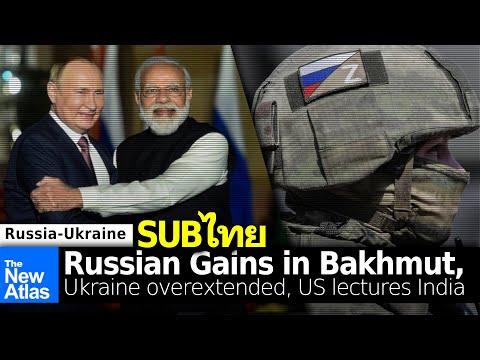
Russian Gains in Bakhmut, Ukraine Overextended, & US Lectures India

 October 17, 2022 (The New Atlas) - Update for Russian military operations against Ukraine for October 17, 2022.  Russian forces are closing...