June 5, 2022 (The New Atlas) - The Oslo Freedom Forum serves as the latest iteration of the US State Department's training ground for subversion around the globe - following in line US-sponsored unrest in Ukraine in 2014 and the so-called "Arab Spring" in 2011.
Who is attending the Oslo Freedom Forum, what takes place there, and what is expected of attendees once they return to their respective nations?
June 3, 2022 (The New Atlas) - A new draft NGO law in Thailand in the process of being passed.
It has led to US-funded fronts posing as "nongovernmental organizations" to protest both in Thailand and by writing letters to the US government demanding they stop the Thai government from passing the law - proving just how dangerous US-funded meddling is in Thailand and how necessary the law is in the first place.
May 7, 2022 (Brian Berletic - New Eastern Outlook) -As part of Washington’s long-standing strategy of encircling and containing China, it seeks to add to its already immense military footprint along China’s periphery, missile installations and specifically, ground-based intermediate-range missiles (GBIRMs) across the Indo-Pacific Region.
A research paper funded by the US government and published by the RAND Corporation titled, “Ground-Based Intermediate-Range Missiles in the Indo-Pacific Assessing the Positions of US Allies,” claims this is necessary because China has developed “a wide array of capabilities that the United States was prohibited from fielding” because of America’s adherence to the Intermediate-Range Nuclear Forces (INF) Treaty of which it is no longer a signatory.
The purpose of the paper is to determine where best to locate these missiles because the US itself has no territory in the region close enough to China and its GBIRMs to put them in check. This, however, is also an admission that China’s GBIRM capabilities are not a danger to the US itself, but rather to US “interests” in the Indo-Pacific region including first and foremost its desired primacy over it.
The paper considers various US “allies” who might host the missiles including Thailand, the Philippines, South Korea, Australia, and Japan.
In each case there are serious complications including the fact that most of these “allies” have close and ever-growing ties with China economically and in some cases even militarily.
Thailand: US Needs Regime Change
Regarding Thailand, the RAND paper cites two obstacles, the first being:
…since the coup, Thailand has not held fair elections resulting in a democratically elected government. Instead, the forces behind the coup remain in power, with a pro-military government pushing the country further down the road of authoritarianism. Observers recognize the February 2019 elections as anything but fair, and the government continues to weaken Thailand’s democratic institutions. The continuing presence of the military-backed government in Bangkok prevents the United States from strengthening US-Thai military relations. As long as this remains true, requesting this regime to host US GBIRMs is highly unlikely.
In reality, RAND’s conclusion that elections in Thailand were “anything but fair” is based solely on the fact that the US client regime of choice – a coalition between US-backed billionaires Thaksin Shinawatra and Thanathorn Juangroongruangkit simply failed to win and take office.
Because political circles representing Thailand’s actual best interests took office, Thai foreign policy was shaped in such a way leading to the second obstacle for US missiles being based in Thailand.
RAND would claim:
Second, the Thai government has shown a propensity to pursue closer ties with China, particularly since the coup. Research reveals that Thai military officers and officials view Chinese influence on Thailand’s security policies as now equal to that of the United States. Some analysts have argued that this is because Thailand views China as benign rather than a revisionist power or a military threat. Others have found that Thailand sees itself as reliant on China for protection against military threats. How much influence these views have on defense decisions remains an ongoing debate, but Thailand has not only purchased arms from China, such as submarines and tanks, but also allowed the People’s Liberation Army Navy to access the Sattahip Naval Base (a port of call often used by the United States) and exercised with China on an annual basis. These closer ties represent a major reason why the United States “should not harbor any illusions that Thailand will be an active partner on China-related challenges.”
Not mentioned is the fact that China is Thailand’s largest trade partner, largest investor, largest source of tourism and thus a direct contributor to one of Thailand’s several major industries, as well as an increasingly important partner in reducing Thailand’s dependency on US weapons and defense partnership. Cultivating closer ties with China is simply in Thailand’s best interests but is a process done with a very conscious effort to maintain a certain level of ties with the United States nonetheless.
It can be assumed that the policymakers behind this RAND report would like to see Thai policy and the government making it changed. But this would mean Thai policy would change in a way that would jeopardize Thailand’s best interests simply to suit Washington’s. Because Thailand’s current ruling circles of political and military power refuse to place Washington’s interests above their own, Washington has embarked on a policy of changing Thailand’s ruling circles of political and military power.
Protests that could be characterized as anti-government, anti-monarchy, and anti-military have taken to the streets on and off since 2019 in the aftermath of Thai general elections that year. The core organizations promoting, supporting, and even leading the protests are funded by the US government through the National Endowment for Democracy (NED). This includes media organizations like Prachatai, Isaan Record, and Bernar News, legal organizations like iLaw (Internet Law Reform Dialogue) who in 2020 organized a petition to rewrite Thailand’s constitution, and Thai Lawyers for Human Rights who not only provide legal support for protest leaders but included staff members who themselves led protests.
In other words, the RAND Corporation is not simply pointing out the shortcomings in Thailand preventing the US from placing missiles in their territory among other attempts to militarily and economically encircle and contain China – the US is already actively attempting to rectify these shortcomings through political interference ranging from coercion up to and including attempted regime change.
It is precisely because of Washington’s approach not only with Thailand but all of the nations mentioned in the RAND Corporation’s report that many of these nations have begun diversifying away from economic and military dependence on the West and the US in particular. Increasing trade with China and Beijing’s foreign policy of non-interference makes turning to China an easy choice. Only through active coercion and interference can the US attempt to convince nations in the Indo-Pacific to rethink this pivot.
The Philippines: Once a Colony…
The Philippines – colonized by the US from 1898 to 1946 – has experienced a similar pivot from West to East and more specifically, from a close (some could say subservient) relationship with Washington to a more balanced relationship using growing ties with Beijing as leverage to ensure it remains that way.
The RAND Corporation says of the Philippines:
The US alliance with the Philippines is in a state of flux. While the Philippine public and elites generally support the United States and the alliance itself, current President Rodrigo Duterte has pursued policies that negatively affect ties. Specifically, since his election in May 2016, Duterte has advocated closer ties with Beijing while concurrently pursuing policies that weaken core pillars of the US-Philippine alliance. Although Duterte has backtracked somewhat on these approaches, leading to some improvement in US-Philippine ties, as long as future Philippine leaders continue similar policies, including opposition to a permanent US military presence, the Philippines is extremely unlikely to accept the deployment of US GBIRMs.
Just like with Thailand – the Philippines counts China as its largest and most important economic partner. Allowing the US to place missiles on its territory for the explicit and sole purpose of threatening China clearly runs contrary to Manila’s best interests.
Just as in Thailand, the US maintains an active policy of political interference in the Philippines to shape its political landscape to place pro-American individuals into positions of power to shift Filipino foreign policy away from reflecting the nation’s interests and instead serving American interests at the cost of the Philippines’ economic and political future.
South Korea: Close Economic Ties with China Trump US Troop Presence
South Korea, despite hosting tens of thousands of US troops, is also considered by RAND an unlikely host of US GBIRMs. The report notes:
Although the alliance between the United States and the ROK was forged during the Korean War, the ROK also retains a close relationship with China to help manage and resolve continuing North Korean security challenges. The ROK also shares close economic ties with China. Because of experiences of Chinese opposition to the ROK hosting a US defensive missile system and the ROK government’s past susceptibility to Chinese pressure, combined with a general deterioration of US-ROK relations, it is highly unlikely that the ROK would consent to host US GBIRMs.
Again, economic ties with China and the fact that hosting US missiles for the explicit use of threatening China would run contrary to South Korea’s own best interests.
Australia: Self-Sabotage
As a matter of fact, the same goes for Australia – also mentioned in the report. And it has only been through immense political interference in Australia and pressure from Washington to sabotage Australia’s economic ties with China, that a general atmosphere of belligerence against China has begun to form. But even so, RAND Corporation sees the positioning of ground-based intermediate range missiles in Australia a provocation too far.
The report states:
Although strong historical ties with the United States and developments in 2021 that indicate an expansion of US access and presence make it impossible to rule out the possibility of Australia being willing to host US GBIRMs, a historical reluctance to host permanent foreign bases, combined with the geographical distance of Australia from continental Asia, makes this possibility unlikely. This is unlikely to change in the coming decade, even as Australia agrees to an increase in US rotational presence.
And while RAND notes that it is unlikely to change in the coming decades there are clearly efforts by the US and its supporters in Australia to change this sooner rather than later.
This is done through policy think tanks like the Australian Strategic Policy Institute (ASPI) funded by the US government and US-based arms manufacturers – shaping Australian foreign policy to suit the interests of the US at the cost of Australia’s economy and its sovereignty.
Japan: The Most Likely Candidate
Even Japan, still occupied by tens of thousands of US troops a generation after the end of World War 2, is seen as unlikely to host such missiles. The RAND report notes that:
Because of Japan’s willingness to strengthen the alliance and pursue efforts to bolster its own defense capabilities vis-à-vis China, however, Japan is the regional ally that appears most likely to host US GBIRMs. That possibility, however, remains low, heavily caveated by the challenge of accepting any increase in US presence and deploying weapons that are explicitly offensive in nature. That is unlikely to change in the years ahead.
However, the report notes that Japan could serves as a partner for a potential alternative to hosting US missiles of the intermediate range category – jointly developing such missiles deployed by the Japanese military itself.
The US Undermines, not Underwrites Indo-Pacific Peace
The US Indo-Pacific Command (USINDOPACOM) on its official website claims:
USINDOPACOM protects and defends, in concert with other US Government agencies, the territory of the United States, its people, and its interests. With allies and partners, USINDOPACOM is committed to enhancing stability in the Asia-Pacific region by promoting security cooperation, encouraging peaceful development, responding to contingencies, deterring aggression, and, when necessary, fighting to win. This approach is based on partnership, presence, and military readiness.
Yet according to US government-funded analysis carried out by the RAND Corporation in this report, existing military cooperation with the US seems more or less testing the limits of what is acceptable in each nation. The RAND Corporation report acknowledges how unpopular the notion of hosting additional US missiles is throughout the Indo-Pacific region despite insinuating its necessity to counter China.
Taken together it is clear that America’s military presence in the Indo-Pacific region is aimed solely at encircling, containing, and confronting China. This is a policy that threatens to undermine not just China’s peace, stability, security, and prosperity, but that of the entire Indo-Pacific region which depends on close and ever-growing ties with China.
Were China an actual threat, nations would be asking the US for its missiles rather than the US military commissioning reports to figure out why each nation does not want them – a problem then passed off to other US agencies and funding arms to resolve through political interference and coercion.
Ultimately, this reveals the US, not China, as the greatest and most persistent threat to the Indo-Pacific region – a region that may not represent perfect diplomatic relations at all times across all issues – but a region that seems to agree that China’s rise is key to each nation’s future individually as well as key to the future of the region as a whole.
The real battlelines will not be between China and its neighbors, but rather between the region and Washington’s various ongoing efforts to undermine sovereignty and eventually change various nations’ willingness to host US missiles as well as cooperate with other measures the US seeks to pursue in its increasingly dangerous competition – some may already say conflict – with China.
Brian Berletic is a Bangkok-based geopolitical researcher and writer, especially for the online magazine “New Eastern Outlook”.
April 4, 2022 (The New Atlas) - As Thailand prepares a new NGO law to encourage better transparency, accountability, and oversight of foreign-funded organizations including those involved in subversive and violent protests - pro-Western media has begun kicking and screaming in opposition to it.
References:
National Endowment for Democracy (NED) - Board of Directors:
March 19, 2022 (Brian Berletic - NEO) - As Russia’s special operations continue in Ukraine so does the West’s propaganda war against it. The propaganda is particularly effective but also particularly predictable in terms of who will be drawn in by it and become hysterical because of it.
This includes right-wing extremists from across the Western world but also the many US-sponsored “pro-democracy” movements elsewhere. This includes within the Southeast Asian Kingdom of Thailand.
Reuters in an article titled, “Thai democracy activists sign up to fight ‘tyranny’ in Ukraine,” would claim:
Far-off Thailand might not seem an obvious place for recruits to Ukraine’s efforts to raise an international volunteer force to defend against Russia’s invasion.
But for former Thai Air Force conscript turned political activist Chanaphong “Ball” Phongpai, the cause is a natural fit for members of the pro-democracy movement that emerged in 2020 to protest a military-backed government in the Southeast Asian country.
Reuters would also claim that these Thai “activists” saw Russia as a “superpower and a tyrant,” lifting phrases verbatim from the halls of Western power and from across Western media headlines.
After years of covering up the violent nature of US-sponsored anti-government protest in Thailand, Reuters obliquely admitted in its more recent article that indeed the protests were violent, noting how those interested in fighting in Ukraine claimed they needed to “switch from holding bottle bombs to holding guns.”
The article concluded by quoting one of the so-called activists, claiming:
“We fight for democracy here. They fight for their democracy there,” he said. “We are like friends. Its the same feeling, the same ideology.”
It is without doubt that Thais seeking to fight in Ukraine share a similar ideology with Ukraine’s current regime and those fighting to sustain it. But while Reuters and the Thai “activists” it interviewed attempted to insist that ideology shared is “democracy,” in reality the true common denominator is subordination to US interests, extensive US backing, and belligerent intolerance to alternative views as well as a deep disdain for the primacy of national sovereignty.
Nazis Lead the Fight Thai Volunteers are Joining – So Says the Western Media
Far from “Russian propaganda,” evidence that Ukraine’s current political order is propped up by actual Nazis including those playing a central role in Ukraine’s current security apparatus has been provided by the Western media itself, every single year since the US-backed coup overthrew Ukraine’s last legitimate elected government in 2014.
Scores of articles from each year have covered Nazi military formations folded into Ukraine’s official armed forces.
In 2014, for example, The Guardian in its article, “Azov fighters are Ukraine’s greatest weapon and may be its greatest threat,” would focus on members of the so-called “Azov Battalion,” noting that while they denied they were Nazis, they openly praised Adolf Hitler and used Nazis symbols for their flags and on their uniforms. The article noted the key role Azov played in the ongoing armed conflict already raging at that point in eastern Ukraine.
By 2015 the Western media admitted that Azov Battalion was rolled into Ukraine’s armed forces as part of the National Guard. Reuters in an article that year titled, “Ultra-nationalist Ukrainian battalion gears up for more fighting,” would note:
The 1,000 strong ultra-nationalist militia has a reputation as a fierce pro-government fighting force in the almost year-old conflict with the Russia-backed rebels in east Ukraine, and is disdainful of peace efforts.
But the radical views of the commanders of a group affiliated to Ukraine’s national guard which works alongside the army, and the use of symbols echoing Nazi emblems have caused alarm in the West and Russia, and could return to haunt Kiev’s pro-Western leadership when fighting eventually ends.
Reuters would also point out in its article that Azov had evolved into an organization including infantry, artillery, and even tank forces.
In addition to admissions across the West’s corporate media, are also articles from outlets like Radio Free Europe/Radio Liberty (RFE/RL) funded by the US government. A 2016 RFE/RL article titled, “Right-Wing Azov Battalion Enters Ukraine’s Political Arena,” would note that in addition to Azov’s inclusion in Ukraine’s armed forces, the armed organization sought to work its way deeper into the government itself.
The US government-funded outlet would also admit that, “human rights organizations have accused the Azov Battalion of torture,” highlighting the obvious outcome of arming actual Nazis and giving them an increasing amount of power both on the battlefield and off it.
By 2017 the threat Azov Battalion posed to both Ukrainians and Ukraine’s neighbors had raised serious concerns – concerns that many in the halls of Western political power attempted to dismiss as “Russian propaganda.” However, even Western media outlets would contradict this claim. An article that year by The Hill titled, “The reality of neo-Nazis in Ukraine is far from Kremlin propaganda,” would note:
There are indeed neo-Nazi formations in Ukraine. This has been overwhelmingly confirmed by nearly every major Western outlet. The fact that analysts are able to dismiss it as propaganda disseminated by Moscow is profoundly disturbing. It is especially disturbing given the current surge of neo-Nazis and white supremacists across the globe.
The most infamous neo-Nazi group in Ukraine is the 3,000-strong Azov Battalion, founded in 2014. Prior to creating Azov, its commander, Andriy Biletsky, headed the neo-Nazi group Patriot of Ukraine, members of which went on to form the core of Azov. Biletsky had stated that the mission of Ukraine is to “lead the White Races of the world in a final crusade for their survival … against the Semite-led Untermenschen.”
The idea that Thai volunteers are attempting to travel to Ukraine and fight alongside actual Nazis against “tyranny” takes on a particularly contradictory tone in light of such observations made even across the a Western media landscaped mostly committed to covering up the true nature of Ukraine’s post-2014 regime and its increasingly toxic security apparatus.
By 2018 even US government-funded RFE/RL would note the danger Ukrainian military formations like Azov posed to nations beyond Ukraine’s borders. An article that year titled, “Azov, Ukraine’s Most Prominent Ultranationalist Group, Sets Its Sights On US, Europe,” pointed out the concerted effort made by Azov to build ties with ultra-right extremists from across the Western world.
In 2019, Israeli publication Haaretz attempted to draw attention to the growing danger in its article, “Inside the Extremist Group That Dreams of Ruling Ukraine.” The article would elaborate further, claiming:
The Azov movement insists it is not neo-Nazi, yet its members have been captured giving Hitler salutes and being virulently anti-Semitic.
The threat of Nazism in Ukraine’s security forces and as well as within Ukraine’s political structures was pointed out even by the inveterate Russophobic US government-funded think tank, The Atlantic Council.
In a 2020 article titled, “The Azov Regiment has not depoliticized,” the Atlantic Council would admit that even the US government was debating whether or not to designate Azov as a “Foreign Terrorist Organization” and that Ukrainian Nazis still played a central role in Azov’s political and military activities.
Also in 2020 Western media outlets like Buzzfeed in articles like, “This Neo-Nazi Group Is Organizing On Facebook Despite A Year-Old Ban,” would point out how Azov was by then designated by the US State Department as a “nationalist hate group” and that despite a supposed ban of the organization across US-based social media, US corporations like Facebook continued making exceptions for and profits from Azov’s online activities.
TIME Magazine in an eight minute long video report titled, “Inside a White Supremacist Militia in Ukraine,” would showcase Azov Battalion’s nationwide political and military activities including running camps for children indoctrinating them into white supremacist ideology, providing them with military training, and preparing them to be inducted into military formations like Azov in the near future.
By 2022 US-based media outlet NPR in an article titled, “A closer look at the volunteers who are signing up to fight the Russians,” would admit that members of Azov were the ones receiving foreign volunteers precisely like the Thais mentioned by Reuters seeking to fight “tyranny” in Ukraine.
The NPR article would admit in regards to Azov that:
That regiment has a reputation for having the fiercest fighters in Ukraine. The paramilitary is credited with recapturing the southern port city of Mariupol from Russian separatists in 2014. And despite their neo-Nazi affiliations, they were folded into Ukraine’s National Guard. Groups like this are what Putin uses when he tries to paint Ukraine as rife with Nazis. It’s part of his justification for invading.
And according to the Western media itself, these claims by “Putin” are far from “attempts” to “paint Ukraine as rife with Nazis.” Ukraine is actually rife with Nazis – so much so that those who believe they will be joining the fight against tyranny will instead be received by the worst forms of tyranny – actual Nazis of formations like Azov Battalion – an organization now many thousands strong, consisting of infantry, artillery, tank, and other forces with detachments located in every major Ukrainian city – in other words – an organization of Nazis Ukraine is utterly rife with.
It is abundantly clear that these Thais now volunteering to fight alongside Nazis in Ukraine had nothing to do with democracy back home. The organizations behind the protests they had been a part of were not a product of Thai democratic aspirations, but of US government funding and interference within Thailand’s internal political affairs. Duped once at home, and now by Western media reports depicting Ukraine as a “victim” of Russian “aggression,” they are being thrown into harm’s way once again for a cause even more hopeless and delusional than the one they failed fighting for at home.
“Volunteers” fighting in Ukraine have already been given a stark wake-up call – their training facility in western Ukraine targeted by a missile strike wiping out most of them, and sending those few who survived fleeing back home, before ever stepping foot on the battlefield.
Buzzfeed in their article, ““I Thought I Was Going To Die”: US And UK Fighters In Ukraine Described The “Chaos” Of A Russian Missile Attack,” make it abundantly clear Russia’s statements regarding the operation was not propaganda, but the actual fate foreign fighters face.
Nations who do little to prevent their citizens from being tricked into traveling to Ukraine to face what is almost certain death provide an example of how Western foreign policy objectives have compromised the self-interests of nations worldwide.
Thais victimized by Western narratives illustrate once again the absolute danger a population can be placed in when a nation like Thailand categorically fails to secure its information space, allowing foreign interests like the US to dominate that information space and prey upon Thai citizens to the point of recruiting them into an armed conflict thousands of miles away.
US control over global media and also social media has only tightened since Russia’s special operations began in Ukraine, and the danger this control the US possess over information space worldwide has only grown. Now more than ever nations around the world need to secure their information space as a matter of national security – and not in some abstract way – but to literally protect their citizens from toxic disinformation so pervasive and compelling, that it has Thais and many others from around the globe literally signing up to join Nazis in combat.
Brian Berletic is a Bangkok-based geopolitical researcher and writer, especially for the online magazine “New Eastern Outlook”.
July 14, 2021 (Joseph Thomas - NEO) - China’s Belt and Road Initiative (BRI) reaches out in all directions, across Central Asia into Europe, up into Russia, through the seas and oceans of Asia, out to Africa and of course, deep into Southeast Asia.
The Southeast Asian leg of BRI consists primarily of a now-under-construction high-speed rail (HSR) line connecting China’s Yunnan Province with Laos, Thailand and perhaps eventually Malaysia and Singapore.
A large number of adjacent projects also are in the making and will complement other infrastructure projects recently constructed over the past decade or under construction now.
This includes various expressways, particularly through mountainous Laos which have already cut trips by road from days to just a day from China’s border with Laos in the north to the nation’s capital of Vientiane near the Laotian-Thai border. Additional expressways are under construction to facilitate more traffic within and through Laos.
Another expressway is currently proposed that will connect northern Thailand to southern China via Laos, cutting travel time between the two nations to just 2 hours.
Bangkok Post’s article, “Laos surveys new expressway linking Thailand, China,” would note:
The new road will connect with Chiang Khong district of Chiang Rai via the existing bridge over the Mekong River.
The 180-kilometre highway would allow vehicles to travel at 80 kilometres per hour and a drive from Thailand to China through Laos would take less than two hours.
The HSR line itself will include both passenger and freight services and across Laos, a network of “landports” to facilitate regional logistical operations.
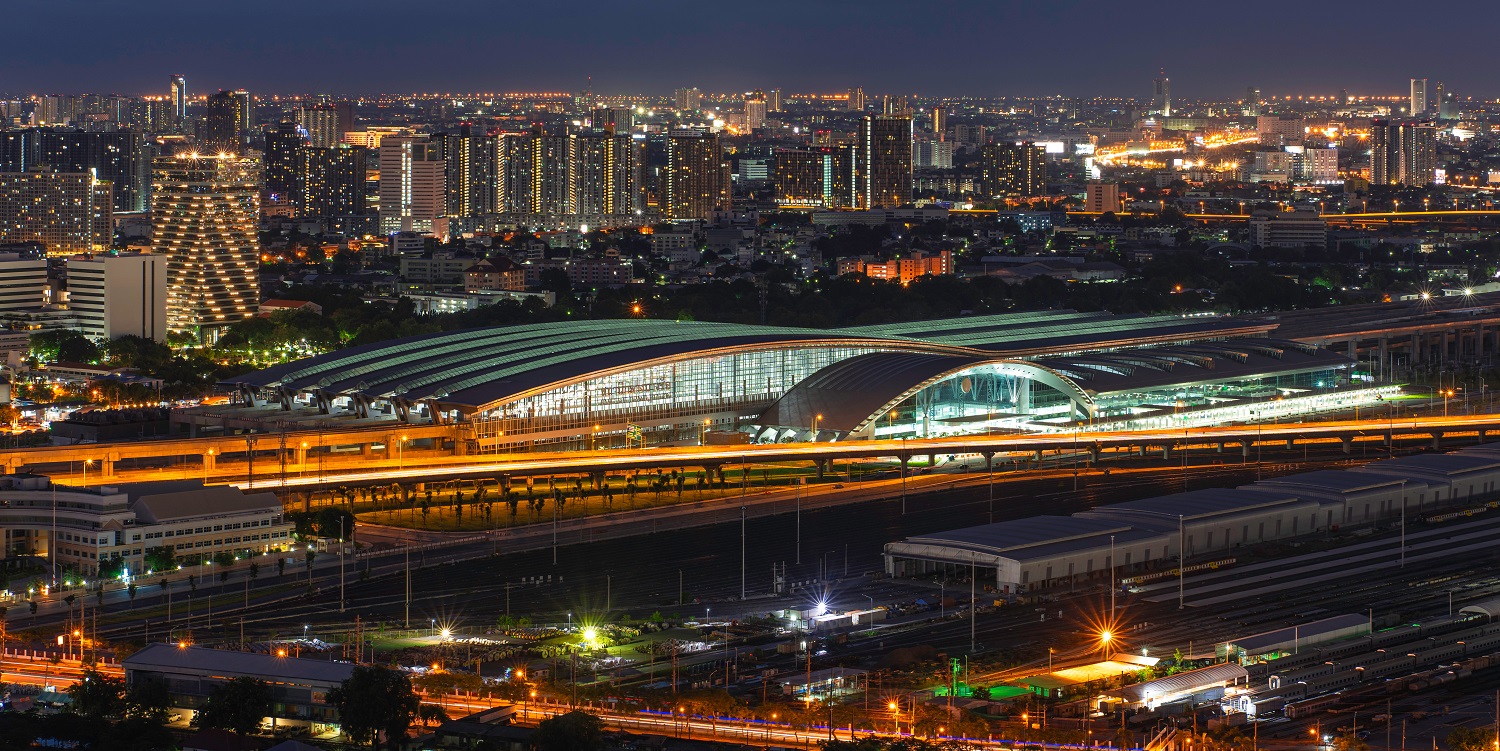
The entire network is already under construction with Bangkok’s new Bang Sue Grand Station completed and ready to open this year, hosting Thailand’s high-speed trains in coming years, and the Laotian leg nearing completion with train services possibly coming online by the end of 2021 or early 2022.
Western Derision & Hopes to Undermine
Criticism for the network of transportation projects stretching into Southeast Asia, like criticism of the BRI itself, stem mainly from Western ambitions to prevent the rise of China and with it, the rise of the rest of Asia.
US media sources like the US State Department’s Voice of America repeatedly floats accusations of Beijing employing “debt-trap diplomacy” while also admitting that Laos, until these projects began, was landlocked, isolating it from regional markets and preventing economic growth.
It’s obvious that Laos’ current economy is not well-suited for paying off massive infrastructure projects, but the infrastructure projects will expand its economy up to and beyond levels needed to do so, which is the fundamental principle behind investing in infrastructure in the first place.
Other cart-before-horse analysis includes claims that there is no market for HSR services across Southeast Asia and specifically in Laos or Thailand. The same flawed arguments were made by bitter Western analysts in a bid to deride China’s own domestic HSR development.
Analysis attempting to conclude low-income passengers wouldn't’ be able or willing to pay for tickets to ride China’s HSR services missed the crucial fact that the building of infrastructure accelerates more than just passengers down a set of rails. It connects cities and rural regions, expands economic activity for a larger number of people and if extensive enough (as China’s HSR network is) it moves whole sections of society up the socioeconomic ladder.
Initially low ridership was seized upon by Western pundits claiming China’s HSR ambitions were too big and the entire project was “in trouble,” as one Business Insider op-ed did in 2011. Now in 2021, Western pundits, despite China State Railway overseeing the nation’s HSR network regularly turning an annual profit, still lecture China over HSR after over a decade of predicting failure that never materialised.
Today, China’s HSR network moves between 2 billion and 3 billion passengers a year and reaches into the most remote areas of the nation (with a leg completed in Tibet just this June) bringing with it tourists, investors, businesspeople and opportunities hitherto out of reach especially for rural regions.
Infrastructure comes first, prosperity follows. Attempting to claim infrastructure is ill-conceived because it won’t immediately profit demonstrates the exceedingly shortsighted nature of many Western observers versus the long-term thinking of China’s government and apparently also of its partners in Laos and Thailand.
Obviously rural regions in Laos or in northeast Thailand will not find HSR services immediately appealing during the first years of operation. But as economic activity flows through these regions made accessible to many more people both within Laos and Thailand and also from China, economic conditions will improve, and ridership will increase, just as it did in China. With the prospect of this regional HSR network also moving freight, new markets will also be made available for businesses and farmers in these regions.
For the West, a tangible jealousy is manifesting itself as China builds infrastructure out of reach of even the richest Western nations. To see nations like Laos and Thailand share in China’s rise seems to pain many in the West even more, many in the West who see their culture and system as superior, yet find it increasingly difficult to explain why Asia as a whole appears to be surpassing the West by a growing number of metrics.
Beyond derision across the Western media, Western governments have mobilised opposition groups in Thailand in a bid to oust the current government primarily because of its close and growing ties with China.
We can expect in the next several years for this opposition to intensify and for both them and their Western sponsors to resort to increasingly desperate tactics as these projects near completion.
If China’s regional ambitions are realised, this opposition along with Western condemnation will become irrelevant as the vast majority of people in the region will see with their own eyes the tangible benefits these projects afford them in their daily lives, rendering moot the well-funded propaganda campaign well underway trying to convince them otherwise.
Joseph Thomas is a Bangkok-based geopolitical researcher and writer, especially for the online magazine“New Eastern Outlook”.
March 13, 2021 (Brian Berletic - LD) - US government meddling around the globe isn't aimed only at elections and regime change, but also at the legal processes within any given targeted nation - including referendums for things up to and including constitutional changes.
Thailand’s constitution will require 2 public referendums before being amended. This process is a matter of Thailand’s internal political affairs - but as in previous elections and regarding petitions to have the constitution rewritten in the first place - the US government and other Western special interests seek to influence and interfere in this strictly internal matter.
US government-funded fronts - through the National Endowment for Democracy (NED) - need to be watched carefully as Thailand prepares for these referendums while raising public awareness of this interference is essential in giving the Thai government the leverage it will need to effectively deal with it.
Brian Berletic, formally known under the pen name "Tony Cartalucci" is a geopolitical researcher, writer, and video producer (YouTube here and BitChute here) based in Bangkok, Thailand. He is a regular contributor to New Eastern Outlook and more recently, 21st Century Wire. You can support his work via Patreon here.
March 10, 2021 (Brian Berletic - LD) - The Thai Prime Minister recently joked with journalists - but through creative editing - the Western media was able to portray it as an "attack" all as part of a "bid to dodge some tough questions."
I show the original clip, the edited version the West presented to the public, and the danger of nations like Thailand not having English-language media to present their side of stories to international audiences to check and balance Western disinformation.
Brian Berletic, formally known under the pen name "Tony Cartalucci" is a geopolitical researcher, writer, and video producer (YouTube here and BitChute here) based in Bangkok, Thailand. He is a regular contributor to New Eastern Outlook and more recently, 21st Century Wire. You can support his work via Patreon here.
March 6, 2021 (Brian Berletic - LD) - Reuters regularly distorts the events surrounding US-backed opposition protests in Thailand.
Far from simply being because Reuters is “Western media,” it is now confirmed that Reuters has recently worked with Western governments to carry out intelligence operations to interfere in the political affairs of nations abroad under the guise of “journalism.”
Brian Berletic, formally known under the pen name "Tony Cartalucci" is a geopolitical researcher, writer, and video producer (YouTube here and BitChute here) based in Bangkok, Thailand. He is a regular contributor to New Eastern Outlook and more recently, 21st Century Wire. You can support his work via Patreon here.
March 1, 2021 (Brian Berletic - LD) - US-backed anti-government protesters in Thailand have once again "rebranded" to shake off the image of an unpopular, violent mob only to stage a poorly attended, extremely violent protest as their first "rally."
I explain how this is part of a wider US plan to create a regional crisis to deny China Southeast Asia as a viable economic, military, and political partner and how US-funded Thai opposition groups are working with US-funded protesters in Myanmar.
Brian Berletic, formally known under the pen name "Tony Cartalucci" is a geopolitical researcher, writer, and video producer (YouTube here and BitChute here) based in Bangkok, Thailand. He is a regular contributor to New Eastern Outlook and more recently, 21st Century Wire. You can support his work via Patreon here.
February 28, 2021 (Brian Berletic - LD) - The US National Endowment for Democracy (NED) has updated its list for programs, organizations, and companies that it is funding in Thailand to interfere in Thailand's internal political affairs. This includes US government funding for companies that interfered in Thailand's 2019 general election.
I explain how the NED's board of directors is made up of people who promote wars and regime change merely behind the smokescreen of "promoting democracy" and "freedom." I show which fronts the US has increased funding for as well as new fronts the US is now funding inside of Thailand.
I also show how the US NED through programs and companies that it funded interfered in Thailand's 2019 general election on behalf of the US-backed billionaire opposition leader Thanathorn Juangroongruangkit and his "Future Forward Party."
References:
US National Endowment for Democracy (NED) - Board of Directors:
Brian Berletic, formally known under the pen name "Tony Cartalucci" is a geopolitical researcher, writer, and video producer (YouTube here and BitChute here) based in Bangkok, Thailand. He is a regular contributor to New Eastern Outlook and more recently, 21st Century Wire. You can support his work via Patreon here.
February 28, 2021 (Brian Berletic - LD) - US government-funded fronts posing as NGOs in Thailand have long undermined the image and role of legitimate nongovernmental organizations.
New legislation has been proposed in Thailand to create more transparency regarding the foreign funding of NGOs in Thailand and to regulate their activities to ensure they fall within the real of non-profit organizations working for the public benefit rather than abusive fronts merely posing as such.
Brian Berletic, formally known under the pen name "Tony Cartalucci" is a geopolitical researcher, writer, and video producer (YouTube here and BitChute here) based in Bangkok, Thailand. He is a regular contributor to New Eastern Outlook and more recently, 21st Century Wire. You can support his work via Patreon here.
February 24, 2021 (Brian Berletic - LD) - Leaked documents reveal the BBC and Reuters received secret British government contracts to interfere politically both inside Russia and in nations along Russia’s borders. It is a documented case in reality of everything (and worse) the West has accused Russia of doing in unfounded fiction.
I explain how media organizations like the BBC and Reuters serve more as extensions of Western intelligence services - using journalism as a cover and how they constitute a national security threat to every nation they operate in around the globe.
Brian Berletic, formally known under the pen name "Tony Cartalucci" is a geopolitical researcher, writer, and video producer (YouTube here and BitChute here) based in Bangkok, Thailand. He is a regular contributor to New Eastern Outlook and more recently, 21st Century Wire. You can support his work via Patreon here.
February 17, 2021 (Brian Berletic - LD) - Let's take a look at a US-backed opposition party in Thailand - Future Forward (now renamed as the Move Forward and Progressive Movement parties).
These are parties that vow to create "equality" in Thailand - to take the "pyramid" of social order and turn it upside with "people power" at the top.
I explain how this is pure propaganda and how those selling these lies to the public in an effort to swell the ranks of US-backed anti-government mobs in the streets have organized their own parties and businesses into the very "pyramidal" structures they claim they seek to topple. They are pyramidal structures they will only make larger and more oppressive if ever they get into power.
In a wider context - these US-backed opposition groups seek to reduce or eliminate Thailand's relationship with China in Washington's bid to encircle and contain China.
Brian Berletic, formally known under the pen name "Tony Cartalucci" is a geopolitical researcher, writer, and video producer (YouTube here and BitChute here) based in Bangkok, Thailand. He is a regular contributor to New Eastern Outlook and more recently, 21st Century Wire. You can support his work via Patreon here.