Showing posts with label belarus. Show all posts

Sunday, September 20, 2020

Thai Opposition Figure Supports US-funded Neo-Nazis in Belarus

 September 21, 2020 (Tony Cartalucci - ATN) - While last weekend's anti-government rally was short on protesters, the overall movement seems to have no shortage of irony. A movement condemning the current Thai government as "fascist" is now openly supporting Nazi-flag waving agitators in Belarus. 

Student protest leader Netiwit Chotiphatphaisal has recently and very proudly come out in support of ongoing anti-government protests in Belarus. 

In a picture he himself posted on social media, he holds up a sign with Thailand's national flag alongside - not Belarus' flag - but the flag anti-government protesters have adopted. It is also the identical flag Nazi collaborators flew during World War II.


The Byelorussian Central Council which existed briefly from 1943-1944 flew the same white flag with a single horizontal red mid-stripe. 

The invocation of Nazi collaboration by current anti-government protesters in Belarus is no accident or coincidence. 

Similarly US-backed protests in Ukraine were also led by Neo-Nazi political parties and militias whose growth after taking power became impossible even for the Western media to conceal any longer.

READ MORE: Ukraine's Neo-Nazis "Suddenly" a Problem as Power Grows

The US and NATO have, since the end of World War II, used the remnants of Germany's Nazis and their collaborators across Europe against its power struggle with Moscow. 

It has been revealed that just like in Thailand, virtually every aspect of Belarus' current opposition is funded and backed by the US government. The US National Endowment for Democracy (NED) on its official website alone lists over 30 organizations or programs it is funding. 

While Thailand's "pro-democracy" protesters denounce the current Thai government as "fascist" and "abusive," they themselves are supporting real fascism backed by the most abusive government on Earth. 

Worse sill, Thai protesters are invoking Thailand's own fascist past by resurrecting the "People's Party," a right-wing fascist movement that overthrew Thailand's absolute monarchy in 1932 before its leader - a military officer named Pridi Banomyong - fled Thailand with Anglo-American aid and later died in exile while living in France. 

Thailand's "pro-democracy" movement, worshiping a fascist military coup 88 years ago, taking US government funds and support today, and now supporting a likewise US-funded protest in Belarus flying the flags of WW2 Nazi collaborators says everything in reality about a Thai movement whose rhetoric attempts to say otherwise. 

This isn't the first time Netiwit has supported a US-funded anti-government protest abroad either. 

He is a vocal supporter of US-backed sedition in Hong Kong, China. 

He has flown to Hong Kong and invited US-backed opposition leaders from Hong Kong to Thailand. 

Netiwit is also openly anti-China and considers himself part of the "Milk Tea Alliance" - a US State Department propaganda tool attempting to string together an Asian-wide united front against China using local US-funded activists since the actual governments and people of the region refuse to join. 


Netiwit has also been invited to the US and British embassies. A picture of him drinking wine inside the British Embassy with Khaosod writer Pravit Rojanaphruk helps further illustrate the level of hypocrisy he and the movement he claims to lead represents. 

Netiwit annually protests in front of the Chinese embassy in Bangkok regarding the Tiananmen Square incident - an event that took place long before he was even born. He does this while dining and drinking wine at the British embassy representing a nation currently invading and occupying nations around the globe where it is torturing, abusing, and killing people. 

READ MORE: Washington's Anti-Chinese "Pan-Asian Alliance"

To protest something dishonestly from decades ago while turning a blind eye to ongoing atrocities today Netiwit reveals to the public exactly the sort of "values" Thailand's "pro-democracy" movement really represent. 

The protests in Thailand, Hong Kong, or Belarus are about aligning to the West more than to any actual demonstrated set of principles. For Netiwit and his Thai protesters, it is also about undermining Thailand's relationship with China who is currently Thailand's largest trade partner, investor, source of tourism, and arms supplier. It is also a crucial partner for several major infrastructure projects including a region-wide high-speed rail network that will pass through Thailand.

Thailand's "pro-democracy" movement claims it wants to move the nation forward yet it has aligned itself to one of the most abusive and regressive circles of global power - the United States and NATO. By backing US-sponsored political subversion in Hong Kong and Belarus - Netiwit and his movement are also backing the undermining of international law and norms and the peace and stability they were created to protect. They do this to Thailand's and the world's own detriment. 

Wednesday, August 26, 2020

Why is the US-NATO Eager for Regime Change in Belarus?

Regime change in Belarus would help extend NATO's presence on Russia's border by over 700 miles.  

August 27, 2020 (Tony Cartalucci - LD) - Belarus borders Russia and despite differences it has had with Russia over the years, the current government represents a much better alternative than a client regime installed by Washington and NATO.


US and EU-backed regime change in Belarus would extend NATO's presence along Russia's borders by over 700 miles in addition to the over 590 mile-long presence NATO-members like Poland, Estonia, Lithuania, and Latvia already make up (this includes borders shared with the Russian oblast of Kaliningrad).

It would also bring NATO troops within almost 240 miles of Moscow, just within cruising range of US-built M1A2 main battle tanks.


Watching NATO's enlargement following the dissolution of the Soviet Union from the 1990's onward makes it a no-brainer as to what motivates US and NATO meddling in Belarusian politics. It is all aimed toward regime change and the shaping of Belarus into an extension of ongoing efforts to smother Russia.

It is the natural continuation of what could be best described as a slow-motion blitzkrieg, where US and NATO methodically dissect Russia's allies abroad, smother its borders, strangle its economy, and foment unrest within Russia itself.

Belarus depends on Russia economically with a significant amount of its imports and exports coming from and going to Russia. Regime change there, made to look like an immense effort to "save" the people of Belarus, would mean the cutting of these economic ties and would leave a vacuum that would take years to fill. Just like in Ukraine following US-NATO led regime change there, economic collapse would be a guarantee.

For Russia, Belarus is among its top 10 trading partners and while Russia could probably find ways of compensating for the loss of trade with Belarus should a Western-backed client regime take power, it would be yet another cut among many inflicted by the West on its besieged economy.

US Meddling in Belarus is Real, Admitted and Ongoing for Decades 

Why would the opposition in Belarus choose economic collapse, the use of their territory to extend NATO's looming presence on Russia's borders and transform the nation into a potential battleground like neighboring Ukraine?

The fact that the opposition is funded by the US and thus making decisions best suited to Washington's interests rather than Belarus' helps explain why.

The US National Endowment for Democracy (NED), an organization well-known for its involvement in fostering regime change around the globe, funds a total of 35 (admitted) programs in Belarus. The specific individuals and organizations in Belarus the NED is funding are not disclosed on the NED's website

US funding Belarus' opposition is nothing new.


As early as 2001 articles in Western newspapers like the CS Monitor's "US spends millions to bolster Belarus opposition," would reveal:
Whatever the outcome, the election is revealing a remarkably high level of US and Western involvement on the side of pro-democracy activists, which has embroiled the American ambassador and senior Western officials in a political firestorm.
The 2001 article also notes:
Washington spent $24 million in Belarus last year, and US officials say the figure is slightly higher this year. That amounts to a small fortune in this impoverished nation wedged between NATO's eastern flank and Russia.
The article then attempts to defend the US' verified role in manipulating Belarus' elections. This includes a defense mounted by then US ambassador to Belarus, Michael Kozak himself.

Some might even say the arguments made sound reasonable until we recall Washington's own reaction to the mere accusations of Russian involvement in US elections in 2016.

If unfounded claims of Russian interference in US elections illicited sanctions leveled against Russia, why would the US believe carrying out a verified campaign of political interference in Belarus is somehow "ok?"

CS Monitor's 2001 article could just as likely have been written yesterday, except for the fact that the US has since raised the issue of election interference in 2016, exposing what is supreme hypocrisy that would be much more difficult to defend.

Of course election interference is never ok, no matter who does it. True democracy is rooted in the notion of self-determination which becomes increasingly impossible the greater outside interference becomes.

The US' attempts to have it both ways, to use allegations of interference in its own political processes as an excuse to level yet more sanctions against Russia, while defending its own interference in Belarus' elections - and the political processes of many other nations around the globe - only further undermines the credibility of its so-called "rules based international order" and those attempting to still defend it.

Not only is the US' interference in Belarus wrong for all of these reasons, if successful in effecting regime change, it will only further ratchet up tensions with Russia and further endanger global peace and stability as a result.

Whatever narratives and excuses being made by the Western media to justify US-NATO interference in Belarus and whatever "dangers" they claim the current government there poses, we have seen throughout the 21st century irrefutable evidence, from Afghanistan and Iraq to Libya, Syria, and Ukraine, that the greatest danger and the very worst calamities follow rather than precede US-led interventions. 

Thursday, August 20, 2020

Belarus ‘Opposition’ Document Reveals Agenda to Pull Country Into NATO and EU

Recent events in Belarus appear to have been designed to moved NATO’s ever-expanding eastern front even closer towards Moscow.

August 21, 2020 (21st Century Wire) - EU bureaucrats, along with Washington’s change agent in the region, the notorious German Marshall Fund, are attempting to push the situation in Belarus deeper into the familiar ‘Color Revolution’ impasse, towards street violence and eventual ‘regime change,’ with the ultimate aim of installing a pro-US and pro-EU leader.


Following its recent Presidential elections, western leaders have called on Belarussian President Alexander Lukashenko to step down and make way for the US-backed candidate who lost the recent election, Svetlana Tsikhanovskaya, claiming that the election was ‘unfair’ and that Belarussian authorities must ‘stop the repression against the Belarus people’ and ‘open a dialogue with civil society.’

Tsikhanovskaya is already forming her own western-backed ‘government in exile’ which will eventually be recognized by Washington and its allies as the “legitimate leader and government” of Belarus. This follows the familiar ‘humanitarian intervention’ template which the US has laid out for targeted countries like Libya, Syria, Ukraine, and most recently for Venezuela.

SEE ASO: Uncovering Faces Of Belarusian Opposition

While this western-driven campaign to remove what Washington believes is a “pro-Russian” leader in Lukashenko, the reality of the subterfuge is much deeper and more profound in terms of its geopolitical significance. No, this is much more than your typical western-backed color revolution. Upon closer examination of Tsikhanovskaya’s own manifesto, it’s clear that this latest regime change effort is not merely to pull Belarus away from close and friendly relations with its neighbor Russian – but rather it’s about forcing the country towards binding partnerships with both NATO and the EU.

Sunday, August 16, 2020

Belarus: Imperialists Run the Same Tired Old Script Day After Day

Whether in Thailand or in Belarus the US uses the same tired template to push regime change and advance its foreign policy, while the Western media covers it up in a tidal wave of lies. Caitlin Johnstone explains. 

August 16, 2020
(Caitlin Johnstone - RT) - The Western establishment narrative managers always follow the same patterns. Just like they fixated on Hong Kong protests, while ignoring those in US-aligned France or Israel, now they’re cheering on protests in Belarus.


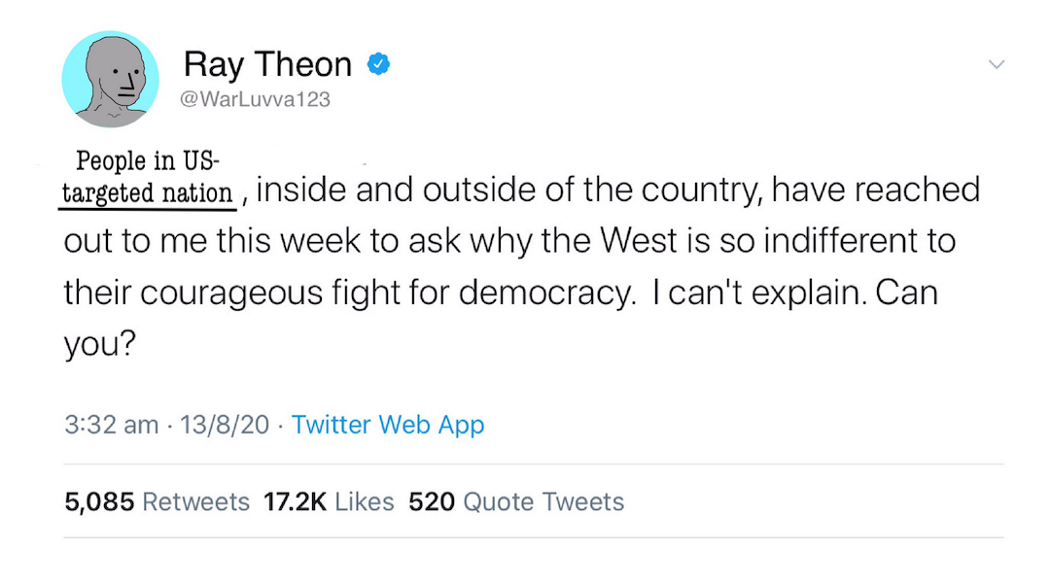
Imperialist pundit and Obama administration Cold Warrior Michael McFaul recently tweeted the following:

“Belarusians, inside and outside of the country, have reached out to me this week to ask why the West is so indifferent to their courageous fight for democracy. I can’t explain. Can you?”

I am not highlighting this tweet because it is remarkable (except for the extremely dubious claim that anyone ever reaches out to Michael McFaul). I am highlighting it because it is completely unremarkable.

Two months ago, Moon of Alabama published an article titled“Belarus – A US Sponsored Color Revolution Is Underway,” documenting all the telltale signs that the Moscow-aligned nation would soon be overrun with protests in opposition to its Soviet-style government. Here’s an excerpt from that June 16 article:

On August 9 Belarus will hold presidential elections. Lukashenko will do his best to win again.

Color revolutions are usually launched over controversial elections. The results are publicly put into doubt even before the election begins. When the results finally arrive, Western media will claim that they diverge from the expectation it created and therefore must have been faked. People will be pushed into the streets to protest. To increase the chaos, some sharp shooters may be put to work to fire at the police and at protesters like it was done in Ukraine. The revolt ends when it is flogged down or when the US favorite candidate is put into place.

Last year the US National Endowment for Democracy financed at least 34 projects and organizations in Belarus. The US does not do that out of charity but to put its finger on the scale.
All the usual imperial narrative management operations were in place in the lead-up to the nation’s election this month, and now we’re seeing CIA cutouts like Radio Free Europe/Radio Liberty and the National Endowment for Democracy cheering on the protests and condemning the Belarusian government in sync with the US State Department.

"We support the protesters and condemn the brutal government crackdown against them,” said the government with no self awareness whatsoever.

So it’s all unfolding according to the same old patterns. A formula that is so tired and repetitive that those with an ear to the ground can predict them before they happen.

Again, I am not highlighting McFaul’s tweet because it is unusual. I am highlighting it because, in our insane world that is dominated by a 'The Blob'-reminiscent empire which constantly works to absorb or destroy all nations which are not aligned with it, it is completely normal and mundane. It’s one of nearly infinite tweets, articles and TV clips I could have chosen from as an example of the way establishment narrative managers consistently twist the story of what’s happening in our world in favor of the US-centralized empire and against governments which have resisted absorption into its gelatinous folds.

In fact, let’s simplify things by translating McFaul’s post into its original generic template format:

© Caitlin Johnstone

There. That’s a bit more honest.

I love my job. Really, I do. But in some ways writing commentary about the shenanigans of Western imperialism is the most boring and repetitive task you can possibly imagine.

There’s really never anything new. It’s the exact same formula with the exact same depraved imperialists spouting the exact same script about nations which rotate in and out of their crosshairs from day to day. And what makes it even more tedious is the fact that everyone’s expected to treat each new “OMG this unabsorbed government must be opposed!” narrative cycle like it’s something new and different.

It isn’t new, and it isn’t different. It’s gotten to the point where it’s the exact same international political news story every single day, and that news story reads as follows:

“US-centralized empire tries to grow larger by absorbing a nation which is fighting to maintain its military, financial, economic and/or resource sovereignty.”

That’s it. That’s all the international politics news you’ll ever see, in its entirety. The rest is just frills laid overtop it so you don’t realize you’re being fed the same exact bulls**t every motherf**king day.

And the billionaire news media always march right along with it, because they’ve all got systems in place to boost narratives which maintain the status quo that those billionaires have built their kingdoms upon. The reporters who work for such mass media outlets have no loyalty to truth or facts, only to facilitating the expansion of the empire.

Don’t believe me? Read this Fairness and Accuracy in Reporting piece from last year documenting the fact that mass media coverage fixated uniquely on the anti-Beijing protests in Hong Kong while ignoring the protests against US-aligned governments like France, Israel, Chile and Haiti. Or this one from 2002 about the way the Washington Post editorial board was constantly shrieking about the need for regime change in Iraq because Saddam might have chemical weapons, but contented itself with a brief and mild finger-wagging during the Reagan administration when he actually used chemical weapons.

They have no principle at all. No interest in truth whatsoever.

If Saudi Arabia pivoted its loyalty from the US to China, we’d immediately begin seeing daily coverage of the atrocities in Yemen like we should have been seeing this entire time.

If Israel pivoted from Washington to Moscow we’d immediately be saturated in news stories about the plight of the Palestinians and the protests against Netanyahu’s corruption.

If Australia left the blob and began insisting on its own sovereignty, the world would suddenly find itself urged on a daily basis to care a lot more about aboriginal rights and the refugees in offshore detention centers.

If the government which exited the imperial blob didn’t have any particularly damning humanitarian abuses on its record, Western intelligence agencies would make something up, and Western media would uncritically report it as an absolute fact.

Mainstream pundits and reporters would make these shifts without skipping a beat. They’d pretend it had been their position the entire time. And when they went to bed at night, they’d sleep like babies.

How do I know this? By observing their current behavior.

And yet every time the establishment narrative managers begin babbling about the Evil Unabsorbed Government of the Week, I get people yelling at me that this time it’s completely different and Mike Pompeo is totally telling us the truth about this one. They’re like a three-year-old who insists on watching the same damn Disney movie thousands of times over, multiple times per day. Only difference is the three-year-old is probably learning something.

As narrative control gets more tenuous, we might start seeing people waking up from the puppet show. Until then, all clear-eyed rebels can do is keep pointing at the gaps in the matrix of this one monotonous, repetitive news story in as many different ways as possible to help wake people up from the propaganda-induced dream.

Caitlin Johnstone, an independent journalist based in Melbourne, Australia. Her website is here and you can follow her on Twitter @caitoz

Friday, November 25, 2011

Belarus Strikes Head of US Color Revolution Snake

US-funded propagandist & agent of sedition Ales Bialiatski gets 4 years in prison in Belarus.
by Tony Cartalucci

November 26, 2011 - Freedom House, premier peddlers of the entirely disingenuous Western "human rights" crusade, has made a passionate plea for the release of Ales Bialiatski, a "prominent Belarusian human rights defender and head of the Human Rights Center “Viasna,”" who has been sentenced to over 4 years in a Belarus prison. What Freedom House doesn't tell you is that Bialiatski is actually the vice president of the US National Endowment for Democracy and George Soros Open Society-funded International Federation for Human Rights (FIDH) - making him anything but a "human rights defender" and instead a coordinator of US-backed destabilization efforts that have been ongoing in the Eastern European nation for years. Bialiatski's US-funded FIDH has also been recently exposed as behind the entire Tunisian uprising in January 2011.


Human rights activist Ales Belyatski in court in Minsk

Photo: US-funded agent of sedition Ales Bialiatski now resides safely behind the bars of a Belarus prison. Bialiatski was vice president of the sedition-sowing FIDH, an umbrella organization that has fomented US-backed unrest from Tunisia to the borders of Russia and China.
....

That Freedom House calls the arrest, trial, and imprisonment of one of their agents of sedition a "human rights abuse" illustrates just how credible their entire "human rights" agenda turns out to be, i.e. not credible at all.

BBC, while also obfuscating Bialiatski's ties to the US government-funded FIDH, claims that his "organisation called Vyasna (Spring)" works to monitor "government's activities against opposition figures." In other words, all the US-backed opposition parties are given rhetorical support from Vyasna who portrays them as hapless victims at the hands of the "tyrannical" Belarus government - just as the US does in many other nations around the world in a bid to install their own autocratic regimes. BBC also notes that Soros' Open Society-funded Human Rights Watch has also predictably come to Bialiatski's aid.

As reported as far back as April, 2011, Belarus has been overtly marked as "next" by Wall Street-London interests dissecting the planet, starting with their premeditated "Arab Spring" destabilization. After Tunisia fell and protests began brewing in Egypt, Foreign Policy magazine published Freedom House's list of "Who's Next?" On the list was Belarus' Aleksander Lukashenko. NATO has admitted the reluctance of Belarus to join its now unjustified yet ever expanding organization, and at the Globsec 2011 conference, Belarus was considered a threat to both the EU and NATO, having turned down NATO in favor of closer ties with Moscow. The corporate mainstream media for their part, has berated the Belarusian government for putting down protests launched after the results of recent elections that saw the Western-backed opposition defeated.

In a March 2011 speech, Joe Lieberman called for the unconditional release of Belarusian "activists" as well as the tightening of sanctions against Belarusian president Aleksander Lukashenko. His speech outlines a clear intention to meddle in the sovereign affairs of Belarus and to fold the nation into an Atlantic NATO EU order.


It is also a matter of record that Lieberman's Belarus protesters were the recipients of training from the US created and funded CANVAS of Serbia. In Foreign Policy's article "Revolution U, it states that "Slobodan Djinovic, one of Otpor's original organizers, began traveling to Belarus, meeting clandestinely with a student movement there. It was soon infiltrated, however, and eventually collapsed."

In a March 2011 report, it was noted that with such a failure as described in Foreign Policy's article, "it is more than likely the US is looking for ways around this, and judging from the contempt Lieberman speaks of the Belarus regime with, it must have long since taken its gloves off and fully recognizes the threat the US State Department has left on its doorstep."

With the Belarus government specifically targeting the ring leaders of US-funded sedition within their borders, it is clear that this analysis was correct and that Belarus knows exactly who its real enemies are and exactly how to deal with them. FIDH's Mr. Bialiatski isn't the first US agent of sedition to see the inside of an Eastern European jail cell, Russia's Mikhail Khodorkovsky has also been imprisoned for his role in US-funded sedition within the Russian Federation. Again, Wall Street and London reacted by claiming his imprisonment was a "miscarriage of justice" and a sign of Russia's "human rights abuses." A full account of Khodorkovsky's "defense" and his crimes can be found here.

Belarus is setting an important precedent in dealing with foreign-funded sedition masquerading behind a disingenuous "human rights" agenda. As pointed out previously, the US National Endowment for Democracy, Freedom House, and their various pet projects are overseen by perhaps the most morally bankrupted men humanity has ever produced. They include warmongers, corporate-fascists, and unabashed promoters of Wall Street-London global hegemony (imperialism). It is an absolute certainty that these individuals and the organizations they collectively belong to are not interested in "human rights" beyond how they can leverage and pervert these noble ideals to deceive well-meaning people into helping them achieve their self-serving agendas.

Friday, July 29, 2011

Belarus Under Siege

Joint Onslaught by US and Russian Oligarchs

by Michèle Brand


On June 29 and 30, US Secretary of State Hillary Clinton was in Vilnius, Lithuania to participate in a meeting of the “Community of Democracies” and to visit one of the many US-funded international “tech camps.” These camps host “civil society” (i.e.opposition) activists from various nations whose governments the US doesn’t appreciate, and teach them internet and social network organizing skills to be used toward fostering, in official words, “democratic transition,” or more correctly, color revolutions and regime change. According to the AP, “Much of the democracy meeting’s opening day dealt with the new mechanics of protest, such as social media networks.” During her visit Clinton stated that “The United States has invested $50 million in supporting internet freedom and we’ve trained more than 5,000 activists worldwide.” This is of course in addition to the hundreds of millions that the US spends in other ways attempting to destabilize its enemies and to force “democratic transitions.”

The choice of Vilnius was not by chance: it lies 30 kilometers from the Belarusian border. This tech camp is hosting 85 activists from the region, “primarily from Belarus.” Belarus is currently being targeted by a concerted effort towards an orange revolution, financed and remote-controlled by the West. Simultaneously, the country is being subjected to a relatively new pressure from the East: certain Russian elements have apparently decided that Belarus and its profitable state-owned enterprises should belong to them, and are contributing in their own way to the effort to destabilize the government.

I’ve just returned to Paris from a second extended trip to Belarus. Western media faithfully relay the monstrous picture of Belarus that our governments want to convey, and so I’d like to report on the situation in this little-known country, and encourage others to visit it in order to experience for themselves the Belarusian culture, economy, hospitality and character. Among other visits I attended an international conference on the resistance to Nazi fascism, in Brest on June 22, the 70th anniversary of the Nazi invasion of the Soviet Union. In a country which lost between a third and a quarter of its population during the war, the memory of the ravages of foreign attacks and the heroism of those who resisted it is very strong and alive. Located dangerously between Europe and Russia, entirely flat and endowed with few natural resources, Belarus has fought hard to build a successful independent state. It is not inclined to lose its sovereignty now.

The United States and other Western countries have been attacking the government of President Alexander Lukashenko ever since it refused to follow the path of the other ex-Soviet countries in the 1990s, which famously sold off the state-owned industries to oligarchs, destroyed the social protection system and allowed kleptocratic mafia capitalism to take over. Under Lukashenko, Belarus has developped gradually into a strong socially-oriented market economy with the highest growth rate in the CIS even during its current financial troubles (according to the CIS Interstate Statistical Committee, between January and April 2011 Belarusian industry grew 12.9% year-on-year), while still maintaining its free health care, job protection, social services, retirement programs, low unemployment, state-subsidized housing and utilities, and high level of education. This is one reason why the country is naturally in the line of fire of the West, whose bankrupt governments are now obsessively telling their citizens that “there is no alternative”: we must drastically decrease or kill pensions and other social programs, fire government employees, flexibilize the work force, privatize education, health care, infrastructure and everything possible, etc. etc. Located just next door to crisis-stricken Europe, Belarus is more than a thorn in its side; it is living proof that European and American neoliberal propaganda is only lies.

This seems to be one reason that the attacks against the Belarusian economic model and its government have recently gone into higher gear. Its economy is an isolated pocket of export-oriented production next to the Western economies of consumption. Belarus was the most highly industrialized area in the Soviet Union, manufacturing machines, petroleum and chemical products for the whole Soviet sphere and receiving its energy and raw materials from the East. 75% of the economy is exports; 80% is state-owned production, and there are many public-private partnerships. Smaller businesses are mainly private. The country has recently benefitted from a good deal of foreign investment, for example from China, which has invested in infrastructure projects and with whom Belarus has a unique commercial credit swap program. GDP grew 7.6% in 2010. Signs of growth are to be seen everywhere, much more so than during my first visit to the country two years ago, and the skyline of Minsk is dotted with cranes.

The first impression one has of Belarus is how clean it is -- there’s hardly a cigarette butt on the street -- and the second is the immense number of trees and parks in the cities. (The third might be, depending on whether one had presuppositions about the country being a late Soviet backwater, the modern cars, cell phones and cosmopolitan way of life of its citizens.) Belarusian cuisine is healthy and delicious; agricultural products are local, low-chemical and inexpensive. The food distribution system is not parasited by rapacious large private distributors. The tomatoes are actually red inside and have a real tomato flavor, not whitish inside and tasteless like in the West. The country’s Gini coefficient, measuring income equality, is excellent (29.7, much better than France or the US, or its neighbors Russia and Poland). The country is attracting immigrants from other CIS states who are fleeing their countries’ corruption, crime and drugs in favor of Belarus’ low crime, low unemployment, social services, clean streets and green cities.

These are some of the reasons that the government of President Lukashenko is genuinely popular among the majority of Belarusians, who naturally compare their society’s development over 20 years to that of their neighbors. And it is this popularity that poses a problem for the West and its desire for “democratic” regime change.

Western governments claim that the presidential election of last December 19 was fraudulent, and use this to justify their recent round of attacks. I have spoken with a number of international observers of that election who affirm that they saw no fraud or irregularities, and exit polls confirmed that the majority of Belarusians voted to reelect President Lukashenko. One such report can be read here: http://www.counterpunch.org/shamir12312010.html. The CIS observers reported that they had witnessed a fair election, while the OSCE, predictably, stated the opposite. The selective coverage of this election in Western media is astounding, and to understand the events I recommend this short documentary: “Ploshcha: Beating Glass with Iron” (http://www.youtube.com/watch?v=JFKHrZPfCqg).

For about a month before the election the major opposition candidates were spending more time calling on their supporters to protest in a central square in Minsk on the evening of the election, than on campaigning in a normal way by outlining their policies and calling on people to vote. On the evening of the election at around 7:00, before voting stations had closed and well before the results were announced, the opposition groups rallied in October Square in Minsk, the traditional place for demonstrations, flying the blue European flag and the red and white former Belarusian flag, symbol of the opposition. Then the presidential candidates called on their supporters to head to the central government building “and ask them to vacate the offices,” and led a crowd of around 7,000 to Independence Square, just in front of the Parliament. It should be said in passing that out of 1.3 million voters in Minsk, this is a small number. Opposition candidates proceded to announce that they contested the election results and to proclaim they were forming a new government, the “government of rescue,” reading a printed statement clearly prepared in advance, before results were announced. The police did not interfere with the rally until a large group of well-prepared individuals forcibly tried to enter the Parliament building, using metal rods and shovels. It could have been worse: in the weeks before the election, Belarusian border authorities had seized a number of cargoes of metal rods, grenades, knives, guns, and explosives. The police intervened and prevented what was clearly an attempt at a coup d’état, following the pattern used in the “tulip revolution” in Kyrgyzstan in 2005. Opposition representatives later claimed that the attack on the Parliament was done by government provocateurs, but many of those arrested and / or filmed trying to break into the Parliament were identified as having relations with various opposition groups.

The goal was apparently twofold: either seize power by occupying the buildings, or if not, at least get international media footage of combat between police and protesters, preferably with blood. Though there were no major injuries, the second goal was obtained since now Western governments and media call this a “violent crackdown” on an opposition rally, and accuse the government of breaching human rights. The hypocrisy of the West, who (with Russia) paid for the campaigns of much of the Belarusian opposition, and who try to foster a “democratic” transition by violently overturning a democratic electoral process, is extraordinary. As many know well, the US has no lessons to give on human rights. I have directly experienced the way in which the US police protect the human rights of non-violent protesters, for example on April 16, 2000 in front of the Treasury building in Washington, when riot cops violently dispersed a group of non-violent activists sitting in the street to protest the policies of the World Bank and IMF, and a young man near me who couldn’t crawl away fast enough had 3 ribs broken by a riot cop’s bludgeon. It seems that the Belarusian police, given the destruction of government property and attempt to take over Parliament, were very restrained. The people still imprisoned after the events of December 19, including 3 ex-candidates, were convicted of participation in or instigation of the riot. Imagine the reaction if a similar event had taken place at the Capitol building.

Many of the ex-presidential candidates (there were 10 candidates in all) have well-documented relations with the West, which isn’t surprising given the millions that the US and Europe spend on “democratic transition” in the country. They generally call for privatization of state enterprises, liberalization of the economy and adhesion to NATO. A number of them have spent time studying regime change at the George C. Marshall Center European Center for Security Studies in Germany, a partnership between the US military (US European Command) and the German government, which, according to the US embassy in Minsk, hosts 25 Belarusians per year. Since 2001, the US has enacted a series of Belarus Democracy Acts, applying economic sanctions, visa blacklists and asset freezes on government-related people and companies, and providing tens of millions of dollars per year for the promotion of “democracy.” In February of this year, citing the recent elections, the US State Department announced an increase of its “democracy assistance” to Belarusian civil society by 30% to $15 million for the year. In 2009, the National Endowment for Democracy gave $2.7 million to finance Belarusian “independent” media, civil society (promoting “democratic ideas and values... and a market economy”), NGOs and political groups. A Wikileaks cable (VILNIUS 000732, dated June 12, 2005) confirmed money smuggling into Belarus on the part of USAID contractors, though such proof is hardly necessary. Also in February, the EU, individual European countries, Canada and the US put together a “war chest” of 87 million euros aiming toward regime change in Belarus. With so much money being offered to anyone who wants a job as an activist, it’s not hard to find takers. Youth who run into trouble are offered free education in the West. There is evidence that many of those who partook in the violent acts of the night of December 19th were paid for their participation, by either Western or Russian elements.

For the West is not the only source of financing, nor of interventionist pressure. One of the most important ex-candidates was financed by the Russians. While Western pressure is a known quantity in Belarus, Russian attempts at destabilization are relatively new. Russian oligarchs have been ogling the profitable Belarusian state enterprises, and since the government has historically refused to sell them, the Russian kleptocracy has begun to try to topple Lukashenko. The Russian media have begun a concerted campaign against the Belarusian government, airing pro-opposition documentaries and indulging in smearing and misinformation. Russian operatives are now making inroads; on the Minsk-Moscow highway, my Belarusian friend pointed out the expensive Russian cars with tinted black windows heading into Minsk. Russian oil prices have risen sharply -- 30% in January -- and the price of natural gas imported from Russia has quadrupled in four years. Although the economy has diversified since independence, it is still reliant on importing energy and raw materials for its production. The hike in energy and commodity prices has had a harsh impact in Belarus, where the cost of energy now makes up 78 cents of every dollar of goods produced. High commodity prices explain the trade deficit despite strong industrial and export growth.

In January of this year, at the same time that the Russians severely raised oil prices, Belarus was subjected to a major speculative attack on its currency. The Russians control 37% of the country’s banking sector, and according to analysts in Minsk, early this year Russian banks started to sell off their Belarusian rubles. In January, 50 times more foreign currency was bought with Belarusian rubles than in December, and that pattern continued in February and March. This sparked the effect desired: inflation of 33% in the first half of the year, general panic and a run on the bank where people tried to convert their Belarusian rubles into dollars or gold. The central bank was obliged to devalue the Belarusian ruble by 36%. The government has not printed currency, contrary to some media reports. The speculative attacks have not been covered in the news; Ria Novosti for example typically stated that “the Belarusian ruble collapsed in the first five months of the year as the result of a large trade deficit, generous wage increases and loans granted by the government ahead of the December 2010 presidential elections, which spurred strong demand for foreign currency.” But the trade deficit is not new and would not itself spark a currency collapse, while wage increases or loans would not logically provoke a demand for foreign currency.

According to Minsk residents, the main problem this Spring has not been a lack of products on the shelves, as one reads in the West, but rising prices, a shortage of foreign currency and hoarding, which has somewhat disrupted the supply chain. When I was there in mid-late June, the shelves were fully stocked, the stores and markets were full of shoppers and there were no lines at gas stations, contrary to what Western media have been reporting. Inflation is apparently stabilizing now. Protests on the Western borders by cross-border traders have been widely covered by Western media who are seeking signs of unrest, but who rarely show that the traffic of cheap Belarusian products and gasoline for sale at a profit in the West is a practice that is harmful for the Belarusian economy, especially in the context of the current economic difficulties. This is why the government recently limited such border crossings to once every 5 days (formerly traders would often go 5 times per day) and to limit the products that can be individually exported. The scarcity of foreign currency explains the late payment of bills to the Russian electricity supplier (which demands payment in dollars), prompting it to temporarily halt delivery of electricity to Belarus a number of times recently. This strong-arming, reported extensively in the international press, is more bark than bite since Russia only provides around 12% of Belarusian electricity and there have been no blackouts.

Because of the spiraling Belarusian ruble, the government has had to seek foreign loans. It has appealed to the IMF for a loan of $8 billion, though the IMF replied on June 13 that a loan would come with the usual strings attached -- structural adjustment programs, privatizations, a freeze on salaries, letting the Belarusian ruble float, etc. The IMF admonishes the government that it has not yet enacted similar conditions that were set with the last loan it received in 2009 during the world financial crisis; for example, a government agency to oversee privatizations was created but no privatizations carried out. On the other hand, it was rarely reported that the IMF also hailed measures by Belarus' government to end the country's financial crisis, for example raising interest rates and supporting the unemployed and poor.

Whether the country will get an IMF loan or not, the traditional refusal to privatize is now ending, since the country was granted a $3 billion emergency loan from the Russian-controlled Eurasian Economic Community, which also had strings attached for the privatization of $7.5 billion of state enterprises over 3 years. This is part of what the Russian oligarchs have been working toward. The first disbursement of this loan, $800 million, was released on June 21, putting an end to the immediate financial problems. However, the Russians may not be getting the cheap deals they had wanted, nor will they necessarily be the beneficiaries of the privatizations. The actual sales and IPOs are in negotiation, and President Lukashenko has been very clear that by Belarusian law, privatizations of state enterprises must follow strict conditions. On June 17th, he stated, “The conditions have been spelt out: the company should develop, it should not be closed, the workers' pay should increase each year, they should be protected socially and, most importantly, the company should be modernized. That is, if you come and buy it, you should invest in its development.” On June 30, Venezuela, with whom Belarus has close economic and diplomatic ties (among other agreements, Venezuela has provided oil to Belarus), announced its interest in acquiring shares in Belarusian state companies. Analysts in Minsk say that the country is reorienting itself away from Russia and toward China. An IPO on foreign stock exchanges of a minority stake in the huge state potash and fertilizer company, Belaruskali, is in preparation, and the national gas pipeline will most likely be sold to Gazprom. Other state enterprises are on the block, and the future is unknown; but President Lukashenko stated recently that “I would like to give you firm assurances that we will not accept risky experiments or an unacceptable lowering of living standards. We will continue implementing a Belarusian economic model, which has proved to be stable under different and complex circumstances for over 15 years.”

The economy seems to be showing signs of stabilizing now. Despite the recent financial troubles, Belarus’ debt remains at an impressively low level: including the recent loan, public debt will not exceed 45% of GDP, including both domestic and foreign public debt. The foreign debt ceiling is 25% of GDP. The government has reported a slight trade surplus of $116 million in May, apparently because of import restrictions enacted this Spring. The finance ministry has recently lowered its 2011 GDP growth forecast to 4.5% and the World Bank has recently lowered it to 2.5%; at even 2.5%, the economy is clearly resisting. The World Bank added that the Belarusian economic model isn’t viable; rather it should be more concerned with the US model of credit-based consumption and skyrocketing foreign debt.

In June, coinciding with these financial problems, Western governments returned to the attack, as though to take advantage of the momentum to destabilize the Belarusian government. On June 14, President Obama renewed and reinforced US sanctions against the country, declaring a “national emergency” (that is, for the US, not Belarus) and citing, incredibly, “the unusual and extraordinary threat to the national security and foreign policy of the United States” that Belarus constitutes. The only way in which he may be right is simply in that the success of the Belarusian economic model constitutes a threat to neoliberal dogma. It is also possible that for Obama the country represents a “threat” to US foreign policy by being located next to Russia, and it may be caught within escalating US and Russian tensions over NATO and the missile shield. If the US could manage to install a Western-friendly government in Belarus, it would be a great step forward in its attempt to surround Russia, which has close military ties with Belarus and whose own missile shield is located there.

Be this as it may, the sanctions are coming from all sides. On June 17, the UN Human Rights Council voted to condemn “human rights violations” following the recent presidential election. On June 20, the European Union in their turn reinforced its sanctions against Belarus, adding companies and names to the blacklist (the Belarusian government has stated its intention to sue the initiators of the sanctions), and the European Bank for Reconstruction and Development has reoriented its financing activities away from the government and toward “civil society.”

And “civil society” hasn’t missed the opportunity provided by US tech camps and the recent financial troubles. Since the beginning of June, there has been a new movement on the part of various opposition groups in Belarus, calling itself “revolution through social networks.” They have taken to weekly protests in the central streets organized on the internet or by twitter in which participants clap their hands, without banners or chanting. Since the violence of December 19th, protests have been prohibited in the central area of Minsk, though they are allowed in certain other areas of the city. Whatever one thinks of this prohibition, it is clear that these protests consist of the same pro-Western, well-financed groups with a new, high-tech face. According to Western media, the protests are being violently repressed and protesters arbitrarily arrested. According to Belarusian authorities, participants have been arrested because they were shouting profanities at police and pushing them. I unfortunately didn’t happen to see one of the protests while I was in Belarus recently, and can’t personally report more details about them. A number of videos of the protests are available on the web, and I’ve seen no violence in them, no raised billy clubs and no blood; one can see protesters being arrested but not what immediately preceded the arrests. If there were major police violence, one could be sure that images of it would be all over the web. Of course, the government should make images available showing that it is violent participants who are arrested, since the arrests only play into the protesters’ hands and give Western governments more fodder for sanctions. The number of participants is unclear from the videos, which are usually closely framed shots. One video claiming to show a clapping protest was clearly not one, as within the clapping crowd (probably an audience applauding an outdoors show) one can see the red and green Belarusian flag, which is never used by those who protest the government -- they fly the former red and white national flag as well as the European blue one.

I did speak to people, including youth, about the protests. One young man, when he learned that I was from the US, said to me, “Flashmob! Fun!” giving me the thumbs up. For him, it was clearly more of a fun public gathering with drums, stomping and clapping, than a real political statement. Another young man told me, “When I read Western media, I wonder, is this my country? Am I in a war zone?” What is clear in the videos is that the crowd is well-off. Belarusian participants in Clinton’s tech camp said as much; according to the AP, they “described the active opposition as largely limited to students and educated citizens. The movement needs the support of working class people, said the activists.” Clearly, the Belarusian working class has reasons not to support the current movements: they are generally satisfied with the policies of President Lukashenko. If the movements are limited to the Western-oriented elite, Western or Russian financed operatives, and youth wanting to have a street party, then they have no future, no matter how many millions the US and others throw at them.

On July 6, the US House renewed the Belarus Democracy Act, sponsored by Rep. Christopher Smith of New Jersey, chairman of the Helsinki Commission. During the debate, Rep. Ron Paul denounced it. He said:

“I rise in opposition to the Belarus Democracy Act reauthorization. This title of this bill would have amused George Orwell, as it is in fact a US regime-change bill. Where does the United States Congress derive the moral or legal authority to determine which political parties or organizations in Belarus -- or anywhere else -- are to be US-funded and which are to be destabilized? How can anyone argue that US support for regime-change in Belarus is somehow promoting democracy? We pick the parties who are to be supported and funded and somehow this is supposed to reflect the will of the Belarusian people? How would Americans feel if the tables were turned and a powerful foreign country demanded that only a political party it selected and funded could legitimately reflect the will of the American people? I would like to know how many millions of taxpayer dollars the US government has wasted trying to overthrow the government in Belarus. I would like to know how much money has been squandered by US government-funded front organizations like the National Endowment for Democracy, the International Republican Institute, Freedom House, and others.... It is the arrogance of our foreign policy establishment that leads to this kind of schizophrenic legislation, where we demand that the rest of the world bend to the will of US foreign policy and we call it democracy. We wonder why we are no longer loved and admired overseas. Finally, I strongly object to the sanctions that this legislation imposes on Belarus. We must keep in mind that sanctions and blockades of foreign countries are considered acts of war. Do we need to continue war-like actions against yet another country? Can we afford it? [...] We have no constitutional authority to intervene in the wholly domestic affairs of Belarus or any other sovereign nation.”

I can only agree wholeheartedly, and wish the government and the people of Belarus courage in their resistance to the current attacks, and success in protecting their independence. At the international conference in Brest on the resistance to Nazism, participants described again and again the heroic courage and strength of the Belarusian people during the war years under the invasion coming from the West. Belarusians will need to continue to draw on that strong character for some time to come, as the attacks are not yet finished, but they have proven they are up to the fight.

Michèle Brand is an independent journalist and researcher originally from the US, living in Paris. She can be reached at michbrand@free.fr.

Thursday, April 21, 2011

Lukashenko: Globalists Are Preparing To Strangle Belarus

"They want to force us to be just like everybody else, like they are eventually.
We are like a bone in their throat. If they try to bend
us, to bring us
down to our knees, we will at least resist. We will fight for our plot of land."

- Alexander Lukashenko, President of Belarus (RIA Novosti)

Paul Joseph Watson
Prison Planet.com
Thursday, April 21, 2011

Belarusian President Alexander Lukashenko warned today that the globalists were preparing to strangle his country because of its refusal to join the new world order, with Belarus set to become the latest target of the contrived “Arab Spring” riots as the NATO powers further encircle Russia and China.

“Belarusian President Alexander Lukashenko said on Thursday Western countries are preparing direct interference in his country’s affairs and are trying “to strangle the country with a slipknot,” reports RIA Novosti.

“First there were political threats, disavowal of [presidential] elections, [European] entry bans and economic sanctions. Then there was an instigation of turmoil on our foreign currency market and dances on the bones after the blast at the Oktyabrskaya metro station,” Lukashenko said addressing the parliament and his people.”

Highlighting how the power elite designates any country that refuses to sacrifice its own sovereignty as a “rogue state,” Lukashenko spoke of how the elite, “Want to force us to be just like everybody else, like they are eventually. We are like a bone in their throat.”

“If they try to bend us, to bring us down to our knees, we will at least resist. We will fight for our plot of land,” the president added.

Just like Colonel Gaddafi and Mahmoud Ahmadinejad, Alexander Lukashenko is an autocrat who rules his country with an iron fist, but because he refuses to play ball with the globalists, Belarus has now become the next target of the manufactured global uprising, with US-trained militants waiting in the wings to overthrow Lukashenko and hand the country over to the NATO powers who are busy swallowing up nations as part of their long term agenda to isolate Russia and China.

Read the rest on PrisonPlanet.com...

Wednesday, April 20, 2011

Besieging Belarus

Next on the globalists' chopping block.
by Tony Cartalucci


Bangkok, Thailand April 20, 2011 - With Libya preparing to face Western troops, and Syria fending off an overtly foreign-backed uprising, other nations long accused of being "rouge" by the global corporate-financier oligarchy are bracing for what is inevitably to come. While earlier assurances were made to the House of Saud, it seems even they are making provisions to secure their kingdom against their own society unhinging, fueled by both years of draconian brutality and now US funded sedition.

The groundwork has been laid for this global upheaval to spread as far as Moscow and Beijing, however a little known republic is getting increasingly more attention from the corporate-financier oligarchy, the Eastern European nation of Belarus. With 9.5 million people and sitting right across the border from Moscow, it serves as the next logical step for NATO's expansion toward the goal of encircling Russia.

After Tunisia fell and protests began brewing in Egypt, Foreign Policy magazine published Freedom House's list of "Who's Next?" On the list was Belarus' Aleksandr Lukashenko. NATO has admitted the reluctance of Belarus to join its now unjustified yet ever expanding organization, and at the Globsec 2011 conference, Belarus was considered a threat to both the EU and NATO, having turned down NATO in favor of closer ties with Moscow. The corporate mainstream media for their part, has berated the Belarusian government for putting down protests launched after the results of recent elections that saw the Western-backed opposition defeated.

Warmonger Joe Lieberman sums up for all who have been paying attention, that the US-funded revolutionary wave is aimed at Belarus next. In a March 2011 speech, Joe Lieberman called for the unconditional release of Belarusian activists as well as the tightening of sanctions against Belarusian president Alexander Lukashenko.


Of course, these Belarusian activists have been trained, funded, and equipped by the West along side activists that have participated in the now admittedly US-funded "Arab Spring." Foreign Policy magazine's article "Revolution U," reported that the US funded and supported CANVAS organization has trained activists from 50 different countries including Belarus. Shortly after CANVAS, then called Otpor, overthrew Serbia's Slobodan Milosevic in 2000, they began clandestinely traveling to Belarus to meet with student activists. Ultimately their network was discovered and shut down. They would later infiltrate Georgian and Ukrainian politics and assist in the Rose and Orange color revolutions respectively.

In 2007, the US International Republican Institute (IRI) openly admitted to funding and supporting activists inside Belarus in an appeal to garner similar support from European Union members. In their appeal they state:

"IRI has been active in furthering democratic processes in Belarus since 2001. Along with our European partners, we work with a coalition of pro-democratic political parties, nongovernmental organizations and activists in Belarus whose goal is to bring true democratic change to a country that has been ruled by a dictator for more than a decade."

More recently, IRI states on their website that, "Pro-democracy reformers require the support of the international community as they stand up to brutal regimes. In Belarus, Burma, Cuba, North Korea, Syria and Zimbabwe IRI is supporting activists and reformers in their efforts to find and open political space," indicating a myriad of extraterritorial meddling around the world, including in Belarus.

IRI's doppelganger organization, the National Democratic Institution (NDI) states on their website that, "NDI has conducted democracy assistance programs in Belarus since 2000, partnering with citizens who want to build democratic political institutions. The Institute has helped to strengthen nongovernmental organizations and political parties, and has helped citizens learn more about their rights and responsibilities."

Brookings Institute and Council on Foreign Relations "task force" member, and current NDI president Kenneth Wollack gave testimony in January, 2011 regarding the December 2010 elections and the failure of the admittedly US funded and supported Belarusian opposition. In his testimony, Wollack explains in excruciating detail the networks and methods they intend to use to bolster the opposition and fill the "political vacuum when openings occur." Everything from US funded poll monitors to sponsoring political activity conducted by opposition parties is explained. Most importantly perhaps is Wollack's repeating of a desire to bring Belarus into the "trans-Atlantic Community," similar to words parroted by Joe Lieberman in his more recent speech on the Senate floor.

Of course, both IRI and NDI are funded by the National Endowment for Democracy (NED), answering the question as to where the Belarusian opposition is getting their money to fund these sponsored events and to rebuild their networks after the December 2010 election. NED itself boasts an array of activities it funds in Belarus including building up NGOs and "civil society," promoting independent media (propaganda), and even training Belarusian activists abroad as were the participants in the recent "Arab Spring."

To get a good idea of what sort of "ideals" the Belarusian opposition embrace, the European Belarus Civil Campaign is a good place to start. Andrei Sannikov, a leading opposition candidate and the "international coordinator" of Charter’97, one of the leading opposition movements in Belarus, is working through the European Belarus Civil Campaign in order to integrate the nation into the globalist European Union.

It is also instructive to consider that the US State Department's Movements.org, which has played an instrumental role in recruiting, training, and supporting activists throughout the "Arab Spring," is also closely following and reporting favorably on the activities of the Belarusian opposition.

Joe Lieberman's outrageous call to further meddle in Belarus' sovereign affairs is but a collective indicator of years of meddling, plotting, funding, and supporting Western aligned opposition to undermine the government in Belarus. The desire to hammer Belarus into the NATO alliance and fully encircle Russia with states as belligerent toward Moscow as Georgia, has all but been openly declared. With the "Arab Spring" turning out to be open subversion and even open war to consolidate regional hegemony across Northern Africa and the Middle East, both Russia and China must brace as the wave of destabilization is purposefully directed toward them and their peripheries.

Friday, March 11, 2011

US Contracting Tech Firms for Revolutions

US shamelessly admitting to funding Middle East revolutions.
by Tony Cartalucci


As previously reported, the US State Department manages a vast array of extra-legal networks of NGOs, propaganda outlets, and organizations like Movements.org that are literally recruiting and training foreign protesters and supporting their efforts as they return home to incite unrest and regime change. It was described how Secretary of State Hillary Clinton was literally sitting on the Broadcasting Board of Governors which oversees "news agencies" like Voice of America, Radio Free Europe, and Radio Free Asia.

Washington Post has now revealed that the US State Department, Department of Defense, and the Broadcasting Board of Governors are all funding technology companies and NGOs (amusingly referred to as "human rights groups") who are providing protesters across the Middle East and North Africa with means to facilitate their online activities including circumventing cyber-security measures employed by target nations.

The US is apparently prepared to spend at least $30 million of taxpayers' money to facilitate this overseas meddling. Secretary of State Hillary Clinton, in a multi-tiered display of unbelievable hypocrisy stated, "I am sure there are certain folks in the governments of these places that would prefer we didn't fund these technologies - just as they would prefer we don't advocate for human rights in general - but it's our long-standing policy to advocate for Internet freedom."

The entire article needs to be read to be believed and can be found here.

Meanwhile, Senator Joe Lieberman took to the podium and decided to spend the people's time to promote another extra-legal meddling in a foreign nation's sovereign affairs, this time in Belarus. Belarus borders Russia and has recently rebuffed NATO's overtures. As previously reported, regime change in Belarus and its joining of NATO is part of a greater agenda of encircling Russia and forcing from it concessions on behalf of the globalist oligarchy.


Senator Lieberman expertly misappropriating,
time,
space, legitimacy, and money

It should be noted that Belarus' protesters were also the recipients of training from the US created and funded CANVAS of Serbia. In Foreign Policy's article "Revolution U, it states that "Slobodan Djinovic, one of Otpor's original organizers, began traveling to Belarus, meeting clandestinely with a student movement there. It was soon infiltrated, however, and eventually collapsed."

It is more than likely the US is looking for ways around this, and judging from the contempt Lieberman speaks of the Belarus regime with, it must have long since taken its gloves off and fully recognizes the threat the US State Department has left on its doorstep.

Russian Gains in Bakhmut, Ukraine Overextended, & US Lectures India

 October 17, 2022 (The New Atlas) - Update for Russian military operations against Ukraine for October 17, 2022.  Russian forces are closing...