Showing posts with label Pakistan. Show all posts

Saturday, April 30, 2022

Suicide Bombing in Pakistan is Part of US Proxy War with China

May 1, 2022 (Brian Berletic - New Eastern Outlook) - A sucide bomber killed four in southern Pakistan including 3 Chinese teachers and their Pakistani driver on Apirl 26.


AP would report in its article, “Suicide blast in southern Pakistan kills 3 Chinese, driver,” that:

The Baluchistan Liberation Army, a militant group in nearby Baluchistan province, has targeted Chinese nationals in attacks in the past.

The group’s statement that followed Tuesday’s attack identified the bomber as Shari Baluch or Bramsh, saying she was the group’s first female bomber. The attack marks “a new chapter in the history of Baluch resistance,” the statement said.

Baluchistan has long been the scene of a low-level insurgency by armed Baluch groups demanding more autonomy and a greater share in the region’s natural resources if not outright independence from Islamabad.

Indeed it is only the latest in a pattern of US-sponsored violence targeting Chinese nationals living and working in Pakistan and fits into a much larger agenda of confronting and confounding China’s rise globally by Washington.

The most recent terrorist attack follows a bombing aimed at China’s representative to Pakistan, Ambassador Nong Rong in April of last year and the killing of 13 people including 9 Chinese engineers a few months later.

All of these attacks have been linked to Baluchistan-based separatists who have been backed by the US government since at least as early as 2011. The goal of supporting separatism in Baluchistan is to raise the costs of or altogether obstruct Chinese-driven development in Pakistan through the extensive China-Pakistan Economic Corridor (CPEC) and in turn, hinder China’s Belt and Road Initiative (BRI) globally. 

US Support of Baluchistan Separatism

A US Congress resolution titled, “Expressing the sense of Congress that the people of Baluchistan, currently divided between Pakistan, Iran, and Afghanistan, have the right to self-determination and to their own sovereign country,” was introduced in February 2012.

It’s sponsor, US Representative Dana Rohrabacher, would explain his motivations for introducing it in an opinion piece published by the Washington Post titled, “Why I support Baluchistan.”

In it he would claim:

I drafted the measure after a Feb. 8 hearing by the House Foreign Affairs subcommittee on oversight and investigations that exposed horrific violations of human rights by Pakistan security forces in Baluchistan. The US State Department, Amnesty International and other human rights groups have verified and denounced the extrajudicial killings, kidnappings, disappearances, illegal detention and torture being used by Pakistani authorities to suppress Baluch aspirations to control their own affairs.

Despite his attempts to cite human rights concerns – these are merely the pretext. He would continue by noting:

Baluchistan is Pakistan’s largest province in area and lies in the south, near Iran and Afghanistan. It is replete with natural resources and treated like a colonial possession. Its natural gas, gold, uranium and copper are exploited for the benefit of the ruling elite in Islamabad; meanwhile, the Baluch people remain desperately poor. The province includes the port of Gwadar, on the Arabian Sea, which China has been developing and may turn into a naval base. The Baluch have been dispossessed of land and fishing as a result, while construction jobs and land grants have gone to Pakistanis from other provinces. 

Baluchistan borders Afghanistan and at the time the US was already occupying the Central Asian country for a decade. Washington depended heavily on Pakistan’s cooperation – which it sometimes did not receive – to move troops and supplies into occupied Afghanistan. Rohrabacher even complained about this in his opinion piece and concluded by saying:

 Islamabad has not only sheltered al-Qaeda but also provided a base of operations for the Taliban, who continue to kill Americans. With one hand officials thumb their noses at us and with the other hand they grab billions in our foreign aid. It is time Washington stopped aiding Pakistan and developed a closer friendship with India and, perhaps, Baluchistan.

Thus it is obvious there were three actual reasons the US was interested in Baluchistan (punishing Pakistan, blocking Chinese development, and obtaining resources) obscured by a fourth serving as a smokescreen – human rights concerns.

Also during this time, other op-eds across the Western media reinforced this obvious motivation.

The National Interest in a 2011 article titled, “Free Baluchistan,” would shamelessly conclude:

Pakistan has given China a base at Gwadar in the heart of Baluch territory. So an independent Baluchistan would serve U.S. strategic interests in addition to the immediate goal of countering Islamist forces.

Beyond mere rhetorical and legislative support, Baluchistan’s separatists received direct help from the US government through the National Endowment for Democracy (NED). To this day the US NED webpage disclosing its programs for Pakistan lists at least 2 programs focused on interfering in Baluchistan’s local political affairs directly amid 27 other programs and organizations funded by the US in Pakistan.

The US NED also includes as a “fellow” Malik Siraj Akbar who oversaw media operations in support of separatism both in Baluchistan itself, and since fleeing Pakistan, from the suburbs of Washington DC.

The pattern matches Washington’s interference and support for violent separatism in China’s western region of Xinjiang. The NED funds a network of organizations working across the US, Europe, and along China’s borders in Central Asian states like Kazakhstan.

In Xinjiang as well, the Western media eagerly reported terrorist attacks while highlighting the government’s inability to address the deteriorating security situation. When China began gaining the upper hand through extensive anti-terrorism programs – the violence was collectively “forgotten” by the Western media and those detained and being deradicalized were instead depicted as political prisoners.

A similar process is taking place in Baluchistan, Pakistan.

With that in mind, China and Pakistan could possiblly address terrorism in the nation’s southwest in a similar manner as was used in Xinjiang – perhaps in a manner even more effective by learning from mistakes made while restoring peace and introducing prosperity to Xinjiang – particularly in regards to countering the West’s information war to complicate deradicalization.

Baluchistan and Xinjiang are just two of many points around the globe the US seeks to stir up violence in its bid to preserve its own global hegemony by dividing and destroying people and regions within the borders of its peers, near-peers, and their allies and partners – particularly China and Russia.

By creating greater public awareness of how the US creates these crises, nations can better explain how and why they are taking measures to resolve them. Only time will tell if Pakistan, possibly with China’s help, can both educate the public regarding why violence continues to target Chinese nationals aiding Pakistan’s development, and work on eliminating it.

Brian Berletic is a Bangkok-based geopolitical researcher and writer, especially for the online magazine “New Eastern Outlook”.

Thursday, July 22, 2021

US Fingerprints on Terrorism Aimed At China-Pakistan Economic Corridor

July 23, 2021 (Brian Berletic – NEO) – In April of this year and then again in July, two attacks in Pakistan, west of the Indus River, appear to have targeted Beijing’s partnership with Islamabad.

In April a terrorist bombing targeted a hotel in Pakistan’s southwest Baluchistan province hosting China’s ambassador to Pakistan, Nong Rong. Ambassador Nong Rong was not at the hotel at the time of the bombing, but the attack still ended up killing 4 and wounding several more.

In July an explosion targeted a bus carrying Chinese engineers working on the China-Pakistan Economic Corridor (CPEC), part of China’s wider Belt and Road Initiative (BRI). This attack killed 13 including 9 of the Chinese engineers.

Such attacks are not new. They are merely the most recent acts of violence amid a long-standing effort by the US and armed militants it has openly supported for years to thwart China’s partnership with Pakistan and to sabotage the BRI.

While US President Joe Biden had unveiled his “Build Back Better World” (B3W) initiative at the February 2021 G7 meeting as America’s answer to China’s BRI, it was clearly a smokescreen behind which the US would continue a campaign of global destabilization and militancy aimed at nations cooperating with Beijing and hosting various BRI projects.

Pakistan is among many nations now facing America’s true answer to the BRI – state-sponsored terrorism, militancy, and political subversion. Joining Pakistan is also Southeast Asian nations like Thailand and Myanmar which have both suffered from US-sponsored anti-government protests in recent years – the latter of the two having protests transform into now ongoing armed conflict.

The US has also targeted China internally, focusing its efforts on radicalizing Uyghur separatists in China’s western Xinjiang region, then undermining Beijing’s efforts to contain the resulting terrorism. Xinjiang serves, without coincidence, as a critical juncture for several BRI routes.

More than Mere Speculation: America’s “Free Baluchistan” Campaign

Much of Washington’s efforts to “free Baluchistan” have been copied and pasted from both US efforts to carve up the Middle East through granting the region’s Kurds defacto autonomous territory, or the US-backed push for a “free East Turkestan” in China’s Xinjiang region. This latter effort is reflected on the US National Endowment for Democracy’s (NED) own official website which lists its programs for Xinjiang, China as “Xinjiang/East Turkestan (China),” deliberately including the name given to the region by separatists.

Beyond mere speculation, the US has openly supported armed separatists in Pakistan’s southwest Baluchistan province for years. This includes entire hearings within the US Congress discussing US support for a “free Baluchistan,” publicly published op-eds written by US-based corporate-funded policy think tanks, and Congressional bills specifically calling for an independent Baluchistan.

As early as 2011, The National Interest would publish a piece by Selig Harrison, director of the Asia Program at the Center for International Policy, titled, “Free Baluchistan.”

In it, Harrison would argue (emphasis added):

While doing less elsewhere in Pakistan, the United States should do more to support anti-Islamist forces along the southern Arabian Sea coast. First, it should support anti-Islamist Sindhi leaders of the Sufi variant of Islam with their network of 124,000 shrines. Most important, it should aid the 6 million Baluch insurgents fighting for independence from Pakistan in the face of growing ISI repression. Pakistan has given China a base at Gwadar in the heart of Baluch territory. So an independent Baluchistan would serve U.S. strategic interests in addition to the immediate goal of countering Islamist forces.

In reality, “supporting anti-Islamist forces” was (and still is) the pretext the US uses to maintain involvement not only in Pakistan’s Baluchistan province, but also across North Africa and the Middle East. Often times the US is actually both sponsoring these extremist forces, while also posing as in support of those fighting them.

The real reason the US was and is interested in Baluchistan was stated in Harrison’s very last sentence, alluding to the fact that an independent Baluchistan would complicate or even entirely expel Chinese interests from the region.

Baluchistan’s Gwadar Port is a crucial checkpoint along China’s BRI. It serves as the terminal destination of the China-Pakistan Economic Corridor and allows China to ship energy and goods from China to the Arabian Sea, bypassing all of Southeast Asia for shipping to and from the Middle East, Africa, and beyond.

In 2012, the US House of Representatives’ Subcommittee on Oversight and Investigations of the Committee on Foreign Affairs would focus specifically on supporting an “independent Baluchistan.”

It would include a prepared statement from retired US Army Lt. Colonel Ralph Peters who would claim:

Baluchistan is occupied territory. It never willingly acceded to Pakistan, does not now wish to be part of Pakistan. If a plebiscite or referendum were held tomorrow, it would vote to leave Pakistan, as would every province and territory west of the Indus River.

He would then denounce US-Pakistan cooperation and compare Pakistan to “pirates,” claiming:

Two hundred years ago, one of our greatest Presidents faced a problem. The Barbary pirates refused to let our ships pass in peace, so we paid tribute money to let our goods pass. Thomas Jefferson put a stop to that. Today, we are paying tribute money again, this time to the Pakistani pirates to let our goods pass to Afghanistan. Mr. Chairman, I am looking for a Thomas Jefferson.

Peters’ statement would reveal a US desire to carve off most, if not all of Pakistan’s territory west of the Indus River – which without coincidence is also where the entirety of the China-Pakistan Economic Corridor passes through. A successful bid for independence by US-backed separatists would effectively end CPEC indefinitely.

The establishment of Baluchistan as a US client regime would also mean both US-occupied Afghanistan and this bordering rump state would combine into a single US-controlled region in the heart of Central Asia with access to the sea, vastly enhancing Washington’s ability to project military power – both conventional and asymmetric – throughout the region.

Also in 2012, a US House of Representatives resolution titled unambiguously, “Expressing the sense of Congress that the people of Baluchistan, currently divided between Pakistan, Iran, and Afghanistan, have the right to self-determination and to their own sovereign country,” would be introduced. Even though it did not pass, it indicates the very open and ongoing support within certain circles of US power to promote an “independent Baluchistan.”

As the US has done with other ongoing separatist projects around the globe, it and its European allies cultivate a government in exile for the imagined nation of Baluchistan.

The favored leader of this imagined nation is the “Khan of Kalat,” Mir Suleman Dawood. In one event hosted by “Democracy Forum” at the UK House of Lords in 2017, Mir Suleman Dawood would claim China’s investments and development of Baluchistan would only heighten tensions.

One of the main complaints made by separatists in Baluchistan is perceived neglect by Islamabad. However, it is very clear that infrastructure development driven by CPEC would alleviate this, meaning opposition to CPEC is in actuality prolonging this neglect – even actively preventing it from being addressed.

During this talk in 2017 in London, it was even made clear that if CPEC projects continued toward completion, the prospect of an “independent Baluchistan” would only become more remote. While it was never stated directly why during the discussion, it is clear that a developed and more prosperous Baluchistan would undermine and overcome separatist extremism in precisely the same way development in China’s Tibet and Xinjiang regions did.

Realistic or Not, US Will Continue Supporting Militancy

While these circles of US and European power promote independence for Pakistan’s Baluchistan province, they also admit the separatist groups themselves are unlikely to achieve independence and would – if ever achieving it – likely devolve into a fractured failed state.

Ralph Peters himself was included in a 2012 Huffington Post article titled, “Serious Internal Issues Undermining Baloch Insurgency And Independence Movement,” where he depicted the independence movement in less than optimistic terms.

The article would note:

According to Peters, one of the most serious issues with the Baloch independence movement is “deeply troubling” infighting. In fact, he is emphatic in his condemnation of such bickering; going so far as to assert: “they are quickly becoming their own worst enemies.”

In his view, individual Baloch simply don’t understand that their personal feuding undermines the larger movement: “Certain Baloch fail to understand that their only hope in gaining independence is if they put their own egos and vanity aside and work together. This is the cold hard fact. They are already outgunned and outmanned. Pakistan will continue to to exploit their differences until they realize this.”

So long as the Baloch continue to engage in “petty infighting,” including “savaging each other in emails,” Peters is pessimistic they can garner widespread support in the West. In fact, he warns that such infighting could eventually put off even their staunchest supporters.

Ultimately, however, whether or not the US can achieve their primary objective of carving off Pakistani territory and outright stopping CPEC, the US will continue supporting militancy in Baluchistan and elsewhere west of the Indus River.

Just as we’ve seen this year with attacks targeting Chinese engineers working on CPEC or an assassination attempt on the Chinese ambassador to Pakistan himself – the militancy will still serve as a significant obstacle in both finishing CPEC and utilizing it to its maximum potential.

President Biden’s B3W proposal was, at face value, an empty proposition lacking even the most basic details – because just like a screen of smoke – it is not meant to do anything except obfuscate. In this case, B3W is obfuscating a campaign of state-sponsored terrorism used by the West as its actual answer to China’s BRI – using armed militants to block or destroy BRI projects rather than present to the world a compelling and constructive alternative to these projects.

What Does the Future Hold for CPEC?

China has demonstrated a significantly compelling solution to US-sponsored separatism in both Tibet and Xinjiang where Chinese security measures coupled with infrastructure projects, job programs, and other means of addressing the root causes of extremism effectively smothered the long-burning fires lit by Washington.

A similar plan for addressing security, poverty, and perceived neglect in Baluchistan would stand the best chance of succeeding there as well.

We can anticipate any security operation or economic program implemented by Pakistan with China’s help will be met by the West’s industrialized “human rights” complex and Western media campaigns to depict it in the same nefarious manner China’s efforts in Tibet and Xinjiang have been depicted – as “genocide.”

The foundations have already been laid, with US NED programs focused specifically on Baluchistan province for years to build up fronts posing as human rights monitoring groups apt at fabricating reports regarding Islamabad’s “abuses” in the region. This localized propaganda campaign could – just as it was in Xinjiang – be internationalized if and when the conditions are deemed right.

It will be a race between Beijing and Islamabad’s ability to develop Baluchistan faster than the US and its allies can undermine and destabilize it, but it is a race that has already clearly begun, and a race that is both dangerous and deadly.

The US “withdrawal” from Afghanistan means that covert operations can be run out of Afghanistan’s territory by US contractors or special operations forces with a better sense of plausible deniability. The UK has also recently vowed to use its special forces for “higher risk” tasks against “big state adversaries” – clearly meaning China (as well as Russia).

Whether or not US and British operators will be plucked by local security forces from covert activities in western Pakistan remains to be seen, but the long-standing support by the West of armed extremists in this region is well established – support that still benefits and fulfills Western foreign policy objectives – so support that will undoubtedly continue well into the foreseeable future.

Brian Berletic is a Bangkok-based geopolitical researcher and writer, especially for the online magazine “New Eastern Outlook”.  

Friday, July 3, 2020

Is Washington Provoking India to a War With China?

F. William Engdahl breaks down the Anglo-colonial history behind China-India-Pakistan border disputes and how they fit into modern geopolitics.

July 4, 2020 (F. William Engdahl - NEO) - US Secretary of State Mike Pompeo in a recent video conference suggested that the US might move some of its troops from Germany to the region around India, citing growing US security concerns in the Asian region. Given the dramatic rise in tensions between India and China over disputed borders in the region of Nepal and Bhutan where several soldiers from both sides reportedly died in hand-to-hand combat, the question is whether Washington is deliberately trying to fan fires of war between the two Asian giant powers. As unlikely as that might be at present, it indicates how unstable our world is becoming amid the ‘coronavirus economic depression’, and the perceived power vacuum of a US in retreat.


Speaking to a virtual Brussels German Marshall Fund Forum on June 25,Secretary of State Pompeo was asked about recent statements that the US military planned withdrawing a contingent of its forces from Germany. He replied that the Chinese threat to India and Southeast Asian nations was one of the reasons America was reducing its troop presence in Europe and deploying them to other places. He cited unspecified recent Chinese actions as “threats to India, threats to Vietnam, threats to Malaysia, Indonesia and the South China Sea challenge,” adding, “We are going to make sure the US military is postured appropriately to meet the challenges.”

The Radcliffe Line
The borders between China and India and Pakistan are one of the most complex and arguably most sensitive regions for potential conflict ever since in 1947 British Viceroy Lord Mountbatten partitioned the British Indian Empire into a dominantly Muslim Pakistan and a dominantly Hindu but secular India.

That partition was opposed by Gandhi and other political leaders in India, who argued instead for a unified federal India with majority Muslim states or Hindu states retaining significant autonomy within a unified India. Mountbatten instead unveiled the secretly-drawn borders of a new Pakistan and India in a manner that fed a devastating slaughter between Hindu and Muslim as 14 million people were suddenly displaced based along the so-named Radcliffe Line that arbitrarily split the Punjab and Bengal provinces of British India between the new Pakistan and India. At the same time, as Mountbatten went back to England, he deliberately left the status of Jammu and Kashmir unresolved. That insured a permanent tension and potential war trigger between the two former parts of British India. Radcliffe, who had never before been in India, was made a Knight Grand Cross of the Order of the British Empire in 1948 for his service.

Now we turn today to the unresolved region which has been a constant point of friction since the British partition, namely Kashmir.


Jammu and Kashmir and Ladakh

In 1972 both countries, India and Pakistan, agreed on a provisional line of control in Kashmir which ceded Jammu and Kashmir and Ladakh to Indian administration, and the Northern Areas to Pakistan. Since the 1962 Sino-India War, China has claimed the northeastern part of Ladakh. Here is where we have the intersection of China, China’s major Belt, Road Initiative partner Pakistan, and India, which has remained steadfastly outside the BRI project. All three are nuclear powers as well.

Until 2019, Ladakh was a region of the state of Jammu and Kashmir. Then in August 2019, the Parliament of India passed an act by which Ladakh became a union territory of India on 31 October 2019. That did not meet with applause in Beijing. Because Ladakh is part of the strategic Kashmir region the Indian Army maintains a strong presence there.

China charged India with illegally building defense facilities across the border into Chinese territory in the Galwan Valley region of Ladakh. The PLA responded by building its presence in the region. Beijing claimed that India was also planning an airbase in Ladakh, something regarded as a strategic threat, as India has a military agreement with the USA which could allow US access to that airbase in a war situation. At that point reportedly, China began moves to block Indian plans in Ladakh.

Despite the fact Modi and China’s Xi Jinping agreed to talks to de-escalate matters, on June 13 the situation in Ladakh exploded into deadly clashes between Indian and Chinese PLA soldiers with numerous dead on both sides in hand-to-hand combat. That was the context in which Pompeo declared, “The PLA (People’s Liberation Army) has escalated border tensions with India, the world’s most populous democracy. It’s militarizing the South China Sea and illegally claiming more territory there, threatening vital sea lanes.” At the same time as tensions between Beijing and Washington escalate, three US aircraft carrier strike groups have been deployed in the Indo-Pacific zone, and there are plans to deploy American missiles in Asia, including India, as Washington looks to establish more bases in the Indo-Pacific region.

Indian journalists say that India’s Darbuk–Shyok–DBO Road infrastructure project in Ladakh is seen by the Chinese as a tool by India to offset the China-Pakistan Economic Corridor of the BRI. They claim that China attempted to capture the Galwan Valley as a pre-emptive measure to stall this DBO Road infrastructure project in Ladakh. According to this report, “China wants to stall the construction of the winding 255-km Darbuk-Shyok-Daulat Beg Oldie road that would give the Indian army easy access to the last military post south of the dominating Karakoram Pass. The Indian side is, however, determined to complete construction of the entire stretch by this summer including the 60-metre bridge across the Galwan rivulet or nallah near the point of its confluence with Shyok river. “ The legacy of the British partition of 1947 today is stark.

India’s ‘Chicken Neck’

As the clashes in Ladakh between China and India were still fresh, reports emerged that Chinese construction of key facilities inside the India-claimed disputed territory of Arunchal Pradesh, in the far northeast of India bordering China, was underway. According to a BJP member of Indian Parliament, Tapir Gao from Arunchal East, Chinese workers from the PLA were building concrete bridges, hydro-electric projects, helipads some 12 kilometers inside the Indian side of the demarcated McMahon Line of Arunachal Pradesh in an area once occupied by the Indian Army.

In recent years India has also accused China of making illegal encroachments on its perimeter in Bhutan and Nepal, further straining relations. Nepal, historically a predominantly Hindu buffer country between Imperial China and British India, underwent a ten-year bloody civil war led by the Communist Party-Maoist of Nepal. In 2007 the Nepal monarchy officially ended and a secular republic was established in 2008.

In recent years China has initiated a number of economic projects in Nepal. During a 2018 visit to Beijing, Nepal Prime Minister KP Sharma Oli, from the Communist Party-Maoist, signed a Memorandum of Understanding for construction of a railway linking Shigatse in Tibet with Kathmandu. Oli also signed on to Beijing’s Belt Road Initiative. That marked a major departure for Nepal which previously was considered by China as India’s sphere of influence, separated from China by the high mountain barrier. The same year China also agreed to allow Nepal use of four Chinese ports to end the country’s trade dependence on India. Under Prime Minister KP Sharma Oli, relations with India have deteriorated as Oli’s ties to Beijing have strengthened.

Bhutan is another strategic buffer state between India and China. In 2017 India and the Royal Bhutanese Army accused China of constructing a road in the disputed territory towards Doklam plateau. India intervened then, supporting Bhutan’s stand and asking China to halt its construction work. As one Indian analyst describes it, “The valley holds strategic significance for India, China as well as Bhutan. India sees it as a dagger pointed towards its so-called ‘chicken’s neck’ sector in the Northeast and rapid Chinese road construction in Tibet could make things difficult for India.”

As seen from New Delhi, the combined actions of China around its perimeter bordering Tibet in China ominously reminds them of the 1950 declaration by Mao that considers Tibet to be China’s right hand palm, with five fingers on its periphery: Ladakh, Nepal, Sikkim, Bhutan, and Arunachal Pradesh, and that it is China’s responsibility to “liberate” these regions. This, known as the Tibet Five Fingers Policy, one never appearing in print apparently, is causing considerable tension in Indian strategic circles.

Seen from Beijing, as relations with Washington become more overtly hostile in recent years and as India and the US appear to be drawing closer together, Chinese actions along India’s perimeter from Kashmir to Arunachal Pradesh seem to be prudent steps to secure Chinese borders as well as China’s strategic BRI corridor in Pakistan from any future Indian threat. Into this nuclear minefield now, the US Secretary of State has hinted at increasing military support for India, hardly a peace-making move. By contrast, Russia, who enjoys constructive relations both with China and with India has offered to mediate. The crisis on the Indian sub-continent looks primed to continue.

F. William Engdahl is strategic risk consultant and lecturer, he holds a degree in politics from Princeton University and is a best-selling author on oil and geopolitics, exclusively for the online magazine “New Eastern Outlook.”

Thursday, July 25, 2019

Destabilizing Pakistan: Bookending Washington's China Policy

July 26, 2019 (Tony Cartalucci - NEO) - Much is being said of US activities aimed at China. Recent protests in Hong Kong together with a US-led propaganda campaign aimed at Beijing's attempts to quell a growing terrorist threat in Xinjiang are aimed at pressuring the nation to fall back into line within Washington's enduring unipolar international order.


The latter of these two campaigns in particular - claims of Chinese authoritarianism as Beijing attempts to neutralize US-backed separatists and terrorists in Xinjiang - has also been spun as China "targeting Muslims."

This ignores the fact that one of China's closest and oldest allies in Eurasia is Pakistan - a Muslim-majority nation. It also ignores the fact that in Pakistan, the US is playing the same game aimed at cultivating violent extremism, separatism, violence, division, and even the dissolution of Pakistan's current borders.

Balochistan - the other Xinjiang 

While all the focus has been directed by the Western media on Xinjiang and a supposed "anti-Muslim crackdown" in the region, Pakistan faces the same problem in its southwestern province of Balochistan. In Pakistan - attempts by the government to root out violent separatists surely is not "anti-Muslim." 

In Balochistan, the US agencies involved in fanning the flames of separatism and violence instead portray Islamabad and the Pakistani military's efforts to restore order as simply trampling "human rights." 

US interference in Balochistan is just as extensive as it is in China's Xinjiang.

Despite the recent move by Washington to list the armed Balochistan Liberation Army (BLA) as a terrorist organization - Islamabad has long accused Washington of funding and arming it along with segments of the Indian government aligned with US interests.

The fact that otherwise ignored activities by Balochistan separatists are covered by certain Indian newspapers even as recently as this year seems to give credence to these accusations. NDTV's article, "Pro-Balochistan Slogans Raised During Imran Khan's Address In US," and India Today's article, "16 EU Members of Parliament write letter to Trump to intervene in Balochistan," are just two such examples.

US support is much easier to track down.

US-based Stanford University's Mapping Militant Organizations project admits that the BLA receives much of its financial aid from the Balochi diaspora. The project's profile on the Balochistan Liberation Army notes:
Due to high community support for autonomy and independence from people of the Balochistan, many analysts suspect that a large amount of the BLA’s income and weapons supply come from donations from the Balochi people. Balochi leaders have also claimed that financial contributions from the Balochi diaspora make it possible to procure arms and ammunition through the black market.
Thus, even if the US is not directly arming and funding the BLA, it is openly supporting pro-separatists among the Balochi diaspora who even Stanford University experts admit are - in turn - funding the BLA's terrorism.

The US move to designate the BLA as a foreign terrorist organization holds little meaning. The BLA will find itself beside organizations like Jabhat Al Nusra in Syria which is all but openly funded and armed by the United States and a large cross-section of Washington's closest European and Arab allies.

Arming militants is only half of the overall strategy seeking to destabilize Pakistan. Subverting national institutions and replacing them with those interlocking with US special interests is the other half.

US NED Working Hard in - and Against - Pakistan  

The US State Department-funded National Endowment for Democracy (NED) and its various subsidiaries are busy at work in Pakistan's Baluchistan province as well as China's Xinjiang.

NED has been directly funding and supporting the work of the "Balochistan Institute for Development" (BIFD) which claims to be:
"...the leading resource on democracy, development and human rights in Balochistan, Pakistan."
In addition to organizing the annual NED-BFID "Workshop on Media, Democracy & Human Rights" BFID reports that USAID had provided funding for a "media-center" for the Baluchistan Assembly to "provide better facilities to reporters who cover the proceedings of the Balochistan Assembly." It can be assumed that BFID meant reporters are "trained" at NED-BFID workshops and at its USAID-funded center.

There is also Voice of Balochistan whose every top-story is US-funded propaganda, including op-eds by US representatives promoting Balochi separatism, foundation-funded Reporters Without Borders, Soros-funded Human Rights Watch, and a direct message from the US State Department.


Like other US State Department funded propaganda outfits around the world - such as Thailand's Prachatai - funding is generally obfuscated in order to main "credibility" even when the front's constant torrent of obvious propaganda more than exposes the game.

The "Free Baluchistan" movement is a US and London-based organizations. The "Baloch Society of North America" serves as a useful aggregate and bellwether regarding US meddling in Pakistan's Balochistan province. The group's founder, Dr. Wahid Baloch, openly admits he has met with US politicians in regards to Balochistan independence. This includes Neo-Conservative corporate-lobbyist and National Endowment for Democracy board member, Zalmay Khalilzad.

Dr. Wahid Baloch considers Balochistan province "occupied" by both the Iranian and Pakistani governments - he and his movement's humanitarian hand-wringing gives Washington the perfect pretext to create an armed conflagration against either Iran or Pakistan, or both, as planned in detail by various US policy think-tanks.

There is also the Baloch Students Organisation-Azad, or BSO. While it maintains a presence in Pakistan, it has coordinators based in London. London-based BSO members include "information secretaries" that propagate their message via social media, just as US and British-funded youth organizations did during the West's operations against other targeted nations during the US-engineered "Arab Spring" in 2011.

And just as US-funded agitators in China's Xinjiang region coordinate their activities with other US-backed groups across the rest of China - such as in Hong Kong and Tibet - other US NED-funded fronts in Pakistan also contribute to a wider campaign of dividing and undermining Pakistan.

The US State Department funds Voice of America Deewa focused on Pakistan's Pashtuns who inhabit Pakistan's northwest region along its border with Afghanistan. 

Despite VOA Deewa's supposed area of focus, it is actually based in Washington DC. While many of the organizations it provides support for do not admit their US funding, organizations like "AdvoPak" are regularly promoted by VOA Deewa. US NED's online publication, "Democracy Digest," also promotes, interviews, and defends groups who appear to be funded by Washington and undoubtedly serve US interests in Pakistan. 

Image: NED Fellow Gulalai Ismail of Pakistan.

This includes the Pashtun Tahafuz Movement (PTM) which was featured by the Digest earlier this year in an article titled, "Pakistan’s military targets protest movement, stifles dissent." While PTM doesn't disclose its funding, it is regularly accused of receiving support from and working for both India and the US.

The Democracy Digest article featured a video interview with a PTM member - Gulalai Ismail - who is in fact an NED Fellow. There is also NED's "Tribute to Gulalai Ismail at the 2013 Democracy Award."

And all of this is just scratching the surface of US meddling in Pakistan's internal politics and of organizations committed to creating synergies with US-backed separatists in Balochistan.

What Does Pakistan's Balochistan and China's Xinjiang Have in Common? 

Balochistan and Xinjiang both appear to be suffering from separatist movements, terrorism, and political destabilization. The common factor is clearly US backing behind both separatist movements - but what is the common denominator that has attracted US attention in the first place?

Both Xinjiang and Balochistan are settings for massive Chinese-led infrastructure and trade initiatives. Western publications like the Business Insider note the importance Xinjiang holds in terms of China's One Belt, One Road (OBOR) initiative. 

Many of the routes that lead out of China, across Central Asia, and eventually into the Middle East and Western Europe pass through Xinjiang. US attempts to destabilize the region in turn directly impact the viability of Beijing's OBOR initiative and the economic wealth and influence it stands to grant Beijing. 

Likewise, a significant leg of the OBOR initiative extends from China and across Pakistan from north to south, through Balochistan until reaching Gwadar Port. Thus, by destabilizing Balochistan, this essential corridor's full potential is inhibited. 

This is a truth US special interests and the media interests they own will never admit to. This is why - instead - diverse tales of China's "anti-Muslim" crackdown and Pakistan's "distain for human rights" in Balochistan are used to sell two different US-backed conflicts fuelled for a singular agenda - impeding China's rise and that of its allies - including Pakistan. 

Tony Cartalucci, Bangkok-based geopolitical researcher and writer, especially for the online magazine “New Eastern Outlook”.

Sunday, December 30, 2018

Western Media Takes Aim at China's OBOR

December 31, 2018 (Joseph Thomas - NEO) - In recent months, American, Commonwealth and European media have taken aim at China. From fabricated stories of interment camps with "1 million" Uyghir Muslims being detained in them to a more recent New York Times article claiming to have "secret plans" revealing the military dimension of its One Belt, One Road initiative (OBOR), the barrage has been heavy on innuendo and accusations but lacking concrete evidence.


Considering the scale of each accusation, it would be assumed a huge wealth of evidence existed to accompany them. After all, how would China hide a detention network detaining, torturing and executing a "million" people? Or develop complex defence systems with international partners in complete secret? 

Yet these stories circulating the West's most prominent newspapers, television networks and online portals aren't simply lacking in a wealth of evidence, they lack any evidence at all.

NYT Cites "Secret Plans," Provides no Evidence They Exist 

The New York Times in its article, "China’s ‘Belt and Road’ Plan in Pakistan Takes a Military Turn," would claim China is pursing decidedly military objectives as part of its wider OBOR initiative. In the article's subtitle, it mentions a "secret plan to build new fighter jets."

The article itself claims:
Just two weeks later, the Pakistani Air Force and Chinese officials were putting the final touches on a secret proposal to expand Pakistan’s building of Chinese military jets, weaponry and other hardware. The confidential plan, reviewed by The New York Times, would also deepen the cooperation between China and Pakistan in space, a frontier the Pentagon recently said Beijing was trying to militarize after decades of playing catch-up. 

All those military projects were designated as part of China’s Belt and Road Initiative, a $1 trillion chain of infrastructure development programs stretching across some 70 countries, built and financed by Beijing.

Yet, upon reading the entire article, no evidence, whatsoever, substantiates the claim that the OBOR initiative has taken a "military turn." There is also no evidence at all presented by the NYT that it has any sort of "secret plan" in its possession.

Repackaged Old News Conflated with OBOR = Smear    

China and Pakistan have longstanding military ties. China and Pakistan also are working together on infrastructure projects as part of China's wider OBOR initiative. NYT categorically fails to explain why two separate spheres of cooperation have been conflated by the newspaper.

Instead, NYT begins listing possible scenarios in which OBOR projects could be used militarily in the future. For example it claims:
A Chinese-built seaport and special economic zone in the Pakistani town of Gwadar is rooted in trade, giving China a quicker route to get goods to the Arabian Sea. But it also gives Beijing a strategic card to play against India and the United States if tensions worsen to the point of naval blockades as the two powers increasingly confront each other at sea.

This is clearly speculation on NYT's part, not drawn from "secret plans" the NYT reviewed, with the NYT not even attempting to claim otherwise.

Further into the article when Gwadar is mentioned again, it cites "military analysts," not a "confidential plan, reviewed by The New York Times." These analysts, the NYT reports, merely claimed Gwadar could be used to expand China's naval footprint.

The NYT's conjecture continues, this time regarding navigation satellites:
A less scrutinized component of Belt and Road is the central role Pakistan plays in China’s Beidou satellite navigation system. Pakistan is the only other country that has been granted access to the system’s military service, allowing more precise guidance for missiles, ships and aircraft. 

The cooperation is meant to be a blueprint for Beidou’s expansion to other Belt and Road nations, however, ostensibly ending its clients’ reliance on the American military-run GPS network that Chinese officials fear is monitored and manipulated by the United States.
The NYT intentionally adds the word "military" and includes "guidance for missiles, ships and aircraft" as examples for Beidou's use to depict this area of cooperation as sinister and militaristic. Yet even the average NYT reader must not only know satellite navigation has many significant civilian applications (food delivery, ordering taxis, road navigation, etc.) but they themselves probably use such applications on a daily basis.

The BBC in an article titled, "How China's GPS 'rival' Beidou is plotting to go global," would even admit:
Originally designed for the Chinese military to reduce reliance on the US-owned GPS, Beidou has turned into a commercial opportunity as its coverage has expanded.  
Last month, local authorities ordered 33,500 - about half of all taxis - in Beijing to install Beidou, and the Chinese government has set a goal that all new cars will be Beidou-guided by 2020.
So while Beidou will certainly be used for military applications just as America's GPS is used militarily worldwide, it will also be used commercially, again, just as America's GPS is. The NYT attempts to pass off the straightforward and well-known dual-nature of satellite navigation as a secret military conspiracy pursued by Beijing.

Despite the article's title claiming OBOR takes a "military turn," the article itself ends up drifting off topic and mainly discussing the risk of debt associated with the extensive non-military projects China and Pakistan are cooperating together on.

Secret Fighter Jets?!  


The New York Times would claim:
According to the undisclosed proposal drawn up by the Pakistani Air Force and Chinese officials at the start of the year, a special economic zone under CPEC would be created in Pakistan to produce a new generation of fighter jets. For the first time, navigation systems, radar systems and onboard weapons would be built jointly by the countries at factories in Pakistan. 
The proposal, confirmed by officials at the Ministry of Planning and Development, would expand China and Pakistan’s current cooperation on the JF-17 fighter jet, which is assembled at Pakistan’s military-run Kamra Aeronautical Complex in Punjab Province. The Chinese-designed jets have given Pakistan an alternative to the American-built F-16 fighters that have become more difficult to obtain as Islamabad’s relationship with Washington frays.
Yet the development of the JF-17 has been ongoing since the 1990s, long before China undertook the OBOR initiative. 

Overall, and for decades, there has been close cooperation between China and Pakistan in the sphere of defence. 


Pakistan has long been a buyer of Chinese military hardware. Both nations are also involved in joint development programmes such as the Al-Khalid and Al-Zarrar main battle tanks which, together with older Chinese-built tanks, make up the bulk of Pakistan's armoured forces.

Since the beginning the JF-17's production, it has been incrementally improved and its production in Pakistan increasingly expanded. All the NYT article reveals is that the next in a very long line of steps toward improving the JF-17 and expanding its production in Pakistan is being taken.

Its relation to OBOR is never actually mentioned or explained by the NYT.

Growing Smears Signals Information War on China 

The New York Times' article claiming the OBOR initiative is a Trojan horse for Chinese military expansion is a clumsy smear.

It cites already well-known joint defence programmes that began in the 1990s before OBOR even existed. It includes mention of a satellite navigation network more likely to be used to deliver kebabs in Pakistan than missiles in war. It also cites military analysts who can, at best, only speculate how joint infrastructure projects could be used militarily in the future.

None of this substantiates the sensational premise of the New York Times' article; that the One Belt, One Road initiative has taken a "military turn."

No evidence is provided that it has, despite the New York Times claiming to have access to a "confidential plan" that proves otherwise. In regards to the plan itself, no evidence is presented that it even exists. While newspapers must protect their sources, as Wikileaks has proven, sources can be protected and documents still presented to the public as proof.

It is revealing that the NYT decided to claim to have access to a confidential plan and still failed to to connect Pakistani-Chinese military ties to the OBOR initiative except through the most stretched of innuendo.

The NYT article is just one of many published in recent months aimed at China, attempting to attack and undermine Beijing's credibility as an international partner, and more specifically, aimed at China's OBOR initiative itself.

While the OBOR initiative demands scrutiny and oversight by all nations involved, that was not the goal of the NYT's article. It was instead to undermine, obstruct, and if possible, derail entirely the initiative. It signals a second front opened alongside the West's already ongoing and extensive anti-Russia campaign.

As the Pentagon struggles to war-game how it will fight an armed conflict against both Russia and China to protect US interests abroad, the Western media is already fighting a two-front war against Moscow and Beijing. How the West's information war shapes up might give us clues to the feasibility or futility of America's more drastic plans for confronting both rising global powers on the battlefield. If the New York Times' recent dud is an indicator, those plans won't fare well.

Joseph Thomas is chief editor of Thailand-based geopolitical journal, The New Atlas and contributor to the online magazine “New Eastern Outlook”.

Sunday, November 25, 2018

EU Event Chastises China-Pakistan Economic Corridor

November 26, 2018 (Joseph Thomas - NEO) - The European Foundation for South Asian Studies (EFSAS) put together a day-long seminar chastising the China–Pakistan Economic Corridor (CPEC). Organised by Jonathan Bullock, a UK Independence Party (UKIP) Member of the European Parliament (MEP), it gathered European critics of China's rise upon the global stage along with US and European-funded agitators active in undermining Chinese-Pakistani relations.


The CPEC is a keystone project amid Chinese-Pakistani ties and an integral part of Beijing's One Belt, One Road initiative (OBOR). It includes energy and transportation projects developing and connecting Pakistan's Baluchistan province along the Arabian Sea with Chinese territory along Pakistan and China's border.

When completed, the projects will increase both Pakistan's prospects and China's influence not only in Pakistan, but across the wider region. Together with other OBOR projects, CPEC will be yet another step toward the rise of Eurasia out from under centuries of European domination.

For MEP Jonathan Bullock of UKIP, it is somewhat perplexing to see a politician supposedly concerned with British independence so eager to interfere in the sovereignty of Pakistan and China, thousands of kilometers from British or indeed, all of Europe's shores.

The EFSAS website included a summary of the CPEC-oriented event:

A high level panel consisting of Members European Parliament (MEPs), Scholars and Academicians spoke at the event and discussed the construction of the China Pakistan Economic Corridor (CPEC) and its interrelated legal, geo-strategic, economic and environmental issues, which directly impact the stability of South Asia. 
Participants claimed that China would assume unwarranted influence over Pakistan over the course of the projects' construction. Concerns related to Pakistan's Kashmir region and Baluchistan were also brought up by representatives of separatist groups, many of which are funded by the US and Europe specifically to serve as vectors for Western influence in Pakistan and agents of destabilisation not only within Pakistan, but between Pakistan and its immediate neighbours (Afghanistan, India, Iran and China).

The EFSAS' statement would claim:
Mr. Fernando Burgés, Programme Manager at the Unrepresented Nations and Peoples Organization (UNPO), provided his perspective on the negative repercussion stemming from the construction of the CPEC, which goes through the disputed territory of Gilgit Baltistan, part of the erstwhile Princely State of Jammu & Kashmir over which Pakistan does not have any legal right.
The UNPO serves as collective representation for myriad separatist groups backed by Western special interests used to agitate around the globe.

They have included or currently include Chechen separatists seeking to carve off territory from Russia's south, Tibetan separatists backed for decades by the US Central Intelligence Agency (CIA) and various groups from Kashmir and Baluchistan. The latter are backed by the US State Department in their bid for independence and the effective end of Chinese access to the Arabian Sea via the recently built Gwadar Port. 


It should be noted that Pakistan's claimed portion of the Kashmir region is its only direct access to the Chinese border in the north. Thus it is especially convenient that here, the UNPO has found yet another group to support which seeks independence and would effectively close Pakistan off from China in the north.

While the European Union's various MEPs complaining about the CPEC will hardly do anything to slow down its construction let alone stop it, even augmented with US and European funded and backed separatist groups attempting to complicate security on the ground, it is important to understand the persistent imperial chauvinism that still deeply infects many circles of political elite across the West.

It is also important to understand how it manifests itself politically through various but entirely disingenuous and cynically abused "human rights" causes. Likewise, it is important to see how it manifests itself on the ground where these interests seek to disrupt their geopolitical competitors instead of finding common grounds for cooperation and mutual benefit.

Alternative circles of interests both in the US and Europe and elsewhere around the globe will seek common grounds for cooperation and mutual benefit with China and its many Eurasian partners. They will ultimately find themselves in prime seats at the table of emerging multipolarism while the instigators and imperial chauvinists find themselves out in the cold.

Joseph Thomas is chief editor of Thailand-based geopolitical journal, The New Atlas and contributor to the online magazine “New Eastern Outlook”.

Monday, February 12, 2018

Countering the Quad: Chinese-Pakistani Relations

February 12, 2018 (Ulson Gunnar - NEO) - The US recently included India in its shifting Asia Pacific policy, as part of its Quadrilateral Security Dialogue (often referred to as the "Quad"). The Quad also includes Australia and Japan along with the United States itself.


The nascent alliance is openly arrayed against China, with member states openly declaring their intent to contribute toward containing Beijing's activities in the region and compete against Chinese efforts to establish greater ties with its immediate neighbors. This includes Japan and Australia pledging to more aggressively patrol the South and East China Seas.

For India's part, it seeks to become a greater power within the Indian Ocean. Additionally, New Delhi has increasingly postured its military against China against the backdrop of greater tensions along the Chinese-Indian border.

China appears to be pursuing its own strategy to break out of the Quad's containment policy, including measures to place India in check.

Beijing's Pakistan to Washington's India  

Part of this strategy includes growing ties between Beijing and Islamabad. This includes a number of major joint infrastructure projects across Pakistan. Collectively known as the China-Pakistan Economic Corridor (CPEC), the ambitious network of projects connects Gwadar port in Pakistan's Balochistan province on the Arabian Sea with the Pakistani-Chinese border near the western Chinese province of Xinjiang.


Railways and roads provide China with access to the Arabian Sea, eliminating the need to move certain goods past Singapore and through the Strait of Malacca.

CPEC also includes a gas pipeline from Gwadar to Nawabshah which will eventually enable gas imports from Iran.


Beyond CPEC, China is also building power plants across Pakistan, developing stronger ties between various Chinese and Pakistani industries and institutions and developing closer Chinese-Pakistani military ties.

Chinese-Pakistani military ties provide the ideal answer to Washington's intentions to use India against China. Pakistan and India have maintained contentious relations for decades, but the fact that both nations possess formidable nuclear arsenals and large conventional armies means that any conflict is short-lived with both sides attempting to avoid major escalations.

China has ensured that Pakistan has maintained military parity with neighboring India, including through the joint-development of both conventional weapons systems and its nuclear program.

Together, these ties will significantly enhance Pakistan's economy, providing long-term jobs both in constructing and maintaining infrastructure projects, as well as adding to national economic growth. They will also ensure that Pakistan maintains military parity with neighboring India, maintaining a balance of power in South Asia.

For Beijing, these ties provide China with access not only to the Arabian Sea, but also with a means of further connecting its western Xinjiang province, allowing for additional economic development there. With a strong ally bordering India, ties with Pakistan also grants Beijing more leverage when maneuvering diplomatically vis-à-vis New Delhi.

Attacking China's Pakistan Flank 

For both nations, these ties represent an answer to pressure they both face from Washington. In China's Xinjiang province, the United States has leveraged socioeconomic disparity there to stoke separatist movements and even terrorism aimed at destabilizing Beijing.

Likewise, Pakistan's Balochistan province hosts violent extremists accompanying a separatist movement also sponsored by Washington.


The US National Endowment for Democracy, an increasingly notorious front used by Washington and Wall Street to influence the internal politics of nations around the globe, has pumped in millions of dollars year-to-year for decades to build up networks in Xinjiang and Balochistan to not only contest control over these regions by their respective central governments, but to also disrupt ambitious economic development in both provinces.

The separatist movement in Balochistan, for example, has targeted Chinese construction projects in a bid to impede the region's development and complicate Chinese-Pakistani ties. The US-sponsored conflict illustrates the true face of Washington's campaign to more widely contain China's political and economic rise in the region.

In 2017, terrorists attacked a laborers' camp at the port of Gwadar, wounding 26. Media outlets like Reuters would specifically mention the likelihood of such attacks upsetting China's One Belt, One Road initiative of which CPEC projects fall under. Disrupting this ambitious project has become the primary objective of US and European policymakers focused on Asia.

Politico in its article, "China’s plans to rule the seas hit trouble in Pakistan," would claim:
China’s strategic ambition to extend its maritime power across the Indian Ocean is hitting severe obstacles in the giant, volatile Pakistani province of Balochistan. 

Beijing’s priority is to develop the sleepy Baloch fishing port of Gwadar, 300 miles west of Karachi, to project its commercial and naval influence further west. But kidnappings, drive-by shootings and bomb attacks in the past few weeks and months offer a chilling warning that China will have to pay a high price for a deep-water harbor near the mouth of the Persian Gulf.
Politico's article notes how Chinese-Pakistani ties put India directly in check. But in a much wider sense, they also put US efforts to contain China in check as well. The article also notes that both China and Pakistan remain unswayed by the violence plaguing Balochistan and are committed to completing CPEC projects in the troubled province.

While the Politico article never mentions the US government and its support of separatists in Balochistan, a local government representative did cite the US military's ongoing occupation of neighboring Afghanistan as being partially responsible for Balochistan's security situation.

More recently it has been reported that China is seeking to establish a military base in Balochistan. This is in addition to an increase in Pakistani military assets in the province.

The Washington Times in its article, "China Building Military Base in Pakistan," would report:
China is constructing its second overseas military base in Pakistan as part of a push for greater power projection capabilities along strategic sea routes. 

The facility will be built at Jiwani, a port close to the Iranian border on the Gulf of Oman, according to two people familiar with deal. 

Plans call for the Jiwani base to be a joint naval and air facility for Chinese forces, located a short distance up the coast from the Chinese-built commercial port facility at Gwadar, Pakistan. Both Gwadar and Jiwani are part of Pakistan’s western Baluchistan province.

The move further cements joint Chinese-Pakistani plans for Balochistan and raises the bar for US-backed efforts to foment conflict in the region. China's invited presence in the region versus America's uninvited covertly-backed separatist movement is a microcosm of America's overall unsustainable policy to contain China.

Hard Choices for Quad Members 

US dominance in Asia has for decades been built upon immense economic disparity between itself and nations across the region plagued by war, large populations and lopsided deals dealt to them by supposedly international institutions. With the rise of China and other regional states, this disparity is diminishing and with it America's dominance of the region.

At one time, a covertly-backed separatist movement would have (and did) confound development in Pakistan. Today, it was the pretext China needed to further expand its reach and definitively answer US efforts with a permanent solution the US has no answer to.

America's attempt to compete against China's economic development with unsustainable military threats and equally unsustainable covertly-backed conflict is a losing battle. The US-led Quad alliance will bring only hardship to its Australian, Japanese and Indian members who will be tasked with picking up the slack and made to pay steep prices economically and diplomatically to do so. In the end, the conflict the Quad seeks to create to foil China and the rest of Asia's ambitions will only hurt the entire region as a whole, including three of the four Quad members themselves, as other analysts have pointed out.

This leaves only one question: how long will it be before America's Quad partners realize cooperating with rather than competing against the rest of Asia is in their best interests, and leave America searching for new partners in even further flung reaches of Asia? The answer will be provided by Beijing's own diplomatic efforts to convince them, including old enemies like Japan and fierce competitors like India, that there is a place in this new Asia for them.

Ulson Gunnar, a New York-based geopolitical analyst and writer especially for the online magazine “New Eastern Outlook”.  

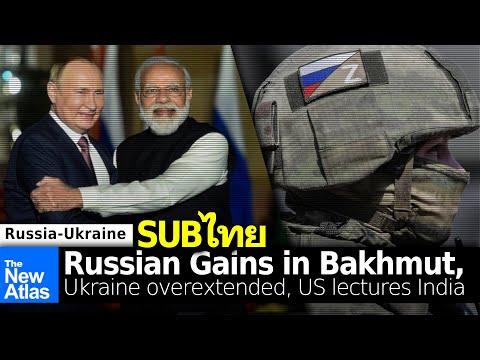
Russian Gains in Bakhmut, Ukraine Overextended, & US Lectures India

 October 17, 2022 (The New Atlas) - Update for Russian military operations against Ukraine for October 17, 2022.  Russian forces are closing...