Showing posts with label india. Show all posts

Thursday, May 27, 2021

US Maritime Bullying Targets "Ally" India

May 27, 2021 (Joseph Thomas - NEO) - Tensions temporarily spiked between Washington and New Delhi when US warships conducted a "freedom of navigation operation" (FONOP) inside India's exclusive economic zone (EEZ) in early April. 

The US' own 7th Fleet website in an announcement would claim: 

On April 7, 2021 (local time) USS John Paul Jones (DDG 53) asserted navigational rights and freedoms approximately 130 nautical miles west of the Lakshadweep Islands, inside India’s exclusive economic zone, without requesting India’s prior consent, consistent with international law. India requires prior consent for military exercises or maneuvers in its exclusive economic zone or continental shelf, a claim inconsistent with international law. This freedom of navigation operation (“FONOP”) upheld the rights, freedoms, and lawful uses of the sea recognized in international law by challenging India’s excessive maritime claims.

The Times of India in its article, "In unusual move, US navy conducts operation near Lakshadweep without India's consent," would report concerns by India's Ministry of External Affairs (MEA): 

"The USS John Paul Jones (US guided missile destroyer) was continuously monitored transiting from the Persian Gulf towards the Malacca Straits. We have conveyed our concerns regarding this passage through our EEZ to the US government through diplomatic channels,” added the MEA.

The article would also note: 

...the “tone and tenor of the aggressive public declaration” of FONOPs in India’s EEZ, at a time when the US is seeking India’s closer cooperation through the Quad and other mechanisms to foster “credible deterrence” against China in the Indo-Pacific, raised the hackles of the Indian security establishment.

Washington's claims that it conducted this operation to uphold "the rights, freedoms, and lawful uses of the sea recognized in international law" means that it sailed its warships into India's EEZ solely for this purpose, fitting into a much wider pattern of America's self-appointed role of enforcing its own interpretations of international law.  

According to the 2015, "US Department of Defense Freedom of Navigation Program Fact Sheet," the US claims:  

The Program is actively implemented against excessive maritime claims by coastal nations in every region of the world, based upon the Department's global interest in mobility and access. The Program is principle-based, in that it is administered with regard to the excessive nature of maritime claims, rather than the identity of the coastal nations asserting those claims. As a result, U.S. forces challenge excessive claims asserted not only by potential adversaries and competitors, but also by allies, partners, and other nations.

But of course FONOPs are inherently political, because they provoke political reactions from those targeted by them. Those reactions are most certainly calculated and understood before FONOPs are conducted. 

Thus, far from objectively "enforcing" what the US claims is "international law," the US FONOP in India's EEZ had a definitive political message; the US holds primacy over the Indo-Pacific region, not only primacy over adversaries like China, but also primacy over "allies" like India. 

Far from conjecture, the US itself in its own policy papers admits this. 

US "Freedom of Navigation" Operations Protect Primacy, Not International Law 

A paper titled, U.S. Strategic Framework for the Indo-Pacific" published as part of the White House archives for the departing Trump administration would open by stating its first "national security challenge" in the region was: 

...how to maintain U.S. strategic primacy in the Indo-Pacific region and promote a liberal economic order while preventing China from establishing new, illiberal spheres of influence, and cultivating areas of cooperation to promote regional peace and prosperity.

While some might point out that China was mentioned specifically by name, that is only because China is a near peer competitor of the United States and the foremost threat to US primacy in the region at the moment. 

Through the US Navy's FONOP in India's EEZ, it's clear that the emergence of any socio-political or economic order in the region independent of Washington's influence and challenging US primacy would also constitute a threat, including nations the US attempts to court into its sphere of influence as allies.  

It is not any specific threat China represents that has prompted America's adversarial and disruptive posture in the Indo-Pacific region, but rather the very general threat posed to American primacy, a threat that clearly nations like India or regional blocs like ASEAN also potentially pose.  

The pursuit of primacy drives America's "freedom of navigation program" in the Indo-Pacific region, not any genuine threat China or India pose to either the national security of the US itself or alleged threats to "international law" the US uses to justify its "freedom of navigation" program.

New Delhi and other rising powers in the region might take note of America's declared and demonstrated agenda in the region, avoiding overly committing to US activities in a bid to balance regional power in regards to rising China. Other, more reliable partners should be sought, because should the US be allowed to create an overbearing political, military and economic presence in the Indo-Pacific region, that leverage will be used against all nations, not just current adversaries like China.    

Joseph Thomas is chief editor of Thailand-based geopolitical journal, The New Atlas and contributor to the online magazine “New Eastern Outlook”.    

Friday, July 3, 2020

Is Washington Provoking India to a War With China?

F. William Engdahl breaks down the Anglo-colonial history behind China-India-Pakistan border disputes and how they fit into modern geopolitics.

July 4, 2020 (F. William Engdahl - NEO) - US Secretary of State Mike Pompeo in a recent video conference suggested that the US might move some of its troops from Germany to the region around India, citing growing US security concerns in the Asian region. Given the dramatic rise in tensions between India and China over disputed borders in the region of Nepal and Bhutan where several soldiers from both sides reportedly died in hand-to-hand combat, the question is whether Washington is deliberately trying to fan fires of war between the two Asian giant powers. As unlikely as that might be at present, it indicates how unstable our world is becoming amid the ‘coronavirus economic depression’, and the perceived power vacuum of a US in retreat.


Speaking to a virtual Brussels German Marshall Fund Forum on June 25,Secretary of State Pompeo was asked about recent statements that the US military planned withdrawing a contingent of its forces from Germany. He replied that the Chinese threat to India and Southeast Asian nations was one of the reasons America was reducing its troop presence in Europe and deploying them to other places. He cited unspecified recent Chinese actions as “threats to India, threats to Vietnam, threats to Malaysia, Indonesia and the South China Sea challenge,” adding, “We are going to make sure the US military is postured appropriately to meet the challenges.”

The Radcliffe Line
The borders between China and India and Pakistan are one of the most complex and arguably most sensitive regions for potential conflict ever since in 1947 British Viceroy Lord Mountbatten partitioned the British Indian Empire into a dominantly Muslim Pakistan and a dominantly Hindu but secular India.

That partition was opposed by Gandhi and other political leaders in India, who argued instead for a unified federal India with majority Muslim states or Hindu states retaining significant autonomy within a unified India. Mountbatten instead unveiled the secretly-drawn borders of a new Pakistan and India in a manner that fed a devastating slaughter between Hindu and Muslim as 14 million people were suddenly displaced based along the so-named Radcliffe Line that arbitrarily split the Punjab and Bengal provinces of British India between the new Pakistan and India. At the same time, as Mountbatten went back to England, he deliberately left the status of Jammu and Kashmir unresolved. That insured a permanent tension and potential war trigger between the two former parts of British India. Radcliffe, who had never before been in India, was made a Knight Grand Cross of the Order of the British Empire in 1948 for his service.

Now we turn today to the unresolved region which has been a constant point of friction since the British partition, namely Kashmir.


Jammu and Kashmir and Ladakh

In 1972 both countries, India and Pakistan, agreed on a provisional line of control in Kashmir which ceded Jammu and Kashmir and Ladakh to Indian administration, and the Northern Areas to Pakistan. Since the 1962 Sino-India War, China has claimed the northeastern part of Ladakh. Here is where we have the intersection of China, China’s major Belt, Road Initiative partner Pakistan, and India, which has remained steadfastly outside the BRI project. All three are nuclear powers as well.

Until 2019, Ladakh was a region of the state of Jammu and Kashmir. Then in August 2019, the Parliament of India passed an act by which Ladakh became a union territory of India on 31 October 2019. That did not meet with applause in Beijing. Because Ladakh is part of the strategic Kashmir region the Indian Army maintains a strong presence there.

China charged India with illegally building defense facilities across the border into Chinese territory in the Galwan Valley region of Ladakh. The PLA responded by building its presence in the region. Beijing claimed that India was also planning an airbase in Ladakh, something regarded as a strategic threat, as India has a military agreement with the USA which could allow US access to that airbase in a war situation. At that point reportedly, China began moves to block Indian plans in Ladakh.

Despite the fact Modi and China’s Xi Jinping agreed to talks to de-escalate matters, on June 13 the situation in Ladakh exploded into deadly clashes between Indian and Chinese PLA soldiers with numerous dead on both sides in hand-to-hand combat. That was the context in which Pompeo declared, “The PLA (People’s Liberation Army) has escalated border tensions with India, the world’s most populous democracy. It’s militarizing the South China Sea and illegally claiming more territory there, threatening vital sea lanes.” At the same time as tensions between Beijing and Washington escalate, three US aircraft carrier strike groups have been deployed in the Indo-Pacific zone, and there are plans to deploy American missiles in Asia, including India, as Washington looks to establish more bases in the Indo-Pacific region.

Indian journalists say that India’s Darbuk–Shyok–DBO Road infrastructure project in Ladakh is seen by the Chinese as a tool by India to offset the China-Pakistan Economic Corridor of the BRI. They claim that China attempted to capture the Galwan Valley as a pre-emptive measure to stall this DBO Road infrastructure project in Ladakh. According to this report, “China wants to stall the construction of the winding 255-km Darbuk-Shyok-Daulat Beg Oldie road that would give the Indian army easy access to the last military post south of the dominating Karakoram Pass. The Indian side is, however, determined to complete construction of the entire stretch by this summer including the 60-metre bridge across the Galwan rivulet or nallah near the point of its confluence with Shyok river. “ The legacy of the British partition of 1947 today is stark.

India’s ‘Chicken Neck’

As the clashes in Ladakh between China and India were still fresh, reports emerged that Chinese construction of key facilities inside the India-claimed disputed territory of Arunchal Pradesh, in the far northeast of India bordering China, was underway. According to a BJP member of Indian Parliament, Tapir Gao from Arunchal East, Chinese workers from the PLA were building concrete bridges, hydro-electric projects, helipads some 12 kilometers inside the Indian side of the demarcated McMahon Line of Arunachal Pradesh in an area once occupied by the Indian Army.

In recent years India has also accused China of making illegal encroachments on its perimeter in Bhutan and Nepal, further straining relations. Nepal, historically a predominantly Hindu buffer country between Imperial China and British India, underwent a ten-year bloody civil war led by the Communist Party-Maoist of Nepal. In 2007 the Nepal monarchy officially ended and a secular republic was established in 2008.

In recent years China has initiated a number of economic projects in Nepal. During a 2018 visit to Beijing, Nepal Prime Minister KP Sharma Oli, from the Communist Party-Maoist, signed a Memorandum of Understanding for construction of a railway linking Shigatse in Tibet with Kathmandu. Oli also signed on to Beijing’s Belt Road Initiative. That marked a major departure for Nepal which previously was considered by China as India’s sphere of influence, separated from China by the high mountain barrier. The same year China also agreed to allow Nepal use of four Chinese ports to end the country’s trade dependence on India. Under Prime Minister KP Sharma Oli, relations with India have deteriorated as Oli’s ties to Beijing have strengthened.

Bhutan is another strategic buffer state between India and China. In 2017 India and the Royal Bhutanese Army accused China of constructing a road in the disputed territory towards Doklam plateau. India intervened then, supporting Bhutan’s stand and asking China to halt its construction work. As one Indian analyst describes it, “The valley holds strategic significance for India, China as well as Bhutan. India sees it as a dagger pointed towards its so-called ‘chicken’s neck’ sector in the Northeast and rapid Chinese road construction in Tibet could make things difficult for India.”

As seen from New Delhi, the combined actions of China around its perimeter bordering Tibet in China ominously reminds them of the 1950 declaration by Mao that considers Tibet to be China’s right hand palm, with five fingers on its periphery: Ladakh, Nepal, Sikkim, Bhutan, and Arunachal Pradesh, and that it is China’s responsibility to “liberate” these regions. This, known as the Tibet Five Fingers Policy, one never appearing in print apparently, is causing considerable tension in Indian strategic circles.

Seen from Beijing, as relations with Washington become more overtly hostile in recent years and as India and the US appear to be drawing closer together, Chinese actions along India’s perimeter from Kashmir to Arunachal Pradesh seem to be prudent steps to secure Chinese borders as well as China’s strategic BRI corridor in Pakistan from any future Indian threat. Into this nuclear minefield now, the US Secretary of State has hinted at increasing military support for India, hardly a peace-making move. By contrast, Russia, who enjoys constructive relations both with China and with India has offered to mediate. The crisis on the Indian sub-continent looks primed to continue.

F. William Engdahl is strategic risk consultant and lecturer, he holds a degree in politics from Princeton University and is a best-selling author on oil and geopolitics, exclusively for the online magazine “New Eastern Outlook.”

Tuesday, June 23, 2020

China vs India: Who Benefits?

June 24, 2020 (Tony Cartalucci - NEO) - A recent border dispute between China and India have resulted in multiple casualties including deaths. It is the first time in decades that this scale of violence has been seen between the two nations. Western headlines have immediately tried to play up the notion of conflict between China and India, but to what end?


China and India respectively have the two largest populations. Both find themselves within the top 5 largest economies on Earth. Both have tremendous historical, cultural, and political influence regionally as well as growing influence globally.

Recent headlines have focused on a simmering conflict along China and India's borders, but at other times in recent years, Chinese and Indian cooperation have been on the rise - a fact conveniently underreported in many articles.

Of course, neither China nor India as nations benefit from armed conflict between one another. Both nations possess large conventional armed forces and both nations possess nuclear weapons. Both nations have suffered from the impact of COVID-19 economically. A large-scale conflict would be costly and catastrophic for China and India.

China has maintained that it was merely responding to Indian aggression along the border and claims it seeks to quickly deescalate tensions.

China's CGTN in an article titled, "China's military urges India to stop provocative actions along border areas," would claim:
China's military voiced strong dissatisfaction and opposition Tuesday to India's provocative actions on Monday evening in the Galwan Valley region, which caused severe clashes and casualties. It urged India to go back to the right track in properly managing disputes.
Conversely, India's media tells a different tale. The violence has been immediately leaped upon by hawks to bolster entirely unrelated issues involving China's "challenge" to the international "status quo." It is a narrative that sounds torn straight from a Washington-based think tank's white papers.

The Indian Express in an article titled, "Explained: What the clash in Ladakh underlines, and what India must do in face of the Chinese challenge," cites Indian politicians, explaining that the incident serves as impetus to create a wider confrontation with China in a bid to roll back not only its regional influence - but its growing global reach.

It claims (emphasis added):
According to Adhir Ranjan Chowdhury, Congress leader in Lok Sabha, this escalation “underlines the scale of the problem and the challenge ahead” for New Delhi in its dealings with Beijing. Chowdhury argues in The Indian Express that “China has clearly twisted the crisis into a strategic opportunity by taking advantage of the geo-political distraction”.

That China is becoming more belligerent across strategic theatres, challenging the status quo, is supported by multiple examples from the South China Sea. For the Government of India, this is a moment to guard against complacency, fostered by decades of nimble diplomacy that led to equilibrium, however precarious, on the border issue with China.
The issue regarding the South China Sea is one entirely manufactured out of Washington, with many of the actors involved - including the Philippines - having long since distanced themselves from the potential conflict in favor of building better ties with Beijing.

For certain Indian politicians to cite Washington's game in the South China Sea, and to then lump it in with this most recent border dispute - rather than simply seeking to deescalate tensions is highly suspicious.


British state media - the BBC - in its article, "India-China clash: An extraordinary escalation 'with rocks and clubs'," would claim:
Mr [Shivshankar] Menon, who served as India's ambassador to China, believes that China is resorting to strident nationalism, due to "domestic and economic stresses" at home. "You can see it in their behaviour in Yellow Sea, towards Taiwan, passing laws without consulting Hong Kong, more assertive on India's border, a tariff war with Australia."
The BBC fails to point out that China's policies toward Taiwan, Hong Kong, and recent trade disputes with Australia are all - without exception - owed to US meddling in China's internal affairs. The US which officially recognizes Taiwan as China's territory has all but worked to carve it off from China and establish it as a US foothold on China's doorstep.

The same can be said of Hong Kong with recent violence there openly sponsored by the US.

Australia - who counts China as its largest trading partner - and whose government is increasingly friendly with Beijing, has recently caved to US pressure and joined in political campaigns accusing China of unleashing COVID-19 - thus kicking off renewed tensions between the two nations.

If Indian politicians and diplomats see the recent border incident as "related" to US-driven conflicts aimed at encircling and containing China - does that mean this most recent border incident and the decidedly more aggressive reaction by some of India's politicians falls into the same category?

Cui Bono? 

China and India have had border issues in the past. Total war has been avoided and the conflicts have done little to change any significant aspects of either nation's regional or global influence. In other words, even if India felt it was losing out to China's rise - using a border incident to start a wider conflict would harldy help India change this fact.

For India - seizing on this conflict regardless of who really initially provoked it - does nothing to serve India's interests in the short, intermediate, or long-term. They do - however - perfectly serve the interests of the United States who would prefer neither China nor India rise as regional powers - and would find it as ideal for both nations to destroy one another partially or entirely while the US reasserts itself across the region.

Provocations and those attempting to exploit them may represent Washington's best interests, but they do not represent India's or China's. Those involved are hawkish and decidedly pro-Washington serving US interests at India's expense.

Meanwhile, other Indian leaders and their Chinese counterparts have worked since the conflict arose to deescalate and resolve border issues - or at least resolve them to where military exchanges are no longer an option.

Even the BBC, at the very end of its article, admitted that despite the illusion of imminent war - China and India have enjoyed growing ties, stating (emphasis added):
"For 10 years, Sino-Indian rivalry has steadily intensified, but remained largely stable," he [Shashank Joshi] said. India and China have also been more engaged. Bilateral trade increased 67 times between 1998 and 2012, and China is India's largest trading partner in goods. Indian students have flocked to Chinese universities. Both sides have held joint military exercises.
It is unlikely that the vast majority in both China and India benefiting from constructive ties between the two nations will give in to a tiny minority who ultimately serve the interests of neither nation and instead the interests of Washington far abroad and away from the consequences of unchecked conflict.

For these reasons it's safe to say that while this conflict is dangerous and both sides need to treat it with maximum caution and care, the fact that neither side benefits from the conflict unraveling out of control means it is very unlikely to do so.

While the recent violence has been unseen in decades, it can be hoped that it is one of the last disputes between China and India that involves violence, and the last gasp of malign interests seeking to sabotage and set back both nations.

Tony Cartalucci, Bangkok-based geopolitical researcher and writer, especially for the online magazine New Eastern Outlook”. 

Friday, October 12, 2018

American Meddling in the Maldives is Aimed at China

October 12, 2018 (Joseph Thomas - NEO) - The United States was exuberant after its proxies took power in the Maldives during the September 24th elections.  Ibrahim Mohamed Solih of the Maldivian Democratic Party (MDP) came out with 58% of the vote over incumbent, President Abdulla Yameen.


Former US Ambassador to the UN Samantha Power would exclaim on social media:
The people of the Maldives (turnout: 89%!) showed extraordinary bravery in ousting their repressive president at the ballot box. They join Ethiopians, Armenians, Malaysians & others in making clear the enduring power - and necessity - of democratic values.

The American media also did little to hide its excitement, and linked the victory directly to a wider US-led effort to set Beijing's regional influence back.

The Wall Street Journal in its article, "More Belt and Road Backlash: The Maldives turns away from China and back toward democracy," would claim:
On Monday President Abdulla Yameen conceded defeat to Ibrahim Mohamed Solih, a longtime member of parliament. Some 90% of eligible voters turned out. Mr. Solih won with 58% of the vote after promising to restore democracy and improve relations with the West. He also vowed to take a harder line against Chinese investment. 
The Wall Street Journal would repeat a now familiar narrative promoted by the US regarding China's One Belt, One Road initiative, claiming:
Alarmists say climate change means the Maldives will be underwater soon, but predatory loans could drown the nation’s finances first. China began investing heavily in the country’s public works in recent years. A 2017 International Monetary Fund report found that its debt-to-GDP ratio “rose nearly 11.5 percentage points from 2014-16.” Its external debt could hit 51.2% of GDP by 2021 thanks to Chinese projects. The IMF says servicing this debt will cost about $92 million a year for four years, while the government takes in only about $1 billion a year.
It is interesting that the Wall Street Journal cites the IMF, a Western-dominated financial institution notorious for its own debt traps, debt traps nations were placed into minus the tangible public works China is building across Eurasia.

As for claims that the Maldives have turned "back toward democracy," nothing could be further from the truth.

America's Proxies in the Maldives Not the Democrats They've Been Made out to Be  

The victorious opposition party, the Maldivian Democratic Party, is headed by former Maldives president, now fugitive Mohamed Nasheed.

Nasheed had been president from 2008-2012. He was forced to resign after being charged with terrorism.

In 2015, he was finally convicted and sentenced to 13 years in jail. After significant pressure from the West, the Maldives allowed Nasheed to travel to the UK on grounds of receiving medical treatment. Nasheed was subsequently granted asylum by the UK government and has worked to return himself to power ever since.


Many reports across the Western media categorically (and likely intentionally) fail to provide details regarding the charges and convictions.

This is because the details tell an astounding story of Western hypocrisy and reveal America's proxies in the Maldives as being as repressive as they've claimed their opponents to be.

The terrorist charges were linked to Nasheed's jailing of a judge in 2012. Western media accounts have since omitted the details of this arrest for obvious reasons, but a BBC article published in a January 2012 titled, "Maldivian army arrests senior judge Abdulla Mohamed," would admit at the time that:
A government statement said the judge, Abdulla Mohamed, had allowed "his judicial decisions to be determined by political and personal affiliations". The arrest comes after he released an opposition leader who had been detained for allegedly defaming the government.
The BBC would further elaborate:
Opposition [to Nasheed's government] activists said that the arrest was in retaliation for the judge ruling that the detention of opposition leader Mohamed Jameel Ahmed one day earlier was illegal, AP news agency reported. 

Mr Ahmed had been arrested for allegedly defaming the government in a television interview. 
In other words, America's "pro-democracy" ally in the Maldives, had jailed an opponent for merely criticising his government on television, then jailed the judge who ruled the imprisonment illegal.

Nasheed's repression is precisely what the US, UK and their virtual army of supposed human rights organisations had used as a basis to label Yameen's government as "repressive."

Nasheed's National Endowment for Democracy Connection

While the Western media has hardly made it a secret that Nasheed and his Maldivian Democratic Party are Washington and London's proxies in a power struggle with Beijing, some of the details of Nasheed's escape to the UK and his activities there since provide greater context to American meddling in the Maldives, contradicting any remaining notion that recent elections had anything to do with democracy.


A 2017 panel discussion organised by the University of Michigan titled, "The Island President's Struggle for Democracy and Environmental Justice in the Maldives," would describe Nasheed's escape as follows:
With his health deteriorating, he managed to find exile in London with the help from international lawyers Jared Genser, Amal Clooney, and Ben Emmerson. He continues his tireless efforts to promote democracy in his homeland and is now poised to pursue presidency again in his beloved homeland.
Nasheed's international lawyer, Jared Genser, also spoke at the panel. His biography was also illuminating (our emphasis):
Jared Genser is Managing Director of Perseus Strategies, a law and consulting firm that focuses on human rights, humanitarian, and corporate social responsibility projects. He is also Founder of Freedom Now, a non-governmental organization that works to free prisoners of conscience worldwide. Genser was an Associate of the Carr Center for Human Rights Policy at Harvard University from 2014-2016, a Visiting Fellow with the National Endowment for Democracy from 2006-2007, and was previously named by the National Law Journal as one of “40 Under 40: Washington’s Rising Stars.” Before founding Perseus Strategies,
The National Endowment for Democracy (NED) is openly Washington's primary means of influencing, infecting, coercing and even overthrowing political orders in an industrialised process of global meddling. Genser's Freedom Now is one of many organisations working in parallel with the NED, and is funded by many of the same government and corporate foundation sponsors.


NED, its subsidiaries and affiliates operate in scores of nations around the globe, openly funding media fronts, lawyers, supposed rights groups and even entire political parties aimed at creating first vectors for US influence within targeted nations, before incrementally overwriting and eventually overthrowing the local institutions and political orders of these nations.

Amid any political conflict grabbing headlines around the globe, by simply following NED funding, America's role in creating or taking advantage of chaos can be quickly ascertained.

A party like MDP run by an open proxy of Western interests, hiding in London flanked by international lawyers and lobbyists including Genser with links to the National Endowment for Democracy, has nothing at all to do with democracy. Democracy first and foremost entails self-determination. A party run by and for foreign interests is precisely the oppose of self-determination and could not be further from true democracy, no matter how much people like Samantha Power insist otherwise.

The contest for power in the Maldives is one of great powers, India, China and the United States, and lesser powers like the UK, struggling for influence over the geographically strategic island nation. It is not one of "ideology," or of "repression" versus "democracy. " It is clear that Nasheed and his party are as bad as they've claimed their opponents are. Double as bad considering Nasheed's hypocrisy and his servile dependence on Washington and London to provide him with a political future.

The Maldives would be best served by a foreign policy that favours neither the US nor China, but attempts to build balanced ties with all nations to serve its own best interests. While there are doubts the previous government was committed to such balance, it is certain Nasheed's proxy government now coming to power is not.

The future of the Maldives will continue to see this power struggle play out. China has exhibited supreme patience, confident that its successes elsewhere will bring even the most stubborn proxies of Western power over to Beijing's side. For Washington, it must struggle to maintain proxies like Nasheed in power, continuously cover up the hypocrisy his party will again undoubtedly indulge itself in, as well as attempt to foil Chinese progress elsewhere in the region and around the globe.

One of these great powers has a sustainable regional strategy. One does not. It takes little geopolitical acumen to determine which is which.

Joseph Thomas is chief editor of Thailand-based geopolitical journal, The New Atlas and contributor to the online magazine “New Eastern Outlook”.

Friday, March 14, 2014

India: Grassroots Activism Builds Wall Against Western Imperialism

7287764d378ca80f44d7a97681332289_largeMarch 14, 2014 (Tony Cartalucci - NEO) - In the Times of India article, “Farmers’ groups give wish list to parties,” it states:
More than 100 farmers’ organisations from about 14 states on Thursday presented a charter of demands to political parties for their considering while preparing the manifesto for the Lok Sabha elections. 
The groups demanded guarantee of minimum income for farm households, ecologically sustainable farming, shift to organic farming and control of rural communities over agricultural resources, including land, water, forests and seeds. They also demanded that open-air release of genetically modified organisms (GMOs) in the garb of field trials be stopped.
Regarding the disturbing trend of suicides sweeping across India’s agricultural sector, the report states:
Citing census data, farmers’ representatives said on an average, one farmer commits suicide every half an hour. Everyday, hundreds of farmers are quitting agriculture. 
“The average monthly income of an overwhelming majority of Indian farmers is far less than what their average monthly expenditure is, making it difficult for most farm households to make their ends meet,” said Kavita Kuruganti, convenor for Alliance for Sustainable and Holistic Agriculture.
Clearly, the agricultural sector of India is failing, and it is not because it has not resigned itself to the devices and designs of foreign big-agri corporations, but precisely because it already has. In rebuttal to the growing backlash against corporations like Monsanto, Western media outlets have proposed that the farmers are wrong about why they claim they are killing themselves, and suggests instead it is both neither as serious as portrayed, and certainly not the result of big-agri’s role in monopolizing India’s agricultural sector.

A 2011 report published by the Center for Human Rights and Global Justice (CHRGJ) claimed the sale of expensive genetically modified seeds to rural Indian farmers was a key factor contributing to the growing suicide crisis. 
“Multinational agribusiness corporations took advantage of India’s new market globalization … by aggressively promoting the introduction of genetically modified seeds in Indian agriculture,” said the report.
But then counters by claiming:
But in 2008, the International Food Policy Research Institute, an alliance of 64 governments, private foundations, and international and regional organizations that aims to end hunger in the developing world, reached an entirely different conclusion. 
“It is not only inaccurate, but simply wrong to blame the use of Bt cotton as the primary cause of farmer suicides in India,” said the report, stating that the introduction of Bt cotton in India had actually been effective in producing higher yields and decreasing pesticide usage by nearly 40%.
The credibility and objectivity of the “International Food Policy Research Institute (IFPR),” particularly in regards to the use of Bt cotton in India, is compromised by the fact that its donors list is dominated by organizations of which Monsanto and other GMO purveyors fund directly.

For example, the “Better Cotton Initiative” which funds the IFPR is in turn backed by big-agri giant Cargill. Another IFPR donor is Crop Life International, which in turn is funded by BASF, Bayer, Dow AgroSciences, DuPont, Monsanto, Syngenta, and others. The laundering of big-agri cash and support through proxy organizations to conceal their involvement only further raises suspicion regarding the integrity and veracity of the IFPR’s contradictory report – a report that just so happens to define reality in terms that suits big business.

And of course, the National Post itself appears compromised, with its article parroting, almost verbatim, the official rebuttal posted on Monsanto’s official website regarding Bt cotton. Offered up in a post titled, “Is Bt or GMO Cotton the Reason for Indian Farmer Suicides,” Monsanto also claims “multiple societal issues are contributing to an unacceptably frequent occurrence of farmer suicides in India,” just as the National Post does – and to no one’s surprise, references the very report the recipient of Monsanto’s laundered funding published.

And while big-agri attempts to deflect attention away from the impact of genetically modified crops, the big-agri chemical racket even without the use of GMO has resulted in the ruination of farmers nationwide not just in India, but in nearby Thailand as well. Were big-agri’s miracle cures as good as they claim, farmers worldwide would be enjoying unprecedented, undeniable prosperity, rather than constantly living upon a razor’s edge, and more often than not falling into the abyss all together.

India’s Grassroots are Fighting Back 

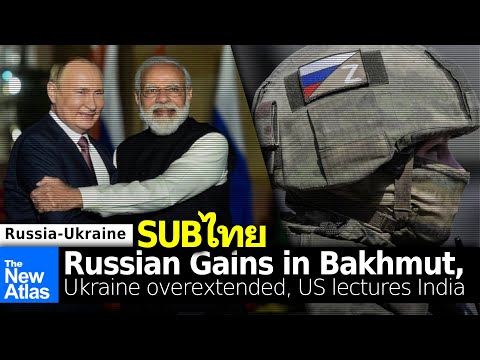
Russian Gains in Bakhmut, Ukraine Overextended, & US Lectures India

 October 17, 2022 (The New Atlas) - Update for Russian military operations against Ukraine for October 17, 2022.  Russian forces are closing...