Showing posts with label philippines. Show all posts

Wednesday, May 25, 2022

West Decries Philippine’s New Government – US-backed Protests Begin

May 26, 2022 (Brian Berletic - New Eastern Outlook) - Recent general elections in The Philippines appear to signal the island nation’s continued but gradual move out from under US subordination and its rise with the rest of Asia as China emerges as both a regional and global superpower.


With Ferdinand “Bongbong” Marcos Jr. set to become the next president along with his running mate, Sara Duterte, daughter of the outgoing President Rodrigo Duterte, the Western media appears convinced that it signals the continued building of relations between The Philippines and China and the gradual diminishing of American influence over both The Philippines and the rest of the region.

The Southeast Asian nation of The Philippines has been of strategic importance to the US pursuit of primacy over Asia for decades. From 1898 to 1946 The Philippines was actually a colony of the United States and since the nation gained its independence at the end of World War 2, the US has sought to maintain a military presence on the island nation, as well as political control over it.

In recent years Philippine President Rodrigo Duterte has seriously challenged attempts by the US to derail the nation’s ties with China. China represents not only The Philippines’ largest trade partner, but also an increasingly important infrastructure partner. When the US in 2016 organized an “arbitration” at the Hague rejecting China’s claims over the South China Sea under the nine-dash line, President Duterte refused to leverage it and instead worked with China bilaterally.

According to The Sydney Morning Herald in an article titled, “There is a new Marcos in Manila and he wants a maritime deal with China,” the incoming president, Marcos will likely continue pursuing bilateral solutions rather than seek a confrontation underwritten by Washington.

The article notes:

Philippines is one of several nations that have territorial disputes with Beijing in the South China Sea. But Marcos has foreshadowed an intention to pursue a maritime deal with Xi Jinping’s regime and set aside an international tribunal ruling in The Hague that rejected China’s sweeping claims to most of the contested waterway under its so-called nine-dash line.

“That arbitration is no longer an arbitration if there’s only one party. So, it’s no longer available to us,” he said in January, adding that war is not an option and “bilateral agreement is what we are left with”. 

The article also noted that Marcos has insisted he would not turn to the US in regards to his nation’s relations with China.

Policy analysts cited in the article would claim that regardless of the incoming Philippine government’s stated policies, the US and its partners, most notably Australia, would “have to make sure the Marcos regime will not lean too much into the Chinese orbit of influence.”

Benar News, admittedly funded by the US government through an annual grant from the United States Agency for Global Media (USAGM), in its article, “Marcos seen as pro-China; Robredo will likely test Beijing ties,” would make it much clearer:

China would likely enjoy friendly ties with the Philippines if Ferdinand Marcos Jr. wins next week’s presidential election, while his main challenger, Vice President Leni Robredo, has vowed to seek help in protecting Philippine waters in the South China Sea, American analysts said.

This “insight” was garnered from Benar News’ interview with the likewise US government-funded Center for Strategic and International Studies (CSIS) whose analyst Greg Poling claimed:

Marcos is the most pro-Beijing of all candidates. He is the most pro-Chinese in a system where most people are anti-Chinese. He avoids the press and debates, and what we have are these off-the-cuff remarks that are pro-Chinese. He is a friend of the Chinese embassy.

Marcos’ opponent during the election was Leni Robredo. She served as vice president with President Duterte (The Philippines vote for president and vice president separately allowing opposing politicians to serve side-by-side).

The Benar News article would claim regarding her position regarding China and the US:

Poling said Robredo may not be ideologically pro-American or a “cheerleader for the alliance,” but she appears to be a nationalist who could tap allies for help in the territorial row that has dragged on for years. 

“She is pragmatic about the South China Sea. [She believes] China is a threat and violates the rule of law in the South China Sea,” Poling said, adding that there was reason to believe that her victory could strengthen the Philippine-US alliance.

Manila is Washington’s biggest ally in Southeast Asia, where an increasingly assertive China is encroaching on other claimant nations’ exclusive economic zones in the disputed South China Sea.

Benar News’ article attempts to suggest Robredo is not excessively “pro-American.” But her track record tells a different story.

Robredo was Washington’s Candidate of Choice

Robredo has previously worked for a legal organization funded through foreign governments and foundations including the US government via USAID. Rouge in an article titled, “The Evolution of Leni Robredo: How the VP Underdog Became the Race’s Strongest Contender,” would note:

Robredo landed a gig with SALIGAN (Sentro ng Alternatibong Lingap Pangligal), an alternative legal support group, begun in Ateneo de Manila University and based in Bicol. “We were like community organizers,” she says of their work. The team would trek to far-flung communities with little to no access to legal aid, and provide paralegal help.

She would spend a decade at SALIGAN, an organization that has for years directly and as part of a wider legal network received funding from and has worked with the US government in shaping and interfering in Philippine sovereign institutions.

In a 2008 USAID document, it would explain:

One ALG, Saligan, reportedly trained almost 500 paralegals to guide farmers’ land reform applications through Department of Agrarian Reform administrative processes. The organization also played a key role in getting the Naga City Government to institutionalize a People’s Council—a permanent official advisory channel for NGO input into the functioning of municipal services. 

With “NGOs” serving as one of the US’ major vectors for interfering in the internal political affairs of targeted nations, SALIGAN’s role in creating councils as “advisory channels for NGO input” means giving US-sponsored organizations the ability to directly influence political decisions.

In 2018 as vice president, Robreto would participate in a US National Endowment for Democracy (NED) program – the Young Leaders for Good Governance (YLGG) Fellowship.

The US government-funded program is meant to not only influence who takes leadership roles in the Philippine government, but also what sort of policies they create – essentially building pro-American political cadres in the heart of the Philippine government.

In an International Republican Institute (IRI) article titled, “Why is it Important to Have Local Level Citizen-Centered Governance in the Philippines?,” it would note Robreto’s role in meeting with participants:

The fellows were particularly honored that Vice President of the Philippines, Leni Robredo spoke at the graduation ceremony. Vice President Robredo addressed the importance of fostering good governance and the crucial role these fellows play in the future of the Philippines, in which they should “innovate and search for better ways to solve problems, change mindsets, take risks and be successful politicians without sacrificing their values.”

While the US accuses China of attempting to influence nations around the globe in contradiction to US interests simply through trade and infrastructure investments, one only has to imagine the reaction from Washington if it was China organizing “leadership programs” to train and install into power its own political cadres.

The Urgency of US-Philippine Military “Cooperation”

A recently published RAND Corporation paper titled, “Ground-Based Intermediate-Range Missiles in the Indo-Pacific – Assessing the Positions of U.S. Allies,” focuses on the necessity for the US to place intermediate-range missiles within striking distance of China. These missiles along with other military assets are prerequisites for any conventional war waged by the US against China – conventional war the US sees as absolutely necessary between now and as early as 2025 to prevent China from irreversibly surpassing the US economically and militarily.

The paper mentions the Philippines specifically, claiming:

The US alliance with the Philippines is in a state of flux. While the Philippine public and elites generally support the United States and the alliance itself, current President Rodrigo Duterte has pursued policies that negatively affect ties. Specifically, since his election in May 2016, Duterte has advocated closer ties with Beijing while concurrently pursuing policies that weaken core pillars of the US-Philippine alliance. Although Duterte has backtracked somewhat on these approaches, leading to some improvement in US-Philippine ties, as long as future Philippine leaders continue similar policies, including opposition to a permanent US military presence, the Philippines is extremely unlikely to accept the deployment of US GBIRMs

Because US strategy in regards to encircling, containing, and potentially waging conventional war against China depends heavily on prepositioning these missiles and other military assets along China’s periphery – especially in regards to Taiwan – securing a sufficient US military presence in the Philippines is crucial. But because such a presence meant solely to threaten China would endanger Chinese-Philippine relations including significant economic ties, no rational government would allow it.

The formation of Marcos’ administration will go far in telling just how Philippine policy toward both China and the US will unfold, but it is safe to say that should the new government attempt build closer ties with China and refuse attempts by the US to recruit it into a regional front against Beijing, the US will employ all the familiar tools used to coerce or even overthrow the government in due time.

If the US is convinced already that the Marcos administration will not pivot toward anti-China policies, it may begin destabilizing efforts through extensive media, NGO, and political networks funded through the NED even before his late-June inauguration. Such efforts would start with youth-led protests citing baseless claims of “voter fraud.” Such protests are already underway.

The New York Times in its article, “Marcos Win Prompts Protests in the Philippines,” claims:

Young voters who had rallied around Leni Robredo during the presidential race gathered to voice their frustration with preliminary results showing her overwhelming defeat. 

The article also claims:

Multiple election observers said they had received thousands of reports of election-related anomalies since the vote on Monday. Malfunctioning voting machines were one of the biggest concerns, with VoteReportPH, an election watchdog, saying the breakdowns had “severely impaired this electoral process.”

VoteReportPH is a conglomeration of US, Western, and allied-funded organizations. “UP Internet Freedom Network,” for example, admits on its website to being funded by the Taiwan government-funded DoubleThink Lab as well as the Western government-funded “Civicus” network. It is only one of many US-funded networks eagerly supporting the current protests.

It is clear Washington sought a different electoral outcome and will use the now familiar tools of US-sponsored “color revolution” to coerce the incoming government to sabotage its ties with China and militarize itself as yet another US proxy. Failing that, the US would seek to overthrow and replace this government with one more to Washington’s liking.

Only time will tell how long these recent protests last and whether or not The Philippines can manage this balancing act with grace, securing socio-economic stability and exploiting the many opportunities offered by China’s regional and global rise, or if through US interference, the Marcos administration is tripped up, landing The Philippines into internal chaos and at the very least, denying the nation as a partner for China.

Brian Berletic is a Bangkok-based geopolitical researcher and writer, especially for the online magazine “New Eastern Outlook”.

Thursday, March 19, 2020

Philippines: Crawling Out From Under America's Shadow?

March 20, 2020 (Joseph Thomas - NEO) - President of the Philippines, Rodrigo Duterte, has announced his intentions to end the nation's security agreement with the United States, specifically its Visiting Forces Agreement. 


The move puts into question America's military presence in the Philippines and the influence it projects across Asia with it. In particular, it further complicates US attempts to encircle and contain the rise of China both in the region and upon the global stage. 

Framing Growing US-Philippines Tensions 

NPR in its article, "Philippines Says It Will End U.S. Security Agreement," would report that: 
At the direction of President Rodrigo Duterte, a fierce critic of the United States, the Philippines announced Tuesday that it would scrap a security pact that allows American forces to train there.
The article would also report:
"It's about time we rely on ourselves. We will strengthen our own defenses and not rely on any other country," Philippine presidential spokesman Salvador Panelo said at a regular press briefing, quoting Duterte.
He said Manila would be open to similar agreements with other countries. "As long as it is favorable to us and there is a mutual benefit to both countries, we are open," he said. 
NPR would cite US pressure placed on the Philippines regarding its "war on drugs" and the alleged human rights abuses stemming from it as the motivation for this recent decision.

Of course, the US itself is one of the leading nations in terms of human rights abuses meaning that any pressure placed on the Philippines for allegedly violating human rights was done solely for political reasons.

In the Philippines' case, its attempts to improve ties with Beijing and distance itself from commitments to its former colonial masters in Washington drive most of Washington's "humanitarian concerns" regarding Manila and its domestic policies.

The Philippines: Former Colony, Current Client State  

NPR would describe the Philippines as having been "a former U.S. territory that gained independence in 1946" and that it "has long viewed Washington as its strongest ally."

In reality, the US seized the Philippines at the end of the Spanish-American War, then brutally extinguished attempts by the island nation to grain independence from Washington resulting in tens of thousands of deaths. The Philippines have since been the subject of US political machinations, meddling, interference and coercion since achieving its mostly symbolic independence in 1946.

Through a mixture of political interference, subversion and even terrorism, the US has attempted to extend its hold over the island nation. In recent years as US influence in Asia wanes and as China's grows, Manila has attempted to break this hold, if not entirely, incrementally through exerting pressure on Washington with threats precisely like the termination of the Visiting Forces Agreement.

The Real Reason Behind the US Military's Presence in the Philippines

NPR claims that the termination of the Philippines' cooperation with the US military could impact the nation's current struggle against extremists in its southern regions. The article mentions the 2017 battle against terrorists linked to the so-called Islamic State (IS) in the city of Marawi and US aid to the Philippine government rendered to win it.


What NPR fails to tell readers is that IS was a deliberate creation of US foreign policy; first to wage proxy war against Syria, and since then used as a proxy elsewhere, or in the Philippines' case, used as an excuse for a perpetual US military presence within Philippine territory.

Of course, the US military is not in the Philippines to help defend the nation against terrorists nor against outside enemies like "China" as Manila has good ties with Beijing, ties that grow stronger each year.

NPR even admits the US maintains a naval presence in the Philippines specifically to serve its ongoing provocations vis-a-vis China, claiming:
The U.S. Navy is also seen as a bulwark against China's territorial ambitions in the South China Sea. About a third of global shipping passes through its sea lanes, and the U.S. conducts Freedom of Navigation Operations in those waters in a bid to keep them open, to China's displeasure. 
The Philippines of course has little to gain from hosting a belligerent nation using its territory as a springboard to provoke one of the Philippines' biggest trade partners and a nation Manila is building other important ties with including military ones, and ties on much more agreeable terms for Manila than those it has with Washington.

The Philippines' agreement with the US is an impediment to the nation's future, not an assurance for it.

But Not as Drastic as it Appears 

Manila's termination of its military agreement with the US may appear drastic. However, it may not even be permanent and will likely be followed by negotiations between Washington and Manila to make existing ties between both nations more agreeable for Manila.

Even if the move is permanent, it will not automatically mean the withdrawal of all US military assets from the Philippines nor will it mean the absolute termination of all military cooperation between the Philippines and the US.

But it does represent the incremental erosion of US influence not only in the Philippines but across the rest of Asia. US hegemony in the region wasn't established overnight, and thus will not be dismantled overnight.

The Philippines is a nation that finds itself in orbit around the US, the product of over a century of US imperialism in the Pacific, but also a nation whose orbit grows in distance each year from Washington. At the same time, nearby China has grown in economic and political size, pulling in nations like the Philippines, not with imperialism but with economic incentives and the promise of doing business without the political prying practiced by Washington.

Since the US lacks any genuine incentive for the Philippines to reverse its growing distance from Washington, it will likely resort to additional provocations that will only push Manila further away and provide additional opportunities for Beijing.

The possible end of the US-Philippines Visiting Forces Agreement doesn't spell the end of US hegemony in Asia or even over the Philippines. It does however mark another incremental step towards both.

Joseph Thomas is chief editor of Thailand-based geopolitical journal, The New Atlas and contributor to the online magazine “New Eastern Outlook”.

Friday, June 21, 2019

US NED-Funded Meddling Exposed in The Philippines

June 22, 2019 (Joseph Thomas - NEO) - With little else to offer the nations of Southeast Asia, the US has opted instead to wield the familiar and well-honed weapon of political subversion to peel potential partners away from Beijing in Washington's continued bid to rescue its waning primacy in Asia-Pacific.


The most recent manifestation of this can be seen in the Philippines where Manila has accused media front Rappler, founded by long-time CNN bureau chief Maria Ressa, and others of representing foreign interests and conspiring with foreign intelligence agencies in direct violation of the nation's constitution.

The Committee to Protect Journalists (CPJ) in its defense of Rappler would claim:
First were the politically motivated state charges that funding provided to the news website Rappler by a U.S. philanthropic foundation represented a violation of constitutional provisions barring foreign control or ownership of Philippine media. 

Then came government allegations in April that journalists from independent media groups, including Rappler, the independent media organization VERA Files, and the non-profit Philippine Center for Investigative Journalism, were involved in a conspiracy to discredit and oust President Rodrigo Duterte's elected government. All four outlets issued statements denying the allegation. 

Now, a pro-government media campaign claims that the same independent news outlets and the Philippine press freedom group Center for Media Freedom and Responsibility are in the pay of the U.S. Central Intelligence Agency (CIA), a potential criminal offense under local law.
The CPJ notes that all of the accused groups are openly and admittedly funded by the US government via the National Endowment for Democracy (NED). The CPJ admits (my emphasis):
All four outlets receive substantial grants from the NED. 

Funded largely by Congress, NED was founded in the early 1980s as a way for the U.S. to openly promote democracy worldwide by providing annual grants to non-governmental groups, according to its website.

The CPJ categorically fails to challenge what are the NED's own assertions that it is merely "promoting democracy worldwide."

NED: The Public Face of (Often Violent) US Regime Change 

The NED's board of directors includes individuals openly involved in US-backed regime change including in Iraq, Ukraine and ongoing US regime change efforts in Venezuela.

Board members including Francis Fukuyama and Elliott Abrams openly advocated the US invasion of Iraq in 2003 in which the government in Baghdad was toppled and its senior leadership murdered based entirely on now verified lies regarding supposed "weapons of mass destruction."

Elliott Abrams is listed on the NED's website as "On Leave," having been appointed as a US special envoy for Venezuela amid ongoing efforts to overthrow the government there.

The Guardian in an article titled, "US diplomat convicted over Iran-Contra appointed special envoy for Venezuela: Elliott Abrams, who was linked to failed coup against Chávez, to join Pompeo to urge security council to recognize Guaidó as head," would report:
Elliott Abrams was appointed US special envoy for Venezuela on Friday, as Donald Trump’s administration and European leaders on Saturday further increase the pressure on the socialist president, Nicolás Maduro, to step aside from leading the country he has taken into a deepening crisis. 

Abrams will accompany the US secretary of state, Mike Pompeo, to a meeting of the UN security council in New York on Saturday, during which Pompeo will urge members to join the US in declaring Venezuela’s opposition leader Juan Guaidó as the legitimate head of state.
The  Guardian also notes:
Abrams is widely remembered in Central America, but particularly from his time in the Reagan administration, when he tried to whitewash a massacre of a thousand men, women and children by US-funded death squads in El Salvador, when he was assistant secretary of state for human rights.
Other NED directors include Victoria Nuland who played a key role in leading US regime change efforts in Ukraine in 2014.

Reuters in its article, "Leaked audio reveals embarrassing U.S. exchange on Ukraine, EU," would admit:
A conversation between a State Department official and the U.S. ambassador to Ukraine that was posted on YouTube revealed an embarrassing exchange on U.S. strategy for a political transition in that country, including a crude American swipe at the European Union. 
The article also admitted:
The audio clip, which was posted on Tuesday but gained wide circulation on Thursday, appears to show the official, Assistant Secretary of State Victoria Nuland, weighing in on the make-up of the next Ukrainian government.
The convergence of senior US representatives openly and repeatedly involved in (often violent) regime change most certainly involving the CIA among myriad other US organisations within the halls of the NED is no coincidence.

The NED exists to promote regime change worldwide, merely under the guise of "promoting democracy worldwide."

The CPJ Defends US-funded Subversion Under Guise of "Press Freedom" 

The CPJ failed categorically to inform readers of facts surrounding the true nature of NED and its activities in its defence of Rappler.

This however should come as no surprise. The CPJ itself is yet another shell organisation likewise funded by US corporate foundations for the purpose of promoting US interests. The CPJ does this by protecting fronts like Rappler under the guise of "press freedom" from the repercussions of engaging in US government-funded subversion.


Fronts like Rappler serve as a propaganda "sword" while the CPJ exists as a "shield" to block efforts by targeted nations to defend themselves.

The CPJ in its 2018 annual report (.pdf) is admittedly funded by corporate foundations like convicted financial criminal George Soros' Open Society Foundation, US corporations like pharmaceutical giant Pfizer and tech giants Twitter, Microsoft and Yahoo, financial institutions like Mastercard and Morgan Stanley and mainstays of Western media including Reuters, Vice, NPR, PBS, Time, the Washington Post, the New York Times, the Wall Street Journal and NBC.

Many of these interests funding the CPJ are involved in activities at the NED. Anne Applebaum, for example, is a senior columnist at the above mentioned Washington Post and serves as an NED director.

The CPJ's defence of Rappler continues, claiming:
Manila Times columnist Yen Makabenta, in an April 30 op-ed, called for the enactment of a foreign agents registration law to "tame in a hurry the intrusive criticism and interference in national affairs by these foreign-funded [media] organizations, whose activities are subversive by design." Makabenta continued, "Indeed, if they are working for a group like the CIA, they could be working to change the government." 
CPJ has chronicled how governments, including in Russia and China, have passed laws that require bloggers, journalists and civil society members to register as foreign agents in moves that threaten to obstruct the free flow of information, including over social media. Makabenta's op-ed suggested the Philippines should implement similar legislation. 
The U.S. government has denied the CIA is involved in any destabilization plot against Duterte. The U.S. ambassador responded to the claims by saying, "There is absolutely no effort by the CIA to undermine the Philippines leadership," according to reports.
Makabenta's fears are well-founded.

Even at a glance the NED's board of directors reflects the organisation's role in fueling regime change worldwide. NED-funded media fronts are demonstrably biased and transparent in their efforts to undermine targeted governments and to promote US-favoured politicians, political parties and opposition groups.

The Philippines' Punishment for Building Bridges with Beijing 

Philippine President Rodrigo Duterte has demonstrated a pattern of disobedience toward Washington, having previously threatened to expel US forces from Philippine territory, building closer ties with Beijing and even excluding Washington from bilateral talks held with Beijing seeking solutions to disputes over the South China Sea.

For all of these reasons and more, President Duterte and others throughout the Philippines' establishment have become targets of US-backed subversion, the public face of which being NED-funded media fronts like Rappler.

A similar pattern can be seen throughout Southeast Asia with NED-funded fronts like Prachatai, iLaw, Isaan Record and Benar News targeting the current Thai government headed by a Beijing-friendly military-led faction that twice ousted US proxy Thaksin Shinawatra and his political allies from power.

It is difficult to say how long organisations like the CPJ can continue successfully defending fronts like Rappler under the guise of defending "press freedom." Only the CPJ's intentional omission of facts like the nature of the NED's board of directors and its extensive history of regime change allows the CPJ to portray its defense of Rappler and others taking NED funds as credible.

Were the CPJ truly dedicated to defending press freedom it would note the danger of foreign-funded sedition dressed up as journalism and alert the public to how this above all else threatens to undermine a free press. Instead, the CPJ defends this abuse, thus ironically undermining genuine press freedom in the process.

Should the Philippines enact an effective foreign agents registration law, other nations in the region might follow, delivering a severe blow to US meddling and pose as a further setback to US ambitions to reassert itself vis-à-vis China. 

With the US unable to compete with China's infrastructure-centred regional partnerships, and even lagging behind in the sale of military hardware, security partnerships and investments, political subversion is the last tool on offer. But maybe taking this last tool away from Washington could be a blessing in disguise. Without it, perhaps Washington will reevaluate other, more constructive methods of engaging with Asia-Pacific (and the rest of the world) based on mutual respect and benefits and above all, upon the primacy of national sovereignty.

Joseph Thomas is chief editor of Thailand-based geopolitical journal, The New Atlas and contributor to the online magazine “New Eastern Outlook”.    

Thursday, December 7, 2017

ISIS Helps US Keep Military's Foot in Philippines' Door

December 7, 2017 (Joseph Thomas - NEO) - Current US ambassador to the Philippines, Sung Kim, recently congratulated the Philippines' armed forces and the US military for their successful completion of KAMANDAG, a joint military exercise held for the first time this year.


The US embassy in the Philippines on its website noted that:
KAMANDAG, which will run until October 11, is an acronym for the Filipino phrase “Kaagapay Ng Mga Mandirigma Ng Dagat,” or “Cooperation of Warriors of the Sea,” emphasizing the close partnership between the Philippine and United States militaries. KAMANDAG will increase overall U.S. and Philippine readiness, improve bilateral responsiveness to crises in the region, and further reinforce our illustrious decades-long alliance. Leading up to the commencement of KAMANDAG, AFP and U.S. forces completed bilateral humanitarian and civic assistance projects at schools earlier this month in Casiguran, Aurora.
The embassy also made particular note that the exercise would "increase counterterrorism capabilities," which is particularly convenient considering the current crisis Manila faces on its southern island of Mindanao, where parts of the city of Marawi are still being held by militants linked to the Islamic State.

News outlets including across the United States and Europe, have noted that fighting in Marawi is backed by foreign interests and includes foreign fighters. Reuters in an article titled, "ISIS-Linked Mmilitants Fighting in Marawi City are 'Paralysed': Philippine Army," would report:
The battle for Marawi has raised concern that ISIS, on a back foot in Syria and Iraq, is building a regional base on the Philippine island of Mindanao that could pose a threat to neighboring Indonesia, Malaysia and Singapore too. 

Officials have said that, among the several hundred militants who seized the town, there were about 40 foreigners from Indonesia and Malaysia but also fighters from India, Saudi Arabia, Morocco and Chechnya. 

The strike on Marawi City suggested to many that pro-Islamic State factions wanted to establish it as a Southeast Asian "wilayat" – or governorate - for the radical group, a view reinforced by video footage the military found last week showing the fighters plotting to cut the town off completely.
With militants in Syria and Iraq clearly the recipients of extensive state sponsorship, particularly from the United States and its closest regional allies, it stands to reason that their ambitions thousands of miles away in the Philippines are likewise state-sponsored.


As to why the US and its allies would sponsor terrorism in the Philippines, the answer is surprisingly simple and straight forward.

US Seeks to Keep Its Foot in the Door

With the election of Philippine President Rodrigo Duterte, US-Philippine relations became increasingly strained. Beyond the political leadership in Manila, overall pragmatic considerations regarding Washington's waning influence in Asia Pacific and Beijing's rise have put increasing distance between the United States and its former colonial holdings in the Philippines.

Manila's unwillingness to help Washington leverage tensions in the South China Sea against Beijing have become a particular point of contention, hindering Washington's attempts to use the Philippine armed forces as a proxy to hem in Chinese interests across the region.


Increasing political pressure to end America's military presence in the Southeast Asian state has left Washington searching for reasons to remain.

In 2014, the Enhanced Defense Cooperation Agreement (EDCA) was signed between the Philippines and the US. Reuters would describe the defence pact in its January 2017 article, "Philippines says U.S. military to upgrade bases, defense deal intact," which claimed:
EDCA allows the expansion of rotational deployment of U.S. ships, aircraft and troops at five bases in the Philippines as well as the storage of equipment for humanitarian and maritime security operations. 

Lorenzana said Washington had committed to build warehouses, barracks and runways in the five agreed locations and Duterte was aware of projects and had promised to honor all existing agreements with the United States.
The article also made mention of strained relations between Washington and Manila as well as the inroads Beijing was making in terms of defence cooperation with the Philippines.

Barring any crisis, it would have appeared that geopolitical momentum was working in Bejing's favour, while irreversibly eroding US influence both in the Philippines and across the region.

Then, in May of 2017, Islamic State-linked militants stormed the city of Marawi, tipping off full-scale military operations including airstrikes conducted by Philippine warplanes.

The BBC would quickly summarise the US problem, its reaction and an all-too-convenient solution in its article, "Marawi siege: US special forces aiding Philippine army," which stated:

US special forces are helping the Philippine military retake the southern city of Marawi from IS-linked militants, the Philippine army says. 

The forces are providing technical help and are not fighting, it said. 

President Rodrigo Duterte had earlier threatened to throw out US troops amid strained relations since taking office.
The US military was threatened with eviction, US-allied state sponsored terrorism appeared suddenly on the Philippines' shores and now the US finds itself with a new purpose for its otherwise unwelcome, unwarranted military presence within the Southeast Asian archipelago nation state.

Why Might KAMANDAG be Significant?

President Duterte had cancelled other joint US-Philippine military exercises in an overall process of downgrading US-Philippine defence relations, according to The Diplomat in its article, "How Much Will Duterte Wreck the US-Philippines Military Alliance?"

The article also seems to suggest that while the US military may not be able to enjoy wider access and use of the Philippines to forward-deploy vis-à-vis Beijing during President Duterte's term in office, in the future this might change.

And while this would have seemed unlikely as Beijing moved closer regarding economic and military cooperation with Manila, with the sudden and overwhelming presence of the Islamic State in the Philippines, the US finds itself already in position to "assist" and with a new justification to propose an expanded military presence there, including reinstating or implementing new joint-military exercises like KAMANDAG.


It is unlikely that this has gone completely unnoticed by policymakers in Manila, and whatever short-term achievements Washington may have gained by this disturbing and intentional use of terrorism as a tool of geopolitical coercion, it will likely lose in the long-term not only in regards to Manila, but regarding Washington's relations with other capitals across Southeast Asia.

Attempts to use terrorism sponsored by Washington's closest Persian Gulf allies in Myanmar also appear to be a means of introducing a US military presence there, a nation that borders China directly. Just as in the Philippines, the US will propose a military presence predicated on counterterrorism. It has also tried to utilise this pretext in neighbouring Thailand, but with little success.

And while the Islamic State claims it intends to build a global caliphate built on a foundation of Saudi-centred Wahhabism, it appears to be doing more in helping the United States build a global order built on a foundation of perpetually "fighting terrorism" its own allies are underwriting with impunity. How long this rouse can sustain US influence globally and within Southeast Asia regionally versus the more constructive alternatives offered by Beijing, including infrastructure and economic opportunities remains to be seen.

Joseph Thomas is chief editor of Thailand-based geopolitical journal, The New Atlas and contributor to the online magazine “New Eastern Outlook”.

Monday, October 16, 2017

US Meddling Across Southeast Asia

October 17, 2017 (Joseph Thomas - NEO) - At a time when US political leaders decry with little evidence what they claim is a pandemic of "Russian interference" in Western political affairs from Western Europe to North America, years of documented evidence exist of this very same interference in the domestic affairs of other nations around the world, funded and directed not by Moscow, but by Washington D.C.


Across Southeast Asia alone is an interlocked, deeply rooted and heavily financed network of American-backed agitators and propagandists, operating behind the cloaks of journalism and rights advocacy, working to upend local, independent political institutions and replace them with a system created by and serving exclusively the interests in Washington that created them.

Shedding Light on US Interference in the Philippines

The Manila Times in a recent article titled, "CIA conduit funding anti-Duterte media outfits," would shed light on US government money being channelled into the Philippines for the explicit purpose of manipulating public perception, particularly regarding politics.

The article cites the National Endowment for Democracy (NED), and its grantees, the Philippine Center for Investigative Journalism (PCIJ), the Center for Media Freedom and Responsibility (CMFR), and the Vera Files.

The article outlines the funding, stating:
NED documents show that for 2015—the earliest year for which data is available—2016 and 2017, it gave the PCIJ $106,900; Vera Files $70,000, and CMFR, $278,000. (Another funder of Vera Files is Reporters without Borders, which is also recipient of NED funds.)

Even if NED wasn’t a CIA conduit, it is an institution funded by the US government, and therefore advances US interests. Shouldn’t we be outraged that the US government is funding anti-Duterte media outfits here?
It also points out that this US interference in Filipino politics fits into a much larger, global pattern of political interference engaged in by the US government. The article cites US interference in Ukraine in particular, noting that it was US backing that eventually led to the overthrow of the elected government there between 2013 and 2014.

The article's author, Rigoberto Tiglao, attempted to contact several of the Filipino US NED grantees, only to be confronted or evaded, a response typical of US NED grantees worldwide when questioned about their foreign funding, the dangerous conflicts of interests they are indulging in and the contradictions of posing as independent media organisations entirely dependent on foreign government funding.


Pressure on the Philippines through US-funded media is only one of several fronts the US is using to transform, direct and determine the future of the Philippines as a nation. It has placed direct political pressure on Manila to cooperate in confronting Beijing over the South China Sea. It has also attempted to use Saudi-funded terrorism in the Philippines' south as a vector to reintroduce a significant and expanding US military presence across the archipelago nation.

The use of terrorism as both a pressure point against Southeast Asian states and as a pretext for a US military presence is a tactic the US is attempting to reuse everywhere from Indonesia and Malaysia, to southern Thailand and neighbouring Myanmar. So is the use of US NED-funded organisations operating under the guise of independent journalism or rights advocacy.

Beyond the Philippines: Thailand and Cambodia 

Thailand faces a similar landscape of compromised opposition organisations posing as independent, yet entirely funded by the US government and US-based corporate foundations. These include Prachatai, Thai Netizens, the New Democracy Movement, the Isaan Record, Thai Lawyers for Human Rights and even the Foreign Correspondents' Club of Thailand (FCCT).

Like their Filipino counterparts, they pose as proponents of democracy and as human rights advocates, but cover current events in a transparently one-sided manner, excusing or omitting abuse and corruption among the opposition and targeting only Thailand's independent institutions, particularly the military and the monarchy.


In Cambodia, US government funding goes one step further, funding the entire opposition, hosting them in Washington D.C. and creating an entire media network to skew public perception in favour of this foreign enterprise and the interests that propel it.


Recently arrested opposition leader, Kem Sokha, got his start at the US State Department and Open Society-funded organisation, the Cambodian Center for Human Rights (CCHR). He would later enter politics, but would continue collaborating directly with the US government, travelling to the United States annually to conspire openly with US representatives to overthrow the Cambodian government.


An article published in the Phnom Post titled, "Kem Sokha video producer closes Phnom Penh office in fear," would quote Kem Sokha, reporting:
And, the USA that has assisted me, they asked me to take the model from Yugoslavia, Serbia, where they can changed the dictator Slobodan Milosevic,” he continues, referring to the former Serbian and Yugoslavian leader who resigned amid popular protests following disputed elections, and died while on trial for war crimes.

“You know Milosevic had a huge numbers of tanks. But they changed things by using this strategy, and they take this experience for me to implement in Cambodia. But no one knew about this."
In essence, while the US tenuously accuses Russia of buying Facebook and Google ads, it is openly engaged in overthrowing nations around the world. In Southeast Asia, these efforts are often interlinked, with US-funded organisations in one country supporting and helping to amplify the activities of another next door.

An American Empire's Success Story: Myanmar 

Myanmar's Aung San Suu Kyi and her National League for Democracy (NLD) political party's ascension into power is an example of where exactly US ambitions will lead if unchecked. With the current government in Myanmar quite clearly disinterested in either democracy or human rights, considering the burgeoning Rohingya crisis, it is proof positive that US-funded interference merely operates behind the façade of such principles, and in no way actually seeks to uphold them.


Many NLD party members are former heads of organisations funded by the US government, while others are the recipients of US NED-funded training programmes.

The current Minister of Information, Pe Myint, received NED and Open Society-funded training at the above mentioned FCCT in Bangkok.

Myanmar is being run by a government handcrafted by US money and interference. It is a government being pressured to turn its back on neighbouring China in favour of US plans, particularly those of its industry and financial institutions. It is also a government currently creating a humanitarian crisis that has opened the door to US-Saudi funded terrorism, a potentially larger conflict featuring brutal violence, all leading to a potential opportunity for a US military presence in a nation that directly borders China.

If allowed to, the US will transform the rest of Southeast Asia into either cooperative client states, or divided and failed states. In either scenario, it will create a united front across Southeast Asia vis-à-vis Beijing that will complicate China's rise both in the Asia Pacific region and upon the global stage, buying time for the current ruling hegemon to consolidate its position or even reassert itself.

Pushing Back 
In many ways, America's own imagined war against Russian influence gives governments across Southeast Asia the perfect precedent and pretext to push back. Cambodia has already expelled the National Democratic Institute (NDI), a subsidiary of the US NED. It has also tightened laws regarding foreign-owned and foreign-funded media organisations. Opposition members who have openly and for years flaunted their foreign sponsorship are now being arrested and tried while their political parties are being disbanded.

As governments expose and uproot foreign influence from the region, it is equally important for Southeast Asia to fill sociopolitical game board with its own pieces regarding social networks, charity organisations, media (both domestic and international) as well as rights advocates. The price for genuinely putting government corruption in the spotlight and in relative check is easily offset by eliminating the shadows foreign-backed opposition parties have used to systematically undermine regional interests for decades from.

Russia and China, the two primary targets of US interference both directly and by disrupting their peripheries in regions like Eastern Europe and Southeast Asia, have implemented a wide array of countermeasures. Governments in Southeast Asia should consider them each in turn and how they could be adapted best to protect sovereignty and stability at home and across the region.

Joseph Thomas is chief editor of Thailand-based geopolitical journal, The New Atlas and contributor to the online magazine “New Eastern Outlook”.

Friday, September 8, 2017

From the Philippines to Myanmar: US to Fight US-Saudi Sponsored Terrorism

September 8, 2017 (Tony Cartalucci - NEO) - With the recent attack on police in Myanmar by terrorists described by Reuters as "Muslim insurgents," and ongoing terrorism plaguing the Philippines where forces are engaged with militants from the so-called "Islamic State," it would appear that terrorism has spread into Southeast Asia with no signs of waning. 


However, the sudden uptick in violence comes at a time when America's so-called "pivot to Asia" has ground to a complete halt, providing the United States with an all-too-convenient pretext to reengage and establish itself across the region in a much more insidious manner. 


US Sought Military Presence in Southeast Asia for Decades but Lacked a Pretext, Until Now 

The United States has openly conspired to establish and expand a permanent military presence in Southeast Asia as a means to confront, encircle, and contain China for decades.

As early as the Vietnam War, with the so-called "Pentagon Papers" released in 1969, it was revealed that the conflict was simply one part of a greater strategy aimed at containing and controlling China.

Three important quotes from these papers reveal this strategy. It states first that: 
“...the February decision to bomb North Vietnam and the July approval of Phase I deployments make sense only if they are in support of a long-run United States policy to contain China.”
It also claims:
“China—like Germany in 1917, like Germany in the West and Japan in the East in the late 30′s, and like the USSR in 1947—looms as a major power threatening to undercut our importance and effectiveness in the world and, more remotely but more menacingly, to organize all of Asia against us.” 
Finally, it outlines the immense regional theater the US was engaged in against China at the time by stating: 
“there are three fronts to a long-run effort to contain China (realizing that the USSR “contains” China on the north and northwest): (a) the Japan-Korea front; (b) the India-Pakistan front; and (c) the Southeast Asia front.” 
While the US would ultimately lose the Vietnam War and any chance of using the Vietnamese as a proxy force against Beijing, the long war against Beijing would continue elsewhere. 


More recently, an American policy think tank, the Project for a New American Century (PNAC) in a 2000 paper titled "Rebuilding America's Defenses" (PDF) would unabashedly declare its intentions to establish a wider, permanent military presence in Southeast Asia.

The report would state explicitly that: 

...it is time to increase the presence of American forces in Southeast Asia.
It would elaborate in detail, stating:
In Southeast Asia, American forces are too sparse to adequately address rising security requirements. Since its withdrawal from the Philippines in 1992, the United States has not had a significant permanent military presence in Southeast Asia. Nor can U.S. forces in Northeast Asia easily operate in or rapidly deploy to Southeast Asia – and certainly not without placing their commitments in Korea at risk. Except for routine patrols by naval and Marine forces, the security of this strategically significant and increasingly tumultuous region has suffered from American neglect. 

Noting the difficultly of placing US troops where they are not wanted, the PNAC paper notes: 
This will be a difficult task requiring sensitivity to diverse national sentiments, but it is made all the more compelling by the emergence of new democratic governments in the region. By guaranteeing the security of our current allies and newly democratic nations in East Asia, the United States can help ensure that the rise of China is a peaceful one. Indeed, in time, American and allied power in the region may provide a spur to the process of democratization inside China itself.
It should be noted that the paper's reference to "the emergence of new democratic governments in the region" is a reference to client states created by the United States on behalf of its own interests and in no way constituted actual "democratic governments" which would otherwise infer they represented the interests of the very people possessing the "national sentiments" that opposed US military presence in the region in the first place.


It should also be noted that in 2000, the United States was cultivating a number of such proxy governments across Southeast Asia including Aung San Suu Kyi and her National League for Democracy in Myanmar, Thaksin Shinawatra in Thailand, and Anwar Ibrahim in Malaysia.

Since 2000, all but one of these proxies have been removed from power with Anwar Ibrahim residing in prison and Thaksin Shinawatra fleeing Thailand to evade a 2 year jail term.


Only Suu Kyi managed to ascend to power as a result of billions spent by her US and European sponsors via the National Endowment for Democracy (NED) and its numerous subsidiaries and affiliates. One of these affiliates - The US Institute of Peace - has openly enumerated how the US on virtually every imaginable level is now dictating the outcome of Myanmar's development from directing its political processes to organizing its economy. It is also providing "technical assistance" on "counter-terrorism."

In the Philippines, attempts by the US to reestablish its military presence and use the nation in its self-serving, elective conflict with Beijing has suffered many setbacks.

US to Fight US-Saudi Sponsored Terrorism in Asia

Most recently Washington found its relationship with Manila unraveling irrevocably in favor of Manila's increasing ties with Beijing. This was until the fortuitous arrival of militants from the so-called "Islamic State" on the nation's shores, overwhelming an entire city in the nation's southern region.

In Myanmar, terrorists have likewise - suddenly - appeared and are operating on unprecedented levels just in time for another push by the United States to establish a permanent military presence in the country to provide "technical assistance" on "counter-terrorism."


Such terrorists - however - have not simply sprung from oblivion. Such organizations conducting operations on the scale seen in the Philippines, southern Thailand, Malaysia, Indonesia, and Myanmar require immense sums of money, organizational capacity, logistical, and political support.

And indeed, it is confirmed that not only does such support exist, it flows from a very logical and familiar source of state-sponsored terrorism - America's oldest and closest ally in the Middle East - Saudi Arabia.

The Wall Street Journal in an article titled, "Asia’s New Insurgency Burma’s abuse of the Rohingya Muslims creates violent backlash." reports in regards to terrorism in Myanmar that (emphasis added):
Now this immoral policy has created a violent backlash. The world’s newest Muslim insurgency pits Saudi-backed Rohingya militants against Burmese security forces. As government troops take revenge on civilians, they risk inspiring more Rohingya to join the fight.
The Wall Street Journal elaborates, stating (emphasis added):
Called Harakah al-Yaqin, Arabic for “the Faith Movement,” the group answers to a committee of Rohingya emigres in Mecca and a cadre of local commanders with experience fighting as guerrillas overseas. Its recent campaign—which continued into November with IED attacks and raids that killed several more security agents—has been endorsed by fatwas from clerics in Saudi Arabia, Pakistan, the Emirates and elsewhere. 

Rohingyas have “never been a radicalized population,” ICG notes, “and the majority of the community, its elders and religious leaders have previously eschewed violence as counterproductive.” But that is changing fast. Harakah al-Yaqin was established in 2012 after ethnic riots in Rakhine killed some 200 Rohingyas and is now estimated to have hundreds of trained fighters.
The foreign-baked terrorism sponsored by Saudi Arabia and literally directed from within its own borders all-too-conveniently creates a pretext for US military presence in Myanmar it otherwise could not justify or in any shape, form, or way pursue. 

A similar superhighway of cash and weapons flows from terrorists operating in the Philippines to Riyadh and its partners in Washington, resulting in a similar opportunity for the US to establish a permanent military presence there in reaction to a crisis of its own intentional engineering. 

While the US proposes an expansive US military presence across Southeast Asia for "counter-terrorism" assistance, it is clear that it is Washington's own aid and support to Riyadh that is at the very source of the security crisis and that simply withdrawing aid and penalizing this state sponsor of terrorism is the solution. 

Yet the United States is not making this most logical of conclusions, nor is it taking this most obvious course of action - indicating full complicity with Saudi state-sponsorship of terrorism and placing responsibility for the death and destruction sown by terrorism across Southeast Asia squarely on Washington.

While the US frames its military presence in Southeast Asia as a cornerstone of peace and stability, it is in fact a policy representing a symptom of the sort of very real instability and chaos the United States and its self-proclaimed "international order" represents. It is particularly ironic that not only is the increasingly rampant terrorism across Southeast Asia a result of intentional Washington policy, it is being used as a pretext for setting the stage of a greater and potentially more devastating regional conflict with China.

Tony Cartalucci, Bangkok-based geopolitical researcher and writer, especially for the online magazine “New Eastern Outlook”.    

Friday, July 14, 2017

Trump's ASEAN Policy Isn't "Confused," It's a Continuation of Decades of Coercion

July 14, 2017 (Joseph Thomas - NEO) - In an effort to reinforce public perception that policy changes when a new administration assumes the White House, US and European analysts have made several attempts to push forward narratives describing US President Donald Trump's foreign policy as "confused" or "unclear" in contrast to his predecessor, President Barrack Obama.


However, upon closer examination, from the Middle East to Asia Pacific, US foreign policy has continued, virtually uninterrupted, for decades.

Thailand-based newspaper, The Nation, in an article titled, "Asean under pressure due to uncertain US policy, China’s ambitions: researchers," would illustrate this by claiming:
Asean will be under tremendous pressure as the United States under Donald Trump’s administration tries to be more engaged without a clear strategy while China competes for the grouping’s favour, experts at the Hawaii-based East-West Center said. 

While it was still hard to see what the Trump administration wanted to do regarding the relationship with Asean, it was expected that the US would continue to see Asean as a useful partner, said Denny Roy, senior research fellow at the research and education institute.
The article also cites former US diplomat Raymond Burghardt reporting:
Burghardt, former US ambassador to Vietnam and deputy envoy to the Philippines, said Vietnam needed to take a crucial role in leading Asean to deal with China regarding the South China Sea as the Philippines seemed to be taking a softer stance to please Beijng. 
However, the article reveals that:
Of the 10 members, Brunei, Malaysia, the Philippines and Vietnam claim sovereignty over islands, rocks, shoals and reefs in the contentious sea. Indonesia is not a claimant but has some conflicts over fisheries. 

The US, which is not a claimant in the area, has championed freedom of navigation as well as urged Asean to speak with one voice in dealing with China.
Thus, nations allegedly involved in claims in the South China Sea are not actually seeking confrontation with Beijing, while other ASEAN members have categorically abstained from becoming involved altogether. The United States, which has no claims whatsoever in the South China Sea, serves as chief antagonist, pressuring states to seek and expand confrontation with Beijing.

It is a process that heightened drastically amid the Obama administration's "pivot to Asia," including a high-profile court case fought by American lawyers on behalf of the Philippines. Despite a predictably successful verdict being delivered, the Philippine government itself refused to use the ruling as leverage against Beijing and decided instead to open bilateral talks, excluding Washington.

A Pattern of Coercion 

In response, the US has increased pressure on the Philippines both openly and covertly.

Overtly, the US has cancelled weapon shipments to Philippine police forces supposedly on humanitarian grounds regarding the government's current "war on drugs" and allegations of sweeping extrajudicial killings. However justified withholding weapons on such grounds may be, US policy presents a paradox when considering record arms deals being simultaneously made with Saudi Arabia and Qatar, two nations notorious for their human rights abuses and two nations currently engaged in brutality both within their borders and beyond them specifically enabled by torrents of US weaponry.

Covertly, terrorism and now even armed combat allegedly linked to the Islamic State has coincidentally made its way to Southeast Asia, targeting not only the Philippines, but also Indonesia and Malaysia for their continued, incremental shift eastward toward Beijing. While US and European media sources insist that terrorist organisations like the Islamic State carry out their atrocities independent of state sponsorship, US intelligence reports and leaked e-mails from among American politicians have revealed otherwise.

Thus, if the "Islamic State" appears amid a geopolitical tug-of-war, as described by academics and former diplomats cited in The Nation's article, and the Islamic State's rise was intentionally fuelled by the United States and is sponsored by America's closest Middle Eastern allies, Saudi Arabia and Qatar, it stands to reason to at least suspect Islamic State activity in Southeast Asia as part of a much wider and well-documented pattern of geopolitical coercion.

Likewise, in 2015 when Thai officials refused American demands to allow suspected terrorists to travel from China onward to Turkey, using Thailand as a transit point, and instead extradited the suspects back to China, terrorism conveniently struck months later, killing twenty in the centre of Bangkok. Ongoing terrorism in Thailand's deep south has sought out by Washington as a vector of drawing Thailand in closer militarily and politically. When closer cooperation is refused by Bangkok, terrorism predictably spikes.


Even Vietnam, despite hopeful predictions by US analysts and former diplomats, is attempting to play a more balanced game between Beijing and Washington, likely painting itself a target for political subversion, economic sabotage and even covert terrorism sponsored by the United States.

But this current pattern of coercion does not simply span the Obama administration and continue under the Trump administration. It is a process of US involvement in Asia Pacific that dates back to when it quite literally occupied the Philippines as a colonial power. Even the Vietnam War, according to America's own intelligence agencies, was fought to contain China, not combat "communism" or defend "democracy."

Thus, "Trump's" ASEAN policy isn't "confused" or "unclear," it is a very clear continuation of a pattern of coercion seeking to maintain what US policymakers and politicians themselves have claimed is American "primacy" across Asia.

Primacy declared by a nation that does not even reside in Asia offers clues as to why ASEAN as a bloc, and its members individually have resisted attempts by Washington to use them as a unified front amid America's geopolitical game with China.

What the US may claim are "gains" and "closer ties" across Asia will result either from concessions made by individual states to stave off more overt and destructive forms of coercion by Washington, or from successful attempts by Washington to overthrow governments opposed to its objectives in Asia Pacific, and resulting client states steering national policy parallel to Washington's.

Admitting this would reveal America as a force of destabilisation, exploitation and inhumanity, usurping entire nations of their right to self-determination. Therefore, it is much more politically convenient for analysts and diplomats to claim American policy is "confused" or "unclear" while this singular agenda continues under the Trump administration.

Joseph Thomas is chief editor of Thailand-based geopolitical journal, The New Atlas and contributor to the online magazine “New Eastern Outlook”.

Wednesday, June 14, 2017

Philippines: ISIS Saves US Foreign Policy, Again

June 15, 2017 (Tony Cartalucci - LD) - In an all too familiar pattern, militants proclaiming ties to the so-called "Islamic State" (ISIS) have once again found themselves aiding US foreign policy, this time in the Philippines where the Philippine government has been increasingly seeking closer ties with Beijing at the expense of Washington's longstanding influence in the Southeast Asian state.


Militants have conducted a large scale military operation seizing parts of the southern Philippine city of Marawi where they have carried out a variety of atrocities and hoisted ISIS flags. Located on the southern island of Mindanao, the city is only slightly removed from Al Qaeda affiliate Abu Sayaff's primary area of operation on nearby Jolo and Basilan islands.

Abu Sayaff and other regional affiliates have received much of their funding and support from one of America's oldest and closest Mideast allies, Saudi Arabia with whom the US has just recently sealed another unprecedented arms deal.

It is now reported that the US military is aiding Philippine troops in attempts to retake the city, highlighting just how ISIS has been used as a pretext to justify Washington's continued influence in the nation - and particularly - the presence of US military forces in Southeast Asia.

AFP would report in an article titled, "US troops on the ground in war-ravaged Philippine city: military," that:
US troops are on the ground helping local soldiers battle Islamist militants in a Philippine city, a Filipino military spokesman said Wednesday, giving the most detailed account of their role.
The small number of US soldiers are providing vital surveillance assistance and, although they do not have a combat role, are allowed to open fire on the militants if attacked first, spokesman Brigadier-General Restituto Padilla said.
AFP also noted that:
The issue of US troops in the Philippines has become extremely sensitive since Rodrigo Duterte became president last year and sought to downgrade his nation’s military alliance with the United States in favour of China.

However, the fact that the militants are funded and supported by US ally Saudi Arabia, and that the Islamic State itself was admittedly a creation of US and Persian Gulf interests, their sudden and spectacular appearance in the Philippines just as US-Philippine ties were at their lowest and impetus to finally remove America's presence from the nation at its highest, indicate that the recent mayhem is more than convenient coincidence.

US Foreign Policy: Breaking Windows By Night, Repairing Them (For a Price) By Day 

Dwindling geopolitical leverage in Asia Pacific has caused the United States to seek a variety of conflicts to serve as pretexts for its continued presence in the region. This includes tensions in the South China Sea where the US has sought to line up nations against China to challenge Beijing's claims over territory and islands there.

One of those nations - in fact - included the Philippines which sidelined an elaborate US-led legal charade over China's claims in the South China Sea in favor of bilateral talks with Beijing directly - excluding the US.

The US has also actively provoked conflict on the Korean Peninsula, threatening North Korea's government with a potential first strike aimed at "decapitating" its civilian and military leadership. Such meddling and the predictable tensions that result have ensured America's continued military presence in South Korea as well as years of lucrative defense contracts.

And while Washington's use of ISIS in the Philippines is the most recent example of how terrorism is being used to justify America's military presence in the region, it certainly isn't the first. Militancy in Thailand's south has been repeatedly used as a pretext for Washington to seek closer ties to Bangkok - ties Bangkok has repeatedly rejected in favor of more diverse military cooperation and acquisitions from China, Russia, Europe, and its own growing domestic industry.


Beyond Asia, the US has used terrorism - including use of ISIS specifically - to justify its military presence everywhere from Libya to Syria and Iraq to Afghanistan.

It was in a leaked 2012 US Defense Intelligence Agency (DIA) memo that it was revealed the US and its allies sought the creation of a "Salafist principality" in eastern Syria for the specific purpose of "isolating" the Syrian government.


The 2012 memo (PDF) would state specifically that:
If the situation unravels there is the possibility of establishing a declared or undeclared Salafist principality in eastern Syria (Hasaka and Der Zor), and this is exactly what the supporting powers to the opposition want, in order to isolate the Syrian regime, which is considered the strategic depth of the Shia expansion (Iraq and Iran). 
The DIA memo would also explain who these "supporting powers" are:
The West, Gulf countries, and Turkey support the opposition; while Russia, China, and Iran support the regime.
Despite Washington's claims of fighting ISIS in Syria, it wasn't until Russia's military intervention in 2015 that saw the terrorist organization's supply lines from Turkey ravaged and its territory and fighting capacity rolled back.

Prolonging ISIS' existence is the continued support it receives from America's closest allies in the region, including Saudi Arabia, Turkey, Qatar, Jordan, and Israel. The US itself has on multiple occasions now directly attacked Syrian forces engaged in combat against ISIS.

Most recently, the US has deployed long-range artillery in southern Syria specifically to target Syrian forces that have overwhelmed ISIS on the Syrian-Iraqi border and threaten to jeopardize Saudi-Jordanian supply lines that have fed the terror organization's presence in Syria for years.

Considering this, ISIS' "sudden" appearance in the Philippines, just in time to justify Washington's otherwise unjustified and unwanted presence and influence in the nation is more than mere coincidence - it is another example of the United States creating crises in order to provide "solutions" that predictably include its continued existence as a regional hegemon.

Not unlike a crooked window repair service that breaks windows at night and repairs them for a price by day, the US is sowing tensions, conflict, murder, and mayhem, then posing as the solution - for a steep geopolitical price.

For nations like the Philippines, turning to its regional neighbors, China, and Russia who have more honest interests in defeating US-sponsored terrorism also targeting them respectively, is the only way to genuinely address immediate security issues and ensure longer-term peace and prosperity. America's presence in the Philippines and its role in extinguishing geopolitical fires it itself lit only guarantees the Philippines a protracted and costly existence as a proxy and pawn amid America's Asia Pacific ambitions.  

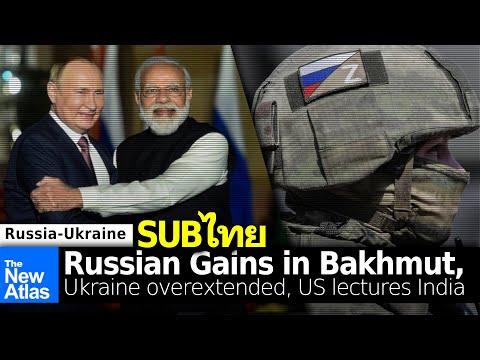
Russian Gains in Bakhmut, Ukraine Overextended, & US Lectures India

 October 17, 2022 (The New Atlas) - Update for Russian military operations against Ukraine for October 17, 2022.  Russian forces are closing...