Showing posts with label lebanon. Show all posts

Wednesday, August 5, 2020

Beirut Blast: Over 100 Dead, 4,000 Injured, Possible Evacuations Due to Toxic Materials

August 6, 2020 (21st Century Wire) - BEIRUT – Yesterday, an immense explosion ripped through Lebanon’s capital of Beirut, emanating from the city’s busy port situated right next to the city centre.


Image: Aerial view of the aftermath of the port explosion showing grain silos still standing next to unusually large crater (Image: CNW@Twitter)
  • Lebanese Red Cross says more than 100 people are dead and thousands are injured from the explosion
  • Health minister appeals for intl assistance
  • Medical supplies stored at a warehouse close to the Beirut port have been destroyed
  • Up to 300,000 could be made homeless by the disaster
  • Lebanon’s prime minister cites ammonium nitrate as the likely cause
  • High Defense Council declares a two-week state of emergency
  • Secretary-general of the Kataeb Party Nizar Najarian reportedly killed
  • Lebanon’s internal security chief says the blast was in a port area with highly explosive material
  • Explosion heard from 150 miles (approx. 240 kilometres) away
According to an official of the Lebanese Prime Minister Hassan Diab, the Beirut explosions were caused by an estimated 2,750 tons of Ammonium Nitrate which was apparently left unsecured for 6 years in a warehouse.


The government vows to punish any officials shown to be negligent in this unprecedented incident which has now claimed the lives of at least 100 residents and injured a further 4,000.

Death tolls could rise sharply once rescue crews are able to search the port area which has been completely leveled as a result of the blast waves.

Windows and doors across the city were blown-in, and blast tremors could be felt as far away as Cyprus.

Continue following 21st Century Wire's coverage here. 

Monday, October 30, 2017

Lebanon Next in US War on Middle East

October 31, 2017 (Ulson Gunnar - NEO) - US politicians, policymakers and commentators insist that the United States military's involvement in Syria and Iraq is solely aimed at defeating militants from the self-titled Islamic State (IS). However, it is abundantly clear that before the Russian intervention in Syria in 2015, the United States was engaged in a proxy war against Damascus, not IS and that as the Russian intervention began rolling IS back and the organization clung to existence, Washington found itself revising its narrative around a new pretext to remain in the region, the "Iranian threat."


Geopolitical analysts have long-warned that regime change in Tehran was always America's ultimate goal and that the conflicts ignited across the Middle East and North Africa region (MENA) was a means of reorganizing the Arab World into a united front against Tehran and its allies and in turn, against Moscow and Beijing.

More recent news articles like the Associated Press', "US pushes Saudi Arabia, Iraq on united front to counter Iran," would report that:
U.S. Secretary of State Rex Tillerson on Sunday promoted a Trump administration goal of uniting Saudi Arabia and Iraq in common cause to counter Iran's growing assertiveness in the Middle East.

Tillerson participated in the inaugural meeting of the Saudi Arabia-Iraq Coordination Committee, along with Saudi King Salman and Iraqi Prime Minister Haider al-Abadi, telling the leaders that the event highlighted the improving ties between the longtime rivals and showed "the great potential" for further cooperation. He noted the August reopening of a major border crossing and the resumption of direct flights between Riyadh and Baghdad.
Attempts by the US to virtually seize control of Iraq's western Anbar governorate to provide a safe haven for militants now on the losing half of an emerging regional balance of power is an indicator that steps are already being taken toward what is in all intents and purposes an escalation, not a withdrawal from the Middle East by the US.

Riyadh's attempts to depict itself as undertaking socioeconomic reforms and its claimed intentions of abandoning its longstanding abuse of Islam through its politically-motivated Wahhabi interpretations appears to be little more than a means of assuaging fears of regional and global partners that Washington and Riyadh's dangerous game of using state-sponsored terrorism as a geopolitical tool has spiraled out of control costing all involved credibility and even stability.

War with Iran, Via Lebanon 

Additionally, the US seeks to pursue conflict along yet another familiar axis, through war between Israel and Lebanon and more specifically Hezbollah.

An editorial written by retired German General Klaus Dieter Naumann, former Chief of Staff of the Bundeswehr and former Chairman of the NATO Military Committee and General Richard Dannatt, former Chief of the General Staff of the British Army, titled, "A third Lebanon war looms: To stop it, US must curtail Iran, sanction Hezbollah," lays out the details of this looming conflict.


While the article portrays a "third Lebanon war" as inevitable, precipitated by Hezbollah and its sponsors in Tehran's aggression against Israel, careful reading and consideration of recent history exposes the editorial as an attempt to create the pretext upon which the US and its allies will provoke this war, not Hezbollah, and not Iran.

The article claims:
Neither Iran nor Hezbollah have any remotely credible reason for their enmity of Israel today — yet they are engaged in an implacable campaign of deadly hatred animated by their version of radical Islam. Hezbollah additionally has to explain to the Lebanese population it claims to represent why it has been killing Muslims in Syria at a furious pace. The best way to close this credibility gap is to attack Israel. Both Hezbollah Secretary General Hassan Nasrallah’s rhetoric, and his terrorist operatives’ actions on the border with Israel confirm this.

Nowhere in the article is it noted Israel's participation in the Syrian conflict, its own state sponsorship of terrorism in neighboring Syria including militants from Jabhat Al Nusra, a US State Department and UK Home Office proscribed terrorist organization, Israel's contributions to US-Kurdish proxies in northern Syria and Iraq and multiple Israel provocations aimed at Iran itself, including the sabotaging of its infrastructure with the Stuxnet computer virus. All of these are more than credible reasons for Iran and Hezbollah's enmity of Israel. 


And while the article attempts to portray Hezbollah and Iran as poised to strike Israel, it admits that it will be merely "capabilities" either possess that will prompt Israel to "take drastic action to protect its civilian population."


In other words, it will be a replay of the 2006 Israeli-Lebanon War in which a minor provocation was used by Tel Aviv to wage full scale war on Lebanon including aerial bombardment and a disastrous land invasion that ended in retreat before reaching the Litani River, its stated objective.

Beyond setting the stage for a potential repeat of the 2006 war, the article also suggests this artificial increase in tensions be accompanied by increased pressure on Hezbollah and Iran, pressure the US and its allies are already applying.

It should be noted that elsewhere, US policymakers have stated multiple times that before war with Iran can be pursued directly, both Syria and Hezbollah must be weakened first. A war with Lebanon thus could be a means to either directly lead into direct conflict with Tehran, or as a means of preparing for one in the near or intermediate future.

Immediate Peace and Stability vs. Constant and Perpetual War 

What is clear is that the 2015 Russian intervention in Syria along with Iran's growing influence in the region has rolled back attempts by the US and its partners to reassert control over the Middle East they have sought since the Cold War. With a new multipolar coalition of emerging regional and global powers, US dreams of hegemony will be increasingly more difficult to achieve with no single "superpower" to topple in order to gain an upper hand.

For governments everywhere from Beruit to Amman and even Riyadh and its Persian Gulf neighbors, the choice of whether to go down this increasingly violent path in pursuit of increasingly distant hegemony Washington has promised them the spoils of, or to constructively embrace multipolarism by pursuing regional stability is fast approaching.

For the US, the threats it has used to coerce some of its more unwilling partners are quickly being dwarfed by the consequences of their complicity. Additionally, with nothing but perpetual war on the horizon as the "plan" to achieve US hegemony in the region, even if Washington succeeded, it will be only after its regional proxies endure years more of dangerous conflict. Nations like Saudi Arabia, mired in conflict in Yemen to the south while its proxies in Syria and Iraq are wiped off the battlefield, walks a dangerous tightrope other nations would be wise to avoid.

Lebanon has been a battlefield in the past the US has used as a vector toward greater regional conflict. Its ability or inability to create conflict there again, directly or through Israel, and that conflict's ability or inability to drag Iran, Syria and other players in directly, will determine the outlook for America's wider agenda in the region.

 Ulson Gunnar, a New York-based geopolitical analyst and writer especially for the online magazine “New Eastern Outlook”.  

Saturday, September 5, 2015

"Revolution" in Lebanon: From Piles of Trash to Piles of Rubble

September 5, 2015 (Tony Cartalucci - NEO) - "Spontaneous." "Genuine." Defiant." The US State Department's marketeers have used these labels in attempts to differentiate its latest wave of global "color revolutions" from the now tired, ineffective, and familiar formulas used everywhere from the US-engineered "Arab Spring," to the Euromaidan in Ukraine, to Bersih 4.0 in Malaysia.


The latest target is Lebanon where protests have begun in the streets of the capital, Beirut. Branded the "YouStink!" marches, the alleged provocation was dysfunctional municipal garbage collection services. However, very predictably, the protests have shifted quickly from what could have been perceived as legitimate demands to outright calls for regime change.

Color Revolutions 2.0

Just recently in Armenia, the US conducted what appeared to be a test run of its new and improved "color revolution" system of regime change. It attempted to create a movement with little if any initial political affiliation and with deeply hidden ties between protest organizers and their US State Department affiliations. Ultimately the so-called "Electric Yerevan" protests, whose alleged grievances were rising electric bills, spent so much time trying to convince Armenians and people around the world that they weren't a US-backed mob, they never succeeded in building up sufficient momentum to move on to the next step.

The trick was to first use rising electrical costs as a pretext to stage the protests, then quickly swing them around to demand a change in government. Likely, provocations and violence were planned for later stages, as well as opportunities for America's client opposition parties to take over and swell the ranks of street mobs with their supporters.

In Armenia, America's next generation of color revolutions failed.

In Beirut, however, it seems that the protests have made it at least to the point where the alleged pretext - piles of garbage - have now been replaced with demands for regime change.

Despite the 2005 so-called "Cedar Revolution" being exposed as entirely US-engineered, paving the way for the expulsion of Syrian troops from Lebanon and an Israeli attack on the country the following year, many even in the alternative press have been taken in by what should be an obvious, albeit more carefully concealed, follow-up to 2005's events.

Spot the Leaders, Follow the Money 

Transcending emotional appraisals of street mobs and reciting the alleged demands and motivations of the protesters themselves, protests are like anything else in the real world - they require leaders, organization, money, logistics, and infrastructure to function.

The "YouStink!" protest is no different.

Trawling through the Western media's reports, several names are repeatedly mentioned as "organizers" and "leaders."

They include Asaad Thebian, an alumni of the US State Department's U.S.-Middle East Partnership Initiative (MEPI). In 2014, Thebian would be standing in front of American flags, and behind a podium with the US State Department's seal affixed to it at a MEPI event, berating the Lebanese government. Now in 2015, he is attempting to overthrow it.

Thebian would be quoted by Al Jazeera claiming:
"We started as dozens of protesters and now we're thousands," Asaad Thebian, an activist with the You Stink! campaign, said during Friday's press conference. "We are demanding parliamentary elections."
The International Business Times would expand on what is clearly taking shape as the true agenda behind the protests. In their article, "'You Stink' Demonstrators In Beirut Issue 72-Hour Ultimatum, Vow To Spread Protests In Lebanon Nationwide," they would report that:
In Beirut’s symbolic Martyrs’ Square recently, protesters have chanted, “The people want the downfall of the government” and “Revolution!” Some have drawn parallels between these rallies and the demonstrations that swept many Arab countries in 2011 and 2012, which led to the toppling of a number of regimes in the Middle East and North Africa.
Joining Thebian is Michel Elefteriades who helped co-organize the US-backed mobs in Lebanon in 2005's "Cedar Revolution" and worked for years to expel Syrian troops from Lebanon. The International Business Times would conduct a lengthy interview with him in their report, "Lebanon You Stink protests: We are not Egypt, claims activist Michel Elefteriades." The report would quote Elefteriades as saying:
"This is not similar to what happened in Egypt or elsewhere where people were manipulated, or without greater political awareness," Elefteriades exclusively told IBTimes UK from Beirut.
Elefteriades, in addition to claiming somehow their protest is different, would also attempt to assuage fears of a power vacuum forming if the current government was ousted:
"There is a leadership that is ready to take over and there will not be a vacuum," Elefteriades explained. "There are many people, with great capacities, but that are still suffocated by this political elite and this new class will never be able to lead this country because those in place don't want to give them space. So, as soon as that old political class will have left, there will be the emergence of a new political class, from one day to the next." 


There is also Lucien Bourjeily, a theater artist who in 2012 organized a London showing of "66 Minutes in Damascus." The London Guardian would review his play, in which the audience was "immersed" in the experience of being a "political prisoner" of the "crumbling Assad regime" in Syria. 


Also telling is Walid Jumblatt's support of the mobs. In a Lebanese National News Agency report titled, "Jumblatt urges You Stink organizers to halt political manipulation of their movement," it was stated that:
MP Walid Jumblatt tweeted on Sunday that yesterday's protest in Down Town Beirut truly expressed the pains suffered by the Lebanese. He compelled those responsible for You Stink movement not to allow political parties to take advantage of this "spontaneous movement" and abort it prematurely. He also urged the movement's organizers to study the proper mechanism to execute their demands.
Jumblatt's calls are similar to those made by US-proxy political opposition parties in Armenia who insisted the protests were "spontaneous" and urged the clearly politically motivated movement to remain 'unpolitical.' An added touch to Lebanon's current round of protests was the protesters rejecting Jumblatt's support for the movement. It is likely that Jumblatt and others will end up literally on stage leading protests if they escalate long enough before sectarian violence is finally triggered.

Jumblatt role is significant and his name should be familiar to those following events in the Middle East. It was Jumblatt who conspired with then US Vice President Dick Cheney on how best to undermine neighboring Syria in the years leading up to the 2011 war. Revealed in Pulitzer Prize-winning journalist Seymour Hersh's 2007 report "The Redirection: Is the Administration’s new policy benefitting our enemies in the war on terrorism?" Jumblatt suggested using the Syrian Muslim Brotherhood, a scheme that even at the time had already gotten underway.

Hersh would report:
Jumblatt then told me that he had met with Vice-President Cheney in Washington last fall to discuss, among other issues, the possibility of undermining Assad. He and his colleagues advised Cheney that, if the United States does try to move against Syria, members of the Syrian Muslim Brotherhood would be “the ones to talk to,” Jumblatt said.
Hersh would also report that funding was already being channeled by the US and Saudi Arabia to the Brotherhood. Of course, by 2011, the Syrian Muslim Brotherhood along with Al Qaeda would use those resources to begin an armed confrontation with the Syrian government which rages on to this day. The events Jumblatt helped set in motion in 2007 and the war in Syria that has played out since 2011, is linked directly to the "YouStink!" protests.

Considering that the various common threads between all involved in Lebanon's current protests include US backing and an overt hatred for Syria, claims that sectarian motivation and politics do not drive "YouStink!" are patently false - an intentional misdirection predicated on "piles of garbage" and repetitive slogans claiming somehow this revolution is not just another US-engineered color revolution. But like in Armenia earlier this year, it is just another US-engineered color revolution.

First Piles of Garbage, Then Piles of Rubble 

The ultimate goal is to create chaos in Lebanon sufficient enough to disrupt Hezbollah's operations regionally against the army of terrorist the US and its regional allies, including supporters of "YouStink!" helped organize as far back as 2007. As in the past, protests in Lebanon are aimed not at improving the future of the Lebanese people, but aimed instead at disrupting the stability of neighboring Syria.


What follows these disingenuous protests is likely a rerun of what followed the so-called "Cedar Revolution" in 2005. After that admittedly US-backed protest and the withdrawal of Syrian troops from Lebanon, Israel conducted extensive air raids and even a ground invasion of the country in the following year. Despite the impression that the "Cedar Revolution" left Lebanon particularly vulnerable, US-backed Israeli operations against Lebanon ended catastrophically for Tel Aviv. The air campaign failed to achieve any strategic or even tactical objectives and the ground invasion was essentially repelled with Israel calling off the operation before reaching the Litani River - the stated objective of Israeli ground forces.

If "YouStink!" can evolve into a sufficient level of chaos undermining Hezbollah in Lebanon, and with the organization's resources already stretched in neighboring Syria fighting terrorist armies backed by the US and its regional allies, Israel will likely be used again in a 2006-style conflict or worse in the hopes that this time the dynamics of the region are decidedly working in the West's favor.

Regardless of the outcome of "YouStink!,"the additional pressure political destabilization in Lebanon puts upon Damascus and Tehran can only detract from efforts to restore peace and stability across the Levant.

"YouStink!" organizers claim they are fighting for the future of Lebanon. In reality, they are jeopardizing not only Lebanon's future, but that of the entire region. They are attempting to strike a match in a region already parched by the heat of the fires of nearby conflict. If "YouStink!" succeeds in their true objectives, they will bring immeasurable suffering to all in Lebanon and to many more beyond their borders. And as in the wake of the "Cedar Revolution," the only parties that stand to benefit are the US and its regional allies who seek nothing less than Lebanon's complete and perpetual failure as a sovereign state.

Tony Cartalucci, Bangkok-based geopolitical researcher and writer, especially for the online magazine“New Eastern Outlook”.   

Thursday, September 3, 2015

Lebanon Protest Leaders Reveal Connections To Western Color Revolution Apparatus

September 3, 2015 (Brandon Turbeville - Activist Post) - Over the past few weeks, Lebanon has found itself embroiled in protests and social unrest the likes of which it has not experienced since 2005. The original issue, legitimate as it may be, surrounded the issue of lack of garbage disposal, yet the protests were soon infiltrated and morphed into an exercise of public rage over shadowy issues like “government corruption.” These protests have gone from peaceful demonstrations to violent clashes between demonstrators and police, with “infiltrators” largely responsible for provocative behavior.


Sectarian tensions are now beginning to surface, a very real fear and dangerous proposition in Lebanon, with members of the “movement” typically resorting to association with tribal identity groups (Christians with Christians, Sunni Muslims with Sunni Muslims, etc.) even during the protests.

As I mentioned in my article, “Color Revolution In Lebanon Designed To Weaken Hezbollah, Syria, Iran,” all of these aspects – shadowy reasons like “government corruption” for protesting, lack of demands, violence, and infiltrators – are hallmarks of a color revolution. So are the clever marketing strategies of “Branding” that see a protest movement, allegedly organic and spread across so many differing and various sectarian groups, develop a mutually agreed upon name for itself so early on.

The most telling aspect of whether or not a movement is actually a color revolution, however, is the “leadership” of that movement and the connections that leadership may have to the color revolution apparatus.

In the case of the You Stink! Movement, those connections are becoming increasingly visible.

Assadd Thebian is represented as one of the leaders of the You Stink! Movement by a number of Western press outlets and, in the Lebanese Press outlet, the Daily Star, he is described as being the “co-founder” of You Stink! Yet, far from being a truly organic Lebanese revolutionary, Thebian is closely connected to the United States Department of State.

Thebian is a participant in the Middle East Partnership Initiative, a program directed by the US State Department for the purposes of directing NGOs in foreign countries in order to facilitate US foreign policy. In other words, the MEPI is yet another program and initiative in the color revolution apparatus.

MEPI was created in December 2002 by the State Department. Its creation was announced in a speech by Secretary of State Colin Powellto the Heritage Foundation in Washington D.C. Powell stated that MEPI was an initiative that was to bear fruit over the long term, not merely 3-5 years. It was created to help pick up the slack in areas where USAID was not able to fully service. Although it was initially dependent upon USAID for support, MEPI has taken off on its own as a formidable color revolution organization.

The same year as its creation, Liz Cheney, daughter of Dick Cheney, was appointed as supervisor of MEPI per her position as U.S. Deputy Assistant Secretary For Near Eastern Affairs. Under Cheney’s direction, MEPI engaged in teaching methods designed to “train Arab journalists” and “teach children,” presumably in the benefits of US Foreign Policy as well as encourage nations within MEPI’s sphere of influence to sign various Free Trade agreements with the United States and move toward a Middle Eastern Free Trade Zone.

A year later in 2003, MEPI announced that it was going to engage in a “detoxification” program designed to improve Palestinian and other Arab countries’ presentation of Israelis in textbooks.

In 2015, MEPI’s main task is to support and “increase the capacity of civil society organizations” meaning NGOs operating in the countries under its purview. As Foreign Policy describes MEPI, it is “a $150 million program to advance democracy in the Middle East, which promotes programs for female literacy and health, as well as business and political training, as a model for more activist, pro-women policies in other parts of the world.”

Of course, “democracy” should be placed in square quotes. “Democracy” as promoted by MEPI and the West is nothing short of imperialism and Anglo-American domination. Notice also that the “pro-woman” aspect of MEPI is designed to promote “activist” policies amongst women, meaning MEPI is in the business of culture creation at best and social upheaval at worst. MEPI’s focus is not just women, of course, but “youth” in general.

MEPI states on its own website that “MEPI supports organizations and individuals in their efforts to promote political, economic, and social reform in the Middle East and North Africa.”

MEPI’s alumni boast of a number of political figures in the Middle East and a number of individuals also associated with the National Democratic Institute (NDI), a notorious color revolution and destabilization organization connected to the NED and the State Department.

MEPI is precisely the program in which Thebian is an alumni, having given a speech at the MEPI Lebanese Alumni Association Annual Dinner in January 2014.

It is worth noting that, when Thebian was sued by Lebanese member of parliament, Ziad Aswad, for “defamation and contempt of religion,” a number of NGOs rushed to Thebian’s defense. Of these NGOs, theSamir Kassir Eyes Foundation boasts of connections to both the NDI and the NED. Another, Maharat Foundation, received $30,000 from the NED’s Freedom of Information program. Another operation, The March Foundation, is funded by USAID.

Other leaders are just as openly involved in the color revolution apparatus as Thebian. Michel Elefteriades, for instance, was a participant in the 2005 Cedar Revolution and a “key militant at Martyr’s Square.” Elefteriades states that the You Stink! Movement is not just another color revolution but, in the same breath, admits that the goal of the movement is full of anarchic elements, a push for decentralization, and an intention to collapse the system of government. Elefteriades makes no mention of what should be put in place of the existing order and it appears that not a single activist on the ground is able to do so either.

Elefteriades states:
There is an awakening of democratic awareness, and it has been a very long time since Lebanon has not come out of these political parties and religious sects to ask that all political leaders be punished or sidelined.[…]

It’s a sort of popular revolution, a mix of many movements – some anarchic in the good philosophical sense such as the refusal of the centralised power – it’s really a grassroots movement so I don’t think its going to stop. The movement will grow.
The goal of the protests, he says is “To bring the collapse of a system that has been in place for decades.” He blames the crisis on a “rotten political class” and the use of “confessionalism” as a governing structure.

While it must be admitted that confessionalism, a form of government where parliamentary seats and political offices are proportioned out according to religious demographics in the country, is an incredibly inefficient and undemocratic way to govern a country, the governing structure exists as a result of intense Western meddling in the internal affairs of Lebanon by the West and by members of the general public so obstinate in their own religious beliefs that they often insist on governance based on that particular religion. It is a fragile government designed to maintain the fragile fabric of a fragile society.

The answer, of course, is to keep religion out of politics and promote a secular government that respects the rights of all. But Elefteriades does not demand such a government, only the destruction of the one currently standing.

Indeed, during the 2005 Cedar Revolution, Elefteriades was an instrumental player in the color revolution as an activist figure, even working closely with CANVAS, a notorious Western color revolution organization. CANVAS was so active during the Cedar Revolution that it now takes credit for the movement’s success.

Lucien Bourjeily, is also hailed as a leading figure in the You Stink! Movement. Bourjeily, however, has long ago revealed himself as a supporter of Western backed destabilization and destruction of sovereign countries by his “66 Minutes In Damascus,” a strange interactive theatre play that transformed the theatre into a “Syrian prison” and the audience into “prisoners.” The goal of the play was to drum up hatred against the “totalitarian” Assad regime and promote the “moderate rebels” who beheaded, murdered, and raped their way across Syria in search of “democracy and freedom.”

Not only that but Bourjeily himself is directly connected to the color revolution apparatus as his own play, “Will It Pass Or Not?” was produced by March, a Lebanese NGO whose partner is USAID.

Laughably, Walid Jumblatt is expressing support for the You Stink! Movement, criticizing the movement’s critics and expressing support for the movement while, at the same time, doing little to address the legitimate issues which begat the initial protests. If any Lebanese politician truly exhibited the term “You Stink!” it would be Jumblatt. It must be remembered that it was Jumblatt who extolled the virtues of the Syrian destabilization, demonized Assad, and has continually justified and praised al-Nusra.

Aside from a number of high-profile activist “leaders,” Andre Vltchek of CounterPunch reveals foreign NGO involvement in the YouStink! Movement as well. Vltchek writes:
Two weeks ago, a friend of mine said jokingly: “I met a kid in Beirut. He told me that he is going to get a job at some European NGO. His duty would be to help to destabilize Lebanon”.

She named the country funding the NGO, but I’d rather not mention it here, in order not to add more oil to fire. We had a good laugh then, but it does not appear too funny, anymore.

Yesterday she told me: “Security forces fired at him.”

He was there. He was not bragging. It was not a joke.
Unfortunately, Vltchek declined to mention the country from which this NGO is funded. However, paragraphs later, we may find a clue. Vltchek states:
Demands appear to be legitimate.

But in Lebanon, one cannot be certain of what lies below the surface. There are rumors that each religious group is now sending its fighters to the barricades.

For years and decades, competing political interests are pulling this tiny country in different directions.

“I spotted a guy who was protesting and who was obviously a British”, a diplomat based in Beirut who did not want to be identified, told me. “He was not a reporter, he was actually one of the protesters! And he spoke no Arabic. There are many bizarre characters at the protests.”

Who is who and who is with whom, is often extremely difficult to define.
While the You Stink! Movement initially seemed to exhibit many of the characteristics of a color revolution, the nature of the protests are even clearer after examining the individuals participating and directing the protests on the ground.

It remains to be seen how far the color revolution will go in Lebanon. After all, the previous attempt in Lebanon in 2005 was successful. Only time will tell whether or not the West will succeed in bringing Lebanon down into levels of chaos and terror currently being witnessed Syria. For the sake of the Lebanese people and the people of the Middle East we must hope that rational actors will appear and put an end to the apparently Western-backed chaos taking place across the country.

Saturday, October 20, 2012

Lebanon Bombing is Impetus for West's Planned Sunni-Shi'ia War

Repost: Saad Hariri Aides Western Syria Destabilization from Lebanon.
by Tony Cartalucci


October 20, 2012 - It was, starting at least in 2007, the goal of the US, Saudis, and Israelis to trigger a region wide sectarian war with which to overrun the governments of Lebanon, Syria, and Iran. This was documented in detail in Seymour Hersh's 2007 New Yorker article, "The Redirection" which was covered in depth in, "Syrian War: The Prequel.

A recent bombing in Beirut, Lebanon left high ranking security chief Brigadier General Wissam al-Hassan dead. Al-Hassan is described as "anti-Syrian." Before Al-Hassan's death was announced, and literally as bodies were still being pulled from the wreckage caused by the bombing, politicians from Saad Hariri's faction began immediately blaming Syria for the attacks. Hariri himself also laid the blame on Syria, offering no other details or supporting evidence.

Hezbollah, Syria, and Iran have all condemned the bombing and cite it as a provocation to start a greater sectarian war, from which none will benefit. Each in turn suspect Israel and the West, as greater sectarian tension is expected to result, playing into long documented attempts by US, Israel, and Saudi Arabia to trigger a sectarian war they hope will be the downfall of Hezbollah, Syria, and Iran.

Suspicious op-eds in pro-Western "Lebanon Now" insist that Syria is responsible, and again without evidence, concludes that blaming Israel is inappropriate, and that the Wall Street-London militant beachhead is by far a lesser threat to Lebanon than what it calls "the most deadly virus" of President Bashar al-Assad's Syria.

The blast has given impetus to Hariri's mobs to flood into the streets, who will no doubt portray themselves to be as "spontaneous" and "independent" as US-engineered mobs were throughout the equally premeditated "Arab Spring."

Hariri in 2007 was, according to US journalist Seymour Hersh, building an armed militant front in northern Lebanon, across the boarder from Homs, Syria. Many of these militants admittedly had direct ties to Al Qaeda, and with US, Israeli, and Saudi support, they were continuously armed, funded, and prepared for the sectarian bloodbath now unfolding. Homs to this day remains as one of the strongholds for terrorist militants operating in Syria.

While the Western media claims it is a shocking revelation that Al Qaeda is "amongst" the fighters attempting to overthrow the Syrian government, it is well documented that it was Al Qaeda from the very beginning who began armed operations against Syria, using Lebanon and Turkey as a base of operations, with explicit support from the West. The operations were carried out under the tenuous cover of "pro-democracy" protests and with a constant torrent of disinformation provided by the Western media.

While the current story in Lebanon develops, it will be useful to understand the role Hariri has so far played. The republished article below, originally posted in May, 2012, is by no means an exhaustive expose of Hariri and his role in executing the foreign agenda driven by Wall Street, London, Tel Aviv, Doha, and Riyadh, which starts well before 2007.
.... 

Originally posted May 21, 2012 -The United Nations has been inexplicably silent over revelations that the United States, Saudi Arabia, and other Persian Gulf states, are arming militants in Syria in direct violation of a UN brokered ceasefire. Additionally, the US has openly threatened to arm Kurd militants in Syria to "rise up" against the government. While in reality this constitutes a greater threat to neighboring Turkey, and perhaps an attempt to motivate Ankara to take a more aggressive stance against Syria, the threat of purposefully inciting more violence in a conflict that has allegedly claimed "10,000" lives, seems not only grossly irresponsible, but a violation of international peace.


Image: A bomb detonates in Syria, May 19, 2012, killing and maiming scores. This is the latest manifestation of overt US and Gulf State military support for terrorists attempting to destabilize and overthrow the Syrian government. The West has planned and prepared years in advance for implementing bloody regime change in Syria and Iran.
....

The West's meddling in Syria does not end there. Recently, clashes have broken out in Lebanon, revealing a large base of operations supporting the destabilization in neighboring Syria, located along the Lebanese-Syrian border. The significance of this discovery, and extremist groups in Lebanon being directly involved, highlights the veracity of a 2007 New Yorker article by Seymour Hersh titled, "The Redirection," which exposed a joint US-Israeli-Saudi operation to create a violent extremist front and direct it at Hezbollah in Lebanon, President Bashar al-Assad in Syria, and at the Iranian government.

In the article, the fact that these extremist forces had direct ties to Al Qaeda was noted, including the fact that many of these militants either participated in fighting US troops in Iraq and Afghanistan, or were affiliated with groups that did: 

"In 2005, according to a report by the U.S.-based International Crisis Group, Saad Hariri, the Sunni majority leader of the Lebanese parliament and the son of the slain former Prime Minister—Saad inherited more than four billion dollars after his father’s assassination—paid forty-eight thousand dollars in bail for four members of an Islamic militant group from Dinniyeh. The men had been arrested while trying to establish an Islamic mini-state in northern Lebanon. The Crisis Group noted that many of the militants “had trained in al-Qaeda camps in Afghanistan.”

According to the Crisis Group report, Saad Hariri later used his parliamentary majority to obtain amnesty for twenty-two of the Dinniyeh Islamists, as well as for seven militants suspected of plotting to bomb the Italian and Ukrainian embassies in Beirut, the previous year. (He also arranged a pardon for Samir Geagea, a Maronite Christian militia leader, who had been convicted of four political murders, including the assassination, in 1987, of Prime Minister Rashid Karami.) Hariri described his actions to reporters as humanitarian.
In an interview in Beirut, a senior official in the Siniora government acknowledged that there were Sunni jihadists operating inside Lebanon. “We have a liberal attitude that allows Al Qaeda types to have a presence here,” he said. He related this to concerns that Iran or Syria might decide to turn Lebanon into a “theatre of conflict."" -"The Redirection," Seymour Hersh, The New Yorker 2007
 The report also made mention of extensive US funding behind Hariri's faction, led then by Fouad Siniora, augmenting the creation of this militant force:

"The United States has also given clandestine support to the Siniora government, according to the former senior intelligence official and the U.S. government consultant. “We are in a program to enhance the Sunni capability to resist Shiite influence, and we’re spreading the money around as much as we can,” the former senior intelligence official said. The problem was that such money “always gets in more pockets than you think it will,” he said. “In this process, we’re financing a lot of bad guys with some serious potential unintended consequences. We don’t have the ability to determine and get pay vouchers signed by the people we like and avoid the people we don’t like. It’s a very high-risk venture.”
American, European, and Arab officials I spoke to told me that the Siniora government and its allies had allowed some aid to end up in the hands of emerging Sunni radical groups in northern Lebanon, the Bekaa Valley, and around Palestinian refugee camps in the south. These groups, though small, are seen as a buffer to Hezbollah; at the same time, their ideological ties are with Al Qaeda." -"The Redirection," Seymour Hersh, The New Yorker 2007
It becomes clear then that Lebanon's recent unrest is a result of a greater gambit targeting not just Syria, but the Hezbollah-Syrian-Iranian sphere of power, following the US-engineered "Arab Spring" installing proxy leaders across the Arab World to specifically support this last leg of geopolitical reordering. Such support has manifested itself as political support from US-proxy president Moncef Marzouki of Tunisia, and similar support from US-installed Libyan Prime Minister Abdurrahim el-Keib, who's nation has also committed not only arms and cash to Syrian terrorists, but fighters as well.


Image: Saad Hariri, former prime minister of Lebanon, is admittedly a co-conspirator in US-Israeli-Saudi designs to destabilize with militant extremists and violently overthrow the Syrian government. While Hariri feigns anti-Israeli sentiment and makes public calls for Lebanese to refrain from sectarian violence, he is the primary facilitator of both extremists crossing over into Syria, and their creating of chaos in the streets of Lebanon. A 2010 Fortune 500-funded International Crisis Group report describes in detail Hariri's deep ties, and indeed dependence, on the West.
....

Now, it is reported that "anti-Assad clerics" have been shot by Lebanese soldiers - and just as was seen during the assassination of Rafic Hariri, demagogues are attempting to draw Sunni Muslims into a conflict with Shi'ias. A strategy of tension is being used to divide the Lebanese people into a deadly conflict mirroring the sectarian, not "democracy," driven unrest ravaging Syria. With Saad Hariri, the US, and Saudi Arabia overtly working to undermine Syrian stability, it appears that all of the characters described by Hersh in 2007 are now openly implementing their plans.

The purposefully nebulous coverage by the Western media over violence in Lebanon so far, and a disingenuous depiction of it being "spill over" from Syria is meant to portray a general sense of chaos consuming the region. In reality, it is a premeditated destabilization dependent on fostering violence between Sunni and Shi'ia Muslims, just as was purposefully done in Iraq to balk an effective Sunni-Shi'ia alliance that achieved initial success fighting a foreign occupation led by the US starting in 2003.

While exposing the premeditated nature of the destabilization consuming Lebanon and Syria is essential, as well as calling for international condemnation of the US for openly attempting to escalate violence in the middle of a mediated ceasefire, calling on people across the Islamic World to refrain from falling into this sectarian trap, and being used as tools of their own division and subjugation by the West is equally important.

Saad Hariri portends that his alliance with the US, Israel, and the Saudis is simply an attempt to protect "Sunnis" from a "Shi'ia threat." In reality, as empires have done all throughout history, Hariri's invitation to the West to meddle in his own nation's affairs will open the door to the destruction and dismemberment of not only his enemies, but inevitably his own movement as well. A faction too weak to fight its rivals is certainly too weak to fight an invited foreign imperial power that decides to overstay its welcome. A strategy of tension is at play in the Islamic World, the trap set, hatred for Israel and rival ideologies the bait. Time will answer the question, "have the people of the world learned enough collectively to avoid it?"

Monday, May 21, 2012

Saad Hariri Aides Western Syria Destabilization from Lebanon

Attempts to trigger Sunni-Shi'ia strategy of tension. 
by Tony Cartalucci

May 21, 2012 -The United Nations has been inexplicably silent over revelations that the United States, Saudi Arabia, and other "Gulf States," are arming militants in Syria in direct violation of a UN brokered ceasefire. Additionally, the US has openly threatened to arm Kurd militants in Syria to "rise up" against the government. While in reality this constitutes a greater threat to neighboring Turkey, and perhaps an attempt to motivate Ankara to take a more aggressive stance against Syria, the threat of purposefully inciting more violence in a conflict that has allegedly claimed "10,000" lives, seems not only grossly irresponsible, but a violation of international peace.


Image: A bomb detonates in Syria, May 19, 2012, killing and maiming scores. This is the latest manifestation of overt US and Gulf State military support for terrorists attempting to destabilize and overthrow the Syrian government. The West has planned and prepared years in advance for implementing bloody regime change in Syria and Iran.
....

The West's meddling in Syria does not end there. Recently, clashes have broken out in Lebanon, revealing a large base of operations supporting the destabilization in neighboring Syria, located along the Lebanese-Syrian border. The significance of this discovery, and extremist groups in Lebanon being directly involved, highlights the veracity of a 2007 New Yorker article by Seymour Hersh titled, "The Redirection," which exposed a joint US-Israeli-Saudi operation to create a violent extremist front and direct it at Hezbollah in Lebanon, President Bashar al-Assad in Syria, and at the Iranian government.

In the article, the fact that these extremist forces had direct ties to Al Qaeda was noted, including the fact that many of these militants either participated in fighting US troops in Iraq and Afghanistan, or were affiliated with groups that did: 

"In 2005, according to a report by the U.S.-based International Crisis Group, Saad Hariri, the Sunni majority leader of the Lebanese parliament and the son of the slain former Prime Minister—Saad inherited more than four billion dollars after his father’s assassination—paid forty-eight thousand dollars in bail for four members of an Islamic militant group from Dinniyeh. The men had been arrested while trying to establish an Islamic mini-state in northern Lebanon. The Crisis Group noted that many of the militants “had trained in al-Qaeda camps in Afghanistan.”

According to the Crisis Group report, Saad Hariri later used his parliamentary majority to obtain amnesty for twenty-two of the Dinniyeh Islamists, as well as for seven militants suspected of plotting to bomb the Italian and Ukrainian embassies in Beirut, the previous year. (He also arranged a pardon for Samir Geagea, a Maronite Christian militia leader, who had been convicted of four political murders, including the assassination, in 1987, of Prime Minister Rashid Karami.) Hariri described his actions to reporters as humanitarian.
In an interview in Beirut, a senior official in the Siniora government acknowledged that there were Sunni jihadists operating inside Lebanon. “We have a liberal attitude that allows Al Qaeda types to have a presence here,” he said. He related this to concerns that Iran or Syria might decide to turn Lebanon into a “theatre of conflict."" -"The Redirection," Seymour Hersh, The New Yorker 2007
 The report also made mention of extensive US funding behind Hariri's faction, led then by Fouad Siniora, augmenting the creation of this militant force:

"The United States has also given clandestine support to the Siniora government, according to the former senior intelligence official and the U.S. government consultant. “We are in a program to enhance the Sunni capability to resist Shiite influence, and we’re spreading the money around as much as we can,” the former senior intelligence official said. The problem was that such money “always gets in more pockets than you think it will,” he said. “In this process, we’re financing a lot of bad guys with some serious potential unintended consequences. We don’t have the ability to determine and get pay vouchers signed by the people we like and avoid the people we don’t like. It’s a very high-risk venture.”
American, European, and Arab officials I spoke to told me that the Siniora government and its allies had allowed some aid to end up in the hands of emerging Sunni radical groups in northern Lebanon, the Bekaa Valley, and around Palestinian refugee camps in the south. These groups, though small, are seen as a buffer to Hezbollah; at the same time, their ideological ties are with Al Qaeda." -"The Redirection," Seymour Hersh, The New Yorker 2007
It becomes clear then that Lebanon's recent unrest is a result of a greater gambit targeting not just Syria, but the Hezbollah-Syrian-Iranian sphere of power, following the US-engineered "Arab Spring" installing proxy leaders across the Arab World to specifically support this last leg of geopolitical reordering. Such support has manifested itself as political support from US-proxy president Moncef Marzouki of Tunisia, and similar support from US-installed Libyan Prime Minister Abdurrahim el-Keib, who's nation has also committed not only arms and cash to Syrian terrorists, but fighters as well.


Image: Saad Hariri, former prime minister of Lebanon, is admittedly a co-conspirator in US-Israeli-Saudi designs to destabilize with militant extremists and violently overthrow the Syrian government. While Hariri feigns anti-Israeli sentiment and makes public calls for Lebanese to refrain from sectarian violence, he is the primary facilitator of both extremists crossing over into Syria, and their creating of chaos in the streets of Lebanon. A 2010 Fortune 500-funded International Crisis Group report describes in detail Hariri's deep ties, and indeed dependence, on the West.
....

Now, it is reported that "anti-Assad clerics" have been shot by Lebanese soldiers - and just as was seen during the assassination of Rafic Hariri, demagogues are attempting to draw Sunni Muslims into a conflict with Shi'ias. A strategy of tension is being used to divide the Lebanese people into a deadly conflict mirroring the sectarian, not "democracy," driven unrest ravaging Syria. With Saad Hariri, the US, and Saudi Arabia overtly working to undermine Syrian stability, it appears that all of the characters described by Hersh in 2007 are now openly implementing their plans.

The purposefully nebulous coverage by the Western media over violence in Lebanon so far, and a disingenuous depiction of it being "spill over" from Syria is meant to portray a general sense of chaos consuming the region. In reality, it is a premeditated destabilization dependent on fostering violence between Sunni and Shi'ia Muslims, just as was purposefully done in Iraq to balk an effective Sunni-Shi'ia alliance that achieved initial success fighting a foreign occupation led by the US starting in 2003.

While exposing the premeditated nature of the destabilization consuming Lebanon and Syria is essential, as well as calling for international condemnation of the US for openly attempting to escalate violence in the middle of a mediated ceasefire, calling on people across the Islamic World to refrain from falling into this sectarian trap, and being used as tools of their own division and subjugation by the West is equally important.

Saad Hariri portends that his alliance with the US, Israel, and the Saudis is simply an attempt to protect "Sunnis" from a "Shi'ia threat." In reality, as empires have done all throughout history, Hariri's invitation to the West to meddle in his own nation's affairs will open the door to the destruction and dismemberment of not only his enemies, but inevitably his own movement as well. A faction too weak to fight its rivals is certainly too weak to fight an invited foreign imperial power that decides to overstay its welcome. A strategy of tension is at play in the Islamic World, the trap set, hatred for Israel and rival ideologies the bait. Time will answer the question, "have the people of the world learned enough collectively to avoid it?"

Monday, May 14, 2012

Fighting Erupts in Lebanon

US, Israeli, and Saudi-funded terrorists destabilizing Syria now under fire in Lebanon. 
by Tony Cartalucci 

May 15, 2012 - According to a 2007 New Yorker article by Seymour Hersh, "The Redirection," the US, Israel, and Saudi Arabia had been assembling a region-wide army of extremist-mercenaries to battle Hezbollah in Lebanon, destabilize and overthrow Syria, and create a united front against Iran. The forces recruited for this effort would come from the ranks of the CIA-created "Arab foreign legion," Al Qaeda itself - extremist groups fresh back from fighting US troops in Iraq and Afghanistan, including listed terror organizations like the Libyan Islamic Fighting Group (LIFG) from Libya.


Hersh's 2007 report exposed the groundwork for the very violence unfolding in Syria today, and now Lebanon. Forces to destabilize Syria were primarily to be staged in northern Lebanon, as explained in the article, and indeed the heaviest fighting over the last year has been seen in the Syrian city of Homs, just across the border from northern Lebanon. Syria's President Bashar al-Assad and his government have been, since the beginning of the violence, attempting to illustrate just this - explained in detail in 2007, and demonstratively being carried out today, with responsibility for deadly bombings being claimed by terrorists, the Pentagon itself admitting Al Qaeda is present in Syria, and reports indicating foreign fighters, weapons, and cash are flowing over Syria's borders.

Lebanon's Turn?

Now, the very staging ground in northern Lebanon being used to destabilize neighboring Syria has erupted into violence. Not by Syrian troops crossing the border, but by indigenous Lebanese factions facing off against each other. News is trickling out slowly and the Western media appears intent on keeping the violence as nebulous and confused as possible, but initial information indicates that extremist groups backed by the US, Israel, and Saudi Arabia are fighting factions connected to Hezbollah. Extremist leaders across the region are attempting to frame the violence as "Sunni versus Shi'ia," a ploy Hezbollah leader Hassan Nasrallah warned against back in 2007:

"Nasrallah accused the Bush Administration of working with Israel to deliberately instigate fitna, an Arabic word that is used to mean “insurrection and fragmentation within Islam.” “In my opinion, there is a huge campaign through the media throughout the world to put each side up against the other,” he said. “I believe that all this is being run by American and Israeli intelligence.” (He did not provide any specific evidence for this.) He said that the U.S. war in Iraq had increased sectarian tensions, but argued that Hezbollah had tried to prevent them from spreading into Lebanon. (Sunni-Shiite confrontations increased, along with violence, in the weeks after we talked.)" -The Redirection, Seymour Hersh
Far from genuine sectarian violence, it was planned since 2007, to use terrorist proxies in a battle stretching from Lebanon to Iran with Arab nations from North Africa to the Middle East aiding the effort, dominated by freshly installed US proxies (Tunisia & Libya) and the Muslim Brotherhood, stated in Hersh's 2007 article to be wards of the West.

Violence has raged for nearly a week, in and around Lebanon's northern port city of Tripoli. While being depicted as violence "spilling over" from Syria, it is clear that the violence is indigenous, sectarian in nature, and directly related to the larger conflict envisioned by US-Israeli-Saudi machinations in 2007 - pitting Sunnis against Shi'ia. An editorial from NOW Lebanon reveals the "sectarian" nature of the violence in Lebanon and how both sides identify as either supporters or opponents of the neighboring Syrian government.

This prevailing "sectarian" aspect reveals what has been stated by geopolitical analysts since the beginning of unrest in Syria - that the violence was driven not by "pro-democratic" aspirations, but by sectarian violence exploited for the sole purpose of advancing the agenda of foreign meddlers - sectarian violence that has now manifested itself in attacks on Christians, Druze, and Alawites, as well as moderate Sunnis across Syria in the midst of this so-called "democratic revolution." 

The sectarian violence now unfolding in Tripoli is not unheard of in Lebanon. The Lebanese military has already been reportedly deployed but is sitting on the sidelines as factions war in the streets. The violence may ebb, as it has in the past, but with the Syrian unrest reaching a critical point and foreign powers desperate to change momentum that's been working against them, foreign-backed terrorist forces could try to ignite a wider sectarian battle in Lebanon. This could be to paralyze Hezbollah ahead of either a coup de grâce delivered to Syria by Turkey, or to simply inflame the entire region in conflict, making the movement of weapons, cash, and foreign support to proxy forces easier to move around, as well as grease the skids for introducing a Kosovo-style intervention.

Regardless, "sectarian" differences between Sunni and Shi'ia Muslims were planned for exploitation since at least as early as 2007 by the US, Israel, and Saudi Arabia, for the sole purpose of advancing their self-serving hegemonic agendas throughout the region. The violence that both sides are playing into will deprive their communities of the security and stability needed for all to prosper and progress, and ultimately leave them at the mercy of foreign dominion.

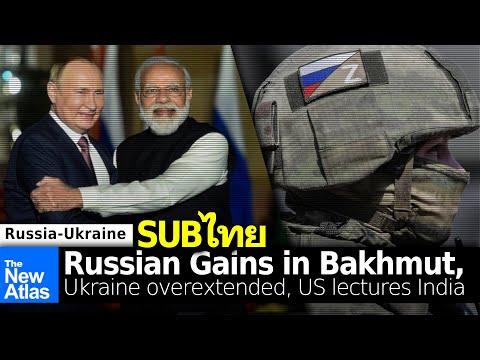
Russian Gains in Bakhmut, Ukraine Overextended, & US Lectures India

 October 17, 2022 (The New Atlas) - Update for Russian military operations against Ukraine for October 17, 2022.  Russian forces are closing...